
Digital transformation for accounting firms is the strategic integration of cloud computing, AI, and automation into core workflows to drive measurable growth, improve accuracy, and elevate client advisory services. Firms that combine these technologies with deliberate process redesign are pulling ahead fast. Cloud plus AI adoption correlates with a 24% higher likelihood of firm growth, and advisory services now account for 13% of revenue on average. The firms winning in 2026 are not the ones chasing the newest tools. They are the ones building technology around well-mapped processes and clear ROI targets.
How does digital transformation for accounting firms actually work?
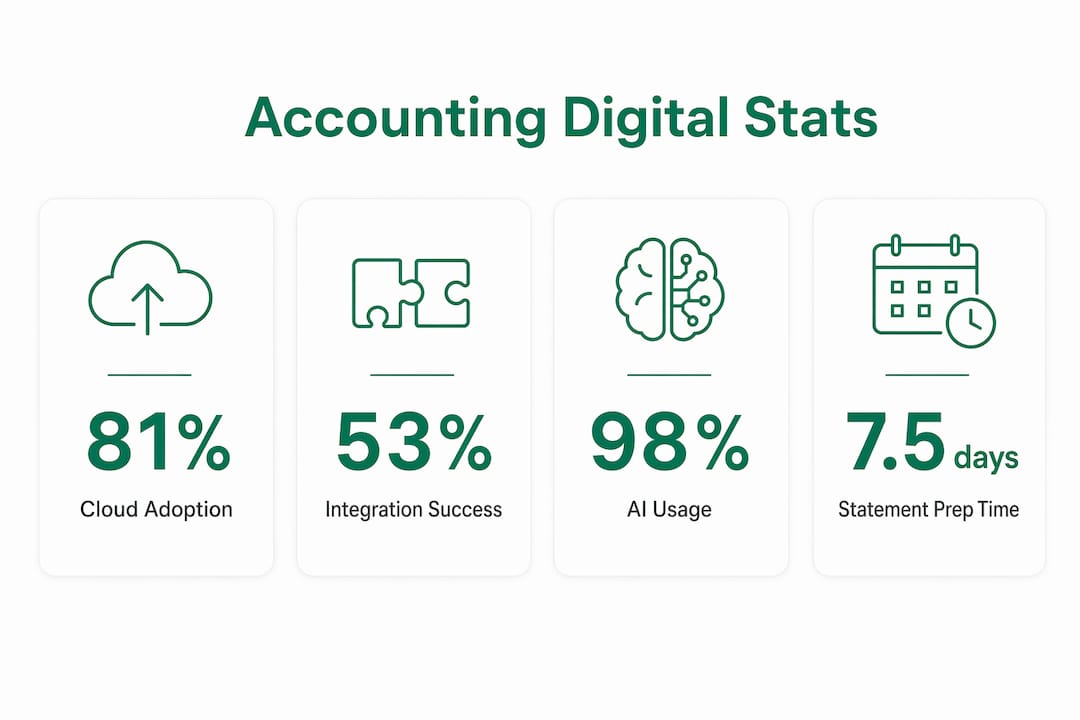
Cloud adoption is the foundation of every successful modernization effort. 81% of U.S. firms now operate at least partially in the cloud, and among high-growth firms that number rises to 86%. That gap matters because cloud infrastructure enables the real-time data access, remote collaboration, and system integration that modern advisory work demands.
Integration is where most firms either win or lose. Firms with highly integrated tech stacks are 53% more likely to report high growth. That statistic reflects a simple truth: disconnected systems create manual work, and manual work kills capacity.

The most common failure mode is the “Frankenstein tech stack,” a collection of point solutions that do not talk to each other. A firm might use one platform for tax prep, another for document management, a third for client communication, and a fourth for billing, with staff manually transferring data between all of them. The result is wasted time, version-control errors, and frustrated staff.
Avoiding that outcome requires evaluating integration before adding any new tool. The right question is not “Does this tool do what we need?” It is “Does this tool connect cleanly to what we already have?”
- Audit your current stack before purchasing anything new. Map every data handoff between systems.
- Prioritize platforms with open APIs or native connectors to your existing practice management and general ledger systems.
- Consider hybrid architectures that combine cloud-hosted platforms with on-premise data stores where regulatory requirements demand it.
- Retire redundant tools rather than layering new ones on top. Fewer, better-connected systems outperform more, fragmented ones.
Pro Tip: Before signing any new software contract, require a live integration demo with your current systems. A tool that cannot connect cleanly on day one will not connect cleanly after you have migrated your client data.
What is the real impact of AI on accounting workflows?
AI adoption in accounting has moved from experiment to standard practice. 98% of accounting professionals now report using AI tools daily or weekly. That near-universal adoption reflects how deeply AI has embedded itself into routine work, not as a novelty, but as a production dependency.
The efficiency numbers are concrete. Accountants using generative AI tools completed monthly statement preparation 7.5 days faster, and routine back-office processing time fell by 8.5%. Those are not marginal gains. For a firm billing 2,000 hours per year per accountant, an 8.5% reduction in back-office time translates directly into recoverable capacity.
Quality improves alongside speed. The same research found a 12% increase in reporting granularity among AI-assisted firms. Clients receive more detailed, more useful financial reports without the firm adding headcount to produce them.
The right mental model for AI in accounting is capacity expansion, not replacement. Firms recover 5–10% time per task and redirect that time toward higher-value advisory work. The accountant’s expertise does not become less relevant. It becomes more available.
“AI delivers measurable value in defined, high-volume workflows like tax prep but remains limited in tasks involving professional judgment under ambiguity. The accountant’s role shifts toward reviewing, interpreting, and advising, not disappearing.”
AI also has clear limits. It performs best in structured, high-volume workflows where the rules are defined. Tasks requiring professional judgment under ambiguity, such as advising a client through a complex restructuring or navigating a contested audit, still require experienced human oversight. Pairing AI output with senior reviewer sign-off is not bureaucratic caution. It is quality control.
- Automate data extraction and categorization in tax and audit workflows first. These are high-volume, rule-based tasks where AI accuracy is highest.
- Use AI for draft generation in client reports, then have a senior accountant review and add interpretive commentary.
- Track time recovered per task after AI deployment. Without measurement, you cannot prove ROI or identify where adoption is stalling.
- Align AI use with Copilot workflows that embed the tool into existing processes rather than requiring staff to switch contexts.
Pro Tip: Treat AI as a junior staff member who is fast and tireless but needs supervision. Assign a senior reviewer to every AI-generated output until your team has calibrated the tool’s accuracy on your specific client base.
Why process mapping must come before platform selection
The single most expensive mistake in accounting firm modernization is buying technology before understanding the process it is supposed to fix. Mapping end-to-end workflows before selecting or building platforms is the defining practice of firms that avoid fragmented systems and wasted spend.
The mapping exercise should trace every step from the first prospect conversation through engagement setup, work delivery, review, billing, and cash collection. That full-cycle view reveals where manual data transfers occur, where approval bottlenecks form, and where client communication breaks down. Those pain points, not vendor feature lists, should drive your technology decisions.
Once the process is mapped, the buy-versus-build decision becomes straightforward. A mature platform exists for most standard accounting workflows. Custom builds make sense only when a workflow is genuinely unique to your firm and no available platform handles it without significant compromise.
| Decision Factor | Buy a Platform | Build a Custom Solution |
|---|---|---|
| Workflow type | Standard, widely practiced | Unique to your firm’s model |
| Timeline | Fast deployment needed | Long build cycle acceptable |
| Maintenance capacity | Limited internal IT | Dedicated development resources |
| Integration complexity | Platform has native connectors | Existing stack requires custom APIs |
| Cost profile | Predictable subscription | High upfront, lower long-term |
A practical example: a mid-market tax firm manually copied client data from its intake form into its tax preparation software, then again into its billing system. Mapping that workflow exposed two redundant data transfers. Automating both with a simple integration layer recovered roughly 20 minutes per client engagement. At 400 clients per year, that is more than 130 hours returned to the firm annually.
The lesson is not that automation is magic. The lesson is that you cannot automate what you have not mapped. Starting with specific pain points and building from there produces better outcomes than deploying broad platforms and hoping staff adapt.
- Document every workflow step from client intake to invoice payment. Use swimlane diagrams to show which role owns each step.
- Identify manual data transfers between systems. Each one is an automation candidate.
- Rank pain points by volume and cost. Fix the highest-frequency bottlenecks first.
- Evaluate platforms against your mapped process, not against vendor demos built on ideal scenarios.
- Pilot one workflow at a time before expanding. Measure time saved before moving to the next process.
How does leadership shape AI adoption and advisory growth?
Leadership defines the ceiling on AI adoption. Firms where managing partners actively set AI strategy and governance see faster, more consistent adoption than firms where AI is left to individual staff discretion. 76% of high-growth firms use AI weekly, and the common thread is leadership that treats AI as a firm-wide capability, not a departmental experiment.
Governance is the practical expression of that leadership. Firm leaders must define which processes AI can touch autonomously and where human review is mandatory. Without those guardrails, staff either over-rely on AI output or avoid using it entirely. Both outcomes waste the investment.
Data governance deserves equal attention. AI tools trained on or connected to client financial data require clear policies on data residency, access controls, and audit trails. Firms operating under AICPA standards or SEC reporting requirements cannot treat data governance as an afterthought.
Training is the most consistently underestimated implementation cost. Staff should be trained during implementation, not after rollout. Waiting until a tool is live to teach people how to use it guarantees a slow adoption curve and inflated support costs.
- Set AI governance policies in writing before deployment. Define autonomous versus human-reviewed tasks explicitly.
- Assign an AI champion in each practice area. This person owns adoption metrics and troubleshoots workflow friction.
- Build training into the implementation timeline, not as a separate phase after go-live.
- Review AI adoption ROI quarterly. Dormant licenses and unused features are a direct cost, not a sunk one.
The advisory opportunity is the strategic payoff. 94% of U.S. firms now offer advisory services, with 63% calling them a key revenue driver. AI creates the capacity to deliver those services at scale. When AI handles routine compliance work, senior accountants have time to provide proactive insights, scenario modeling, and strategic planning. That shift changes the firm’s economics from linear headcount growth to repeatable, scalable advisory revenue.
Pro Tip: Inaction on AI integration now carries greater operational risk than implementation does. Firms that delay governance decisions are not avoiding risk. They are accumulating it.
Key Takeaways
Successful digital transformation in accounting requires process mapping before platform selection, AI embedded into workflows rather than layered on top, and leadership-defined governance to protect quality and drive measurable advisory growth.
| Point | Details |
|---|---|
| Cloud integration drives growth | Firms with integrated tech stacks are 53% more likely to report high growth than those with fragmented systems. |
| AI expands capacity, not headcount | AI recovers 5–10% of time per task, which firms should reinvest into client advisory work. |
| Process mapping comes first | Map workflows from prospect to cash collection before selecting or building any platform. |
| Leadership sets the adoption ceiling | Firms where leaders define AI governance and train staff during implementation see faster, more consistent adoption. |
| Advisory is the revenue opportunity | 94% of U.S. firms now offer advisory services, and AI creates the capacity to deliver them at scale. |
What I have seen firms get wrong about digital transformation
The firms that struggle most with digital modernization share one pattern: they buy technology to solve a problem they have not fully defined. A new platform arrives, staff get a two-hour training session, and six months later the tool is barely used. The licenses sit idle, the old manual process continues in parallel, and leadership wonders why the investment did not pay off.
The firms that get it right start with a different question. Not “What tool should we buy?” but “Where are we losing time, and what does that cost us per year?” That framing changes everything. It turns technology selection into a financial decision with a measurable baseline, not a feature comparison exercise.
I have also seen firms treat AI adoption as a one-time project rather than an ongoing practice. The tools evolve fast. A workflow that runs well on today’s AI capabilities will need to be revisited in 12 months. Firms that build a culture of continuous measurement and adjustment outperform those that deploy once and move on.
The human side is underestimated every time. Staff who feel that AI threatens their role will find ways to work around it. The firms that communicate clearly that AI expands capacity rather than cuts jobs see adoption rates that actually match their license counts. That communication is leadership’s job, and it cannot be delegated to an IT memo.
— Mad
Gozera helps accounting firms get real ROI from Microsoft 365 Copilot
Accounting firms investing in Microsoft 365 Copilot often face the same problem: licenses sit unused, workflows stay manual, and the expected productivity gains never materialize.
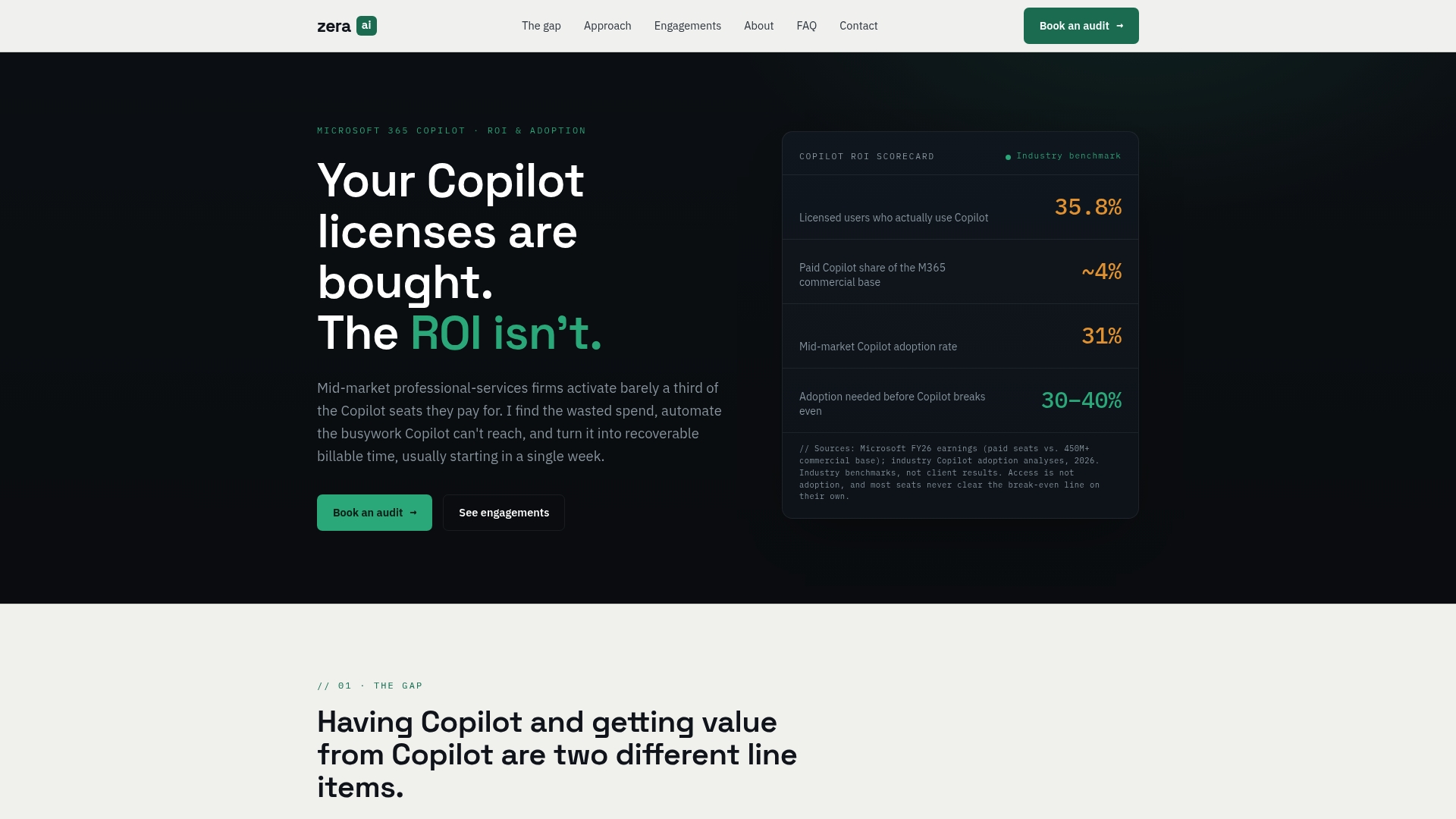
Gozera specializes in fixing exactly that. The firm measures actual Copilot usage through telemetry, identifies dormant licenses, and rebuilds workflows so the tool generates recoverable billable time rather than overhead. For mid-market accounting firms with 50–500 staff, Gozera’s Copilot adoption consulting delivers a data-driven path from idle licenses to demonstrated ROI, without lengthy change management programs or generic training sessions. If your firm has Copilot licenses and is not measuring their output, that is the first problem worth solving.
FAQ
What is digital transformation for accounting firms?
Digital transformation for accounting firms is the structured integration of cloud platforms, AI tools, and automation into core workflows to improve efficiency, accuracy, and client advisory capacity. It is a continuous process, not a one-time technology purchase.
How does AI affect accounting staff and their roles?
AI expands what accounting staff can accomplish rather than replacing them. Research shows accountants using AI complete monthly statement preparation 7.5 days faster and redirect recovered time toward higher-value advisory work.
What is a Frankenstein tech stack and why does it matter?
A Frankenstein tech stack is a collection of disconnected software tools that require manual data transfers between them. It creates errors, wastes staff time, and prevents firms from scaling advisory services efficiently.
How should accounting firms start their digital transformation?
Firms should start by mapping end-to-end workflows from client intake to invoice payment, identifying manual bottlenecks before selecting any platform. Starting with specific, high-frequency pain points produces faster and more measurable results than broad platform deployments.
What role does leadership play in AI adoption at accounting firms?
Leadership must define AI governance policies, set boundaries between autonomous AI tasks and mandatory human review, and train staff during implementation. Firms where managing partners actively own AI strategy see significantly higher adoption rates and faster ROI.