
BLUF: Microsoft Copilot processes enterprise prompts and responses inside the Microsoft 365 service boundary, and enterprise contractual protections apply the moment a license is assigned. Prompts, responses, and the Microsoft Graph data Copilot draws on are stored as “content of interactions” under Enterprise data protection in Microsoft Copilot and Microsoft Copilot Chat, and that content is not used to train foundation models for enterprise workloads under the Data Protection Addendum and Product Terms. That’s the good news. The part IT leaders skip, and later regret, is verifying the tenant configuration around it before rollout.
Before you hand out licenses, confirm four things:
- Your organization’s Data Protection Addendum (DPA) coverage actually extends to Copilot workloads in your contract
- Which data residency option your tenant qualifies for, and whether it covers Copilot interaction data specifically
- Microsoft Purview retention policies are configured, not left on default settings
- Optional connected experiences and third-party model access are reviewed and explicitly enabled or disabled
Skip these checks and you’re not protected by ignorance. You’re just unaware of what you already agreed to.
Key Takeaways
Enterprise Copilot’s privacy protections are real and contractually backed, but they only function correctly when admins configure retention, residency, and agent permissions rather than relying on defaults.
| Point | Details |
|---|---|
| Enterprise protections apply automatically | Copilot prompts and responses fall under the DPA and aren’t used to train foundation models for enterprise workloads. |
| Retention needs active configuration | Purview retention policies, not defaults, determine how long Copilot interactions are kept or deleted. |
| Residency has three layers | Product Terms, ADR, and Multi-Geo each cover different scope; confirm which applies to your tenant specifically. |
| Web queries leave the boundary | Bing-directed queries are identifier-stripped but governed by a separate privacy framework than tenant data. |
| Governance drives adoption and ROI | Gozera pairs telemetry audits with workflow integration to turn governance-first Copilot rollouts into recoverable billable time. |
Table of Contents
- Copilot Data Privacy and How Copilot Reads Organizational Data
- What Happens to Your Prompts and Responses After You Hit Enter
- Enterprise Data Protection, the DPA, and What “Not Used for Training” Really Means
- Data Residency Choices: Product Terms, ADR, and Multi-Geo
- Web Queries, Bing, and Third-Party Models: What Leaves Your Tenant
- Your Governance Checklist Before Copilot Goes Live Firm-Wide
- Security Fundamentals: Encryption, Isolation, and Monitoring
- What Mid-Market Firms Get Wrong When Rolling Out Copilot
- Why Governance Is an Adoption Lever, Not Just a Compliance Cost
- Turning Copilot Governance Into Measurable ROI
- Frequently Asked Questions
- Sources
Copilot Data Privacy and How Copilot Reads Organizational Data
Copilot doesn’t have its own private stash of company information. It reads what the signed-in user can already access: files in OneDrive and SharePoint, Outlook email, calendar entries, and Teams chats and channel posts. Permission boundaries that existed before Copilot arrived, existed the same way after. If a paralegal can’t open a partner’s restricted matter folder today, Copilot won’t surface it in a generated summary either.
Where this gets more complicated is Graph connectors and agents. Graph connectors let Copilot index external content, such as a document repository outside SharePoint, and agents (custom or Microsoft-built) can be granted specific data scopes by an admin. Every agent installed in your tenant needs its own permission review, because an overly broad agent can technically reach content a narrower Copilot deployment never would.
Sensitivity labels and permission inheritance matter here too. A file labeled “Confidential, Internal Only” should carry that protection through to anything Copilot generates from it, but label propagation into generated output isn’t always automatic. Verify this behavior directly during a pilot rather than assuming it.
- Copilot only surfaces content the requesting user is already authorized to see
- Graph connectors and agents extend reach and need individual permission review
- Sensitivity labels should inherit into generated content, but confirm it in testing
- Microsoft Copilot Chat with web grounding behaves differently from tenant-scoped Copilot in Word, Excel, or Teams
Pro Tip: Run a controlled pilot where a test user with intentionally limited SharePoint access asks Copilot to summarize a folder they shouldn’t see. If anything leaks through, you’ve found a permissions gap before a real employee does.
What Happens to Your Prompts and Responses After You Hit Enter
Every prompt you type into Copilot and every response it generates becomes “content of interactions,” and that content lives inside Microsoft 365 services, not some separate AI training pipeline. It’s treated as organizational data, which means it inherits the same governance tools you already use for email and documents through Microsoft Purview.
Retention isn’t a “set it and forget it” default. Consumer-facing Copilot guidance mentions conversation history retained for a set period under standard settings, but enterprise tenants control this directly through Purview retention policies, which can shorten, extend, or place legal holds on that data as needed.
Three things every admin should confirm before go-live:
- Users can self-delete their own Copilot interaction history, but this doesn’t override an active retention policy or legal hold set at the tenant level.
- Legal and compliance teams can place holds on Copilot interactions the same way they would on email, which pulls that data into eDiscovery scope.
- Interaction history is fully discoverable through Purview auditing, meaning it shows up in litigation, regulatory inquiries, and internal investigations whether or not anyone remembers Copilot was involved.
The overlooked risk: firms that treat Copilot as a “just a chat tool” and exclude it from their compliance and eDiscovery planning create an unmanaged evidence trail. If a partner asks Copilot to draft a client email and that exchange later matters in a dispute, it’s discoverable, whether your retention policy accounted for it or not.
Enterprise Data Protection, the DPA, and What “Not Used for Training” Really Means
The contractual backbone of Copilot’s privacy posture is the Microsoft Products and Services Data Protection Addendum, combined with the Product Terms that govern how Enterprise Data Protection (EDP) applies to Copilot specifically. Under these terms, prompts, responses, and the Graph data Copilot references for grounding are not used to train the underlying foundation models for enterprise customers, per Microsoft’s own documentation.
That’s a real commitment, but it comes with a boundary IT teams often miss: it applies to enterprise-licensed Copilot experiences operating inside the Microsoft 365 boundary, not automatically to every AI feature a vendor bolts onto a Microsoft product.
Enterprise Copilot experiences using Microsoft 365 are governed by enterprise data protection and shouldn’t be treated the same as a consumer chatbot interaction, a distinction that matters enormously when communicating rollout expectations to staff, according to Microsoft’s privacy and protections documentation.
Optional telemetry is the one area where opt-in matters. Feedback submissions, where a user flags a response as helpful or not, can include the underlying content, and admins control whether that feedback channel is even available.
Before signing off on a rollout, confirm with Microsoft or your reseller:
- That your license SKU is explicitly covered under the current DPA language for Copilot workloads
- Whether your industry vertical (legal, financial services, healthcare) triggers any additional contractual riders
- How feedback and diagnostic data collection can be disabled tenant-wide if your compliance policy requires it
Data Residency Choices: Product Terms, ADR, and Multi-Geo
Data residency for Copilot isn’t a single switch. There are three overlapping mechanisms, and firms in regulated industries need to know which one actually applies to their tenant.
Product Terms residency commitments define the baseline: where core Microsoft 365 data sits at rest, based on the region assigned at tenant creation. Advanced Data Residency (ADR) is an add-on for organizations that need stronger commitments than the baseline, including additional data categories staying in-region. Multi-Geo lets a single tenant span multiple geographic regions, useful for a firm with offices spread across, say, Canada and the EU that needs different data-at-rest locations per office.
Microsoft has been expanding what these commitments cover specifically for Copilot interaction data, including plans for a Data Location Card inside the admin center so tenants can verify where their data actually sits rather than relying on documentation alone, according to Microsoft’s residency capability announcement.
The limitation that trips people up: data-at-rest residency and in-country processing (where the actual inference happens) are not the same guarantee, and rollout of full in-country processing for Copilot has been staged by region and timeline, with Canada included in broader expansion planning rather than available everywhere immediately.
Ask Microsoft or your partner directly:
- Does our current tenant provisioning qualify for ADR, or would we need to re-provision?
- Does Multi-Geo cover Copilot interaction data the same way it covers mailbox and SharePoint data?
- What’s the actual timeline for in-country processing in our specific region, not the general announcement date?
Web Queries, Bing, and Third-Party Models: What Leaves Your Tenant
Not everything Copilot does stays inside your Microsoft 365 boundary. When Copilot needs current information it doesn’t have from your organizational data, it can generate a search query sent to Bing, and Microsoft strips user and tenant identifiers from that query before it goes out, per Microsoft’s privacy and protections page. Those web queries fall under the Microsoft Services Agreement and Privacy Statement, a different legal framework than the one governing your tenant-scoped Copilot data.
Some Copilot experiences also route through third-party model providers as an optional layer, and admins control whether that’s enabled at all.
- Web-grounded queries to Bing are identifier-stripped, not tenant-attributed
- Third-party subprocessor models are optional additions, not a default path for organizational data
- Admins can disable optional connected experiences tenant-wide through the Microsoft 365 admin center
- Legal and compliance teams should sign off on which connected experiences stay enabled before go-live
If your firm handles privileged client information under strict confidentiality obligations, the safer starting position is often to disable optional connected experiences by default and enable them selectively once each is reviewed.
Your Governance Checklist Before Copilot Goes Live Firm-Wide
A safe rollout isn’t a one-time approval. It’s a checklist someone actually owns.
- Confirm DPA coverage for your specific license SKU and get written confirmation your Copilot workloads fall under it.
- Set sensitivity labels and DLP policies before deployment, not after, so Copilot inherits protection rather than testing it in production.
- Configure Purview retention and legal hold settings for Copilot interaction data specifically, matching your existing email and document retention schedule.
- Turn on audit logging for Copilot activity and confirm someone reviews it, not just that it’s technically capturing data.
- Restrict agent and Graph connector permissions to the narrowest scope that still does the job, and review every custom agent before it goes live.
Bring these questions to Microsoft or your implementation partner:
- Are we eligible for ADR today, or does our tenant need reconfiguration first?
- Which third-party subprocessors are involved in any optional Copilot features we’re considering, and can we disable them individually?
- What’s the committed SLA if we need to change our data location designation later?
Red flags that should stop a rollout cold: no clear audit trail for Copilot activity, an inability to enforce retention specifically on Copilot interactions, or global web grounding enabled with zero admin visibility into what’s being sent externally. None of these are hypothetical. They’re the gaps firms discover during a compliance audit, usually the hard way.
For procedural completeness, Copilot data needs the same legal hold and evidence collection process as any other communication channel; if your litigation hold checklist doesn’t mention Copilot by name, it’s incomplete. Firms considering a broader governance-first Copilot playbook tend to catch these gaps before litigation, not during it.
Pro Tip: Assign one named owner for Copilot governance, not a committee. Shared ownership is how retention settings get configured once at launch and never touched again.
Security Fundamentals: Encryption, Isolation, and Monitoring
Underneath the contracts and admin settings, the infrastructure layer matters too. Copilot data is encrypted at rest and in transit, and Microsoft’s datacenter physical security and tenant isolation model, the same one backing the rest of Microsoft 365, applies to Copilot workloads as well. One tenant’s data doesn’t mix with another’s.
Logging and monitoring differ somewhat from general-purpose Azure AI services, since Copilot’s human review and abuse-monitoring policies are scoped to enterprise commitments rather than the broader consumer AI review process.
Security teams should validate a few things directly rather than take vendor claims at face value:
- Confirm least-privilege role assignments for anyone managing Copilot admin settings
- Require multi-factor authentication for all privileged admin accounts touching Copilot configuration
- Route Copilot audit logs into your existing SIEM so anomalies get flagged the same way other Microsoft 365 activity does
- Check the admin center directly for current encryption and isolation documentation rather than relying on secondhand summaries
What Mid-Market Firms Get Wrong When Rolling Out Copilot
Three mistakes show up repeatedly in mid-market professional-services firms deploying Copilot without a governance-first plan: nobody audits actual Copilot interactions after launch, sensitivity label inheritance is assumed rather than tested, and agent permissions get approved broadly because nobody wants to be the bottleneck.
Telemetry closes that gap. Track active user counts against licenses purchased, flag prompts that reference client-identifiable data, and identify dormant licenses draining budget with zero usage. A telemetry-driven review usually surfaces both problems: unmanaged Copilot activity and wasted license spend, in the same audit.
The framework that works: baseline measurement first, then a controlled pilot with a limited group, then policy enforcement based on what the pilot reveals, then automation once governance is solid.
- Audit actual Copilot prompts for sensitive data exposure, don’t assume policy compliance
- Verify sensitivity label inheritance in real generated output, not just documentation
- Restrict agent usage to reviewed, scoped permissions before wider rollout
- Measure license utilization against active usage to find dormant seats early
Pro Tip: Run your telemetry audit before your compliance audit finds the gaps for you. It’s a far cheaper conversation to have first.
Why Governance Is an Adoption Lever, Not Just a Compliance Cost
Treating Copilot privacy and governance as a checkbox slows adoption more than it protects anyone. Employees who don’t trust how their prompts are handled use Copilot less, or worse, route around it. Firms that build clear governance upfront, sensitivity labels working, retention configured, agents scoped, see faster genuine adoption because staff aren’t second-guessing whether the tool is safe to use on real client matters.
That governance groundwork also produces the telemetry data that shows which licenses are actually earning their cost and which sit idle. Privacy compliance and license ROI aren’t separate conversations. They’re the same audit.
Turning Copilot Governance Into Measurable ROI
A privacy checklist tells you Copilot is configured safely. It doesn’t tell you whether your firm is getting anything back for the license spend. That’s the gap Gozera works in: measuring actual Copilot usage against licenses purchased, flagging dormant seats, and rebuilding real workflows, contract review, client intake, billing reconciliation, around Copilot instead of leaving adoption to chance.
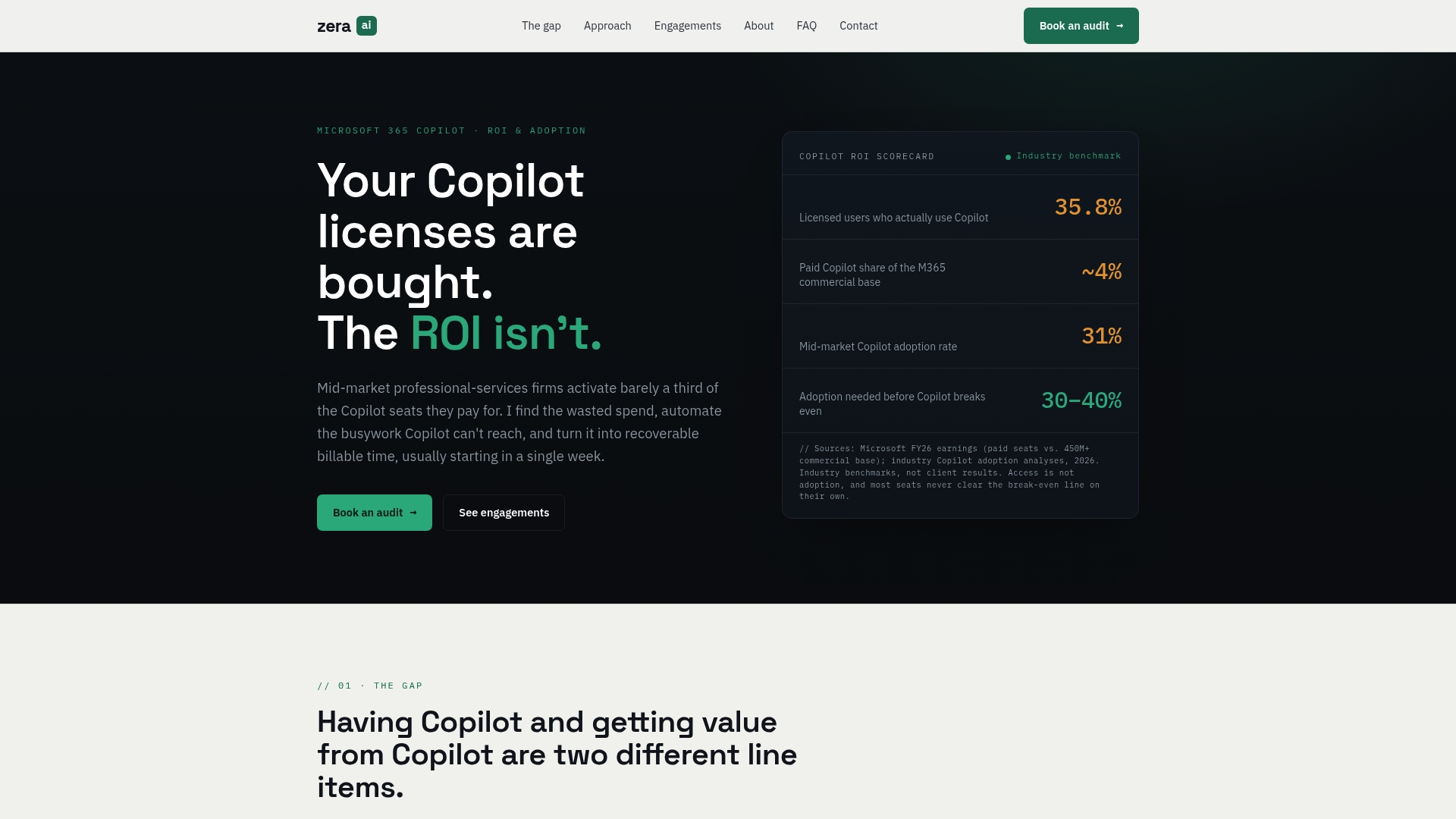
Gozera runs Copilot audits using telemetry, not guesswork, for mid-market law, accounting, consulting, and engineering firms, then integrates the workflows that actually recover billable time. Firms working with a dedicated AI strategy partner alongside this kind of engagement often close governance gaps faster because security and adoption get addressed together instead of sequentially. If your firm licensed Copilot months ago and still isn’t sure who’s using it or why, start with a Copilot adoption audit to see where the usage, and the risk, actually sits.
Frequently Asked Questions
Is Copilot safe for enterprise data?
Yes, for licensed enterprise Copilot experiences operating inside the Microsoft 365 boundary, where the Data Protection Addendum and Product Terms govern how prompts and responses are handled. Safety still depends on admin configuration: retention policies, sensitivity labels, and agent permissions all need active setup rather than default settings.
Does Microsoft use Copilot data to train its AI models?
No. Enterprise Copilot prompts, responses, and the Graph data used for grounding are not used to train foundation models for enterprise workloads, per Microsoft’s own privacy documentation. This commitment applies to enterprise-licensed use within the Microsoft 365 service boundary.
How long does Copilot keep my prompts and responses?
Retention depends on your organization’s Purview policy configuration rather than a single fixed default. Enterprise tenants can shorten, extend, or place legal holds on Copilot interaction data the same way they manage email retention.
Can employees delete their own Copilot chat history?
Users can typically delete their own interaction history through self-service controls, but this doesn’t override an active retention policy or legal hold set at the tenant level by an admin.
What’s the difference between Copilot data residency and data-at-rest location?
Data residency commitments under Product Terms, ADR, or Multi-Geo govern where your organization’s data sits at rest. In-country processing, where the actual inference happens, is a separate and more limited commitment still expanding by region, including planned coverage for Canada.
Do I need Advanced Data Residency (ADR) for Copilot?
Only if your compliance obligations require stronger in-region guarantees than the baseline Product Terms provide. Regulated firms should confirm tenant eligibility and provisioning requirements directly with Microsoft before assuming ADR applies automatically.
Can I disable third-party AI models within Copilot?
Yes. Optional connected experiences and third-party subprocessor models are admin-controlled and can be enabled or disabled tenant-wide, which matters for firms under strict client confidentiality obligations.
Sources
- Enterprise data protection in Microsoft Copilot and Microsoft Copilot Chat
- Announcing the expansion of Microsoft’s data residency capabilities
- M365 Copilot data processing goes local to meet sovereignty demands