
AI in professional services is the strategic application of artificial intelligence to improve productivity, client outcomes, and competitive positioning across consulting, legal, accounting, and technical firms. The industry term for this shift is “AI-enabled service delivery,” and it covers everything from automated document drafting to real-time compliance monitoring. 62% of US professional and technical services firms actively use generative AI in production workflows in 2026, making the sector the second-highest adopter nationally. That number dwarfs the 17.3% national average across all industries. Adoption is no longer the question. Value realization is.
What are the main benefits and use cases of AI in professional services?
AI in professional services firms delivers the most measurable gains in three areas: speed, consistency, and analyst capacity. A lawyer who once spent four hours reviewing a 200-page contract can now complete a first-pass review in under 30 minutes using AI-assisted contract analysis. A consulting team that manually compiled market data across 12 sources can now generate a structured briefing in minutes. These are not hypothetical gains. They are the baseline expectations firms set when deploying AI in a professional setting.
The most common production use cases across legal, accounting, and consulting firms include:
- Document drafting and review: AI generates first drafts of contracts, memos, and reports, which professionals then refine and approve.
- Compliance monitoring: Automated tools flag regulatory changes and map them against existing client obligations in real time.
- Financial analysis: AI processes large datasets to surface anomalies, trends, and forecasts that would take analysts days to produce manually.
- Client intake and matter management: AI classifies incoming requests, routes them to the right team, and populates matter management systems automatically.
- Research synthesis: Legal and consulting professionals use AI to summarize case law, precedent, and market intelligence across thousands of documents simultaneously.
The critical distinction is that AI augments professional judgment. It does not replace it. A senior partner still makes the call on litigation strategy. A managing director still owns the client relationship. AI handles the volume work so professionals can focus on the judgment work.
Pro Tip: Use domain-specific AI tools rather than general-purpose models. A legal AI trained on case law and contract language will outperform a generic tool on contract review every time. The same principle applies to tax, audit, and engineering workflows.

Why do many professional services firms struggle to capture full value from AI?
The adoption rate is high, but the value realization rate is not. 91% of firms report that their organizations fail to capture AI’s full potential. That gap exists because most firms treat AI as a tool purchase rather than an operational change.
The most common barriers to full value capture include:
- No named AI strategy: Firms without a formal AI strategy see dramatically worse outcomes. In firms with a defined strategy, 66% of staff say AI meets or exceeds expectations, compared to just 22% in firms without one.
- Shadow AI usage: Professionals use unsanctioned AI tools outside firm-approved systems. This creates data security risks, inconsistent outputs, and governance blind spots that undermine firm-wide confidence in AI.
- No ROI measurement: Only 18% of professional services organizations track ROI on their AI investments. 42% do not measure it at all. Without measurement, firms cannot identify which AI deployments work and which waste budget.
- Talent development concerns: 48% of professionals worry that AI undermines the development of independent judgment in early-career staff. 71% say structured mentoring from experienced peers is necessary to offset this risk.
“Nearly one-quarter of professionals who experience AI value gaps are considering leaving their firms within two years, at a replacement cost estimated at $232,000 per professional. The cost of a poor AI strategy is not just lost productivity. It is lost people.”
The governance problem is particularly acute. Shadow AI usage is not a fringe behavior. It happens when firms deploy licenses without training, without workflow integration, and without clear policies. Professionals fill the gap with whatever tool works, regardless of whether it is approved. A structured AI literacy program and a published governance framework are the two fastest ways to close this gap.
Pro Tip: Publish a one-page AI acceptable use policy before you expand any AI license deployment. It does not need to be a legal document. It needs to answer three questions: what tools are approved, what data can be used, and who owns the output.
How are commercial models evolving to monetize AI in professional services?
The traditional time-and-materials billing model breaks down when AI compresses delivery time. A task that once took 10 hours at $300 per hour generates $3,000 in fees. The same task completed in 2 hours with AI generates $600. The primary bottleneck to scaling AI in professional services is not technical integration. It is commercial model modernization.
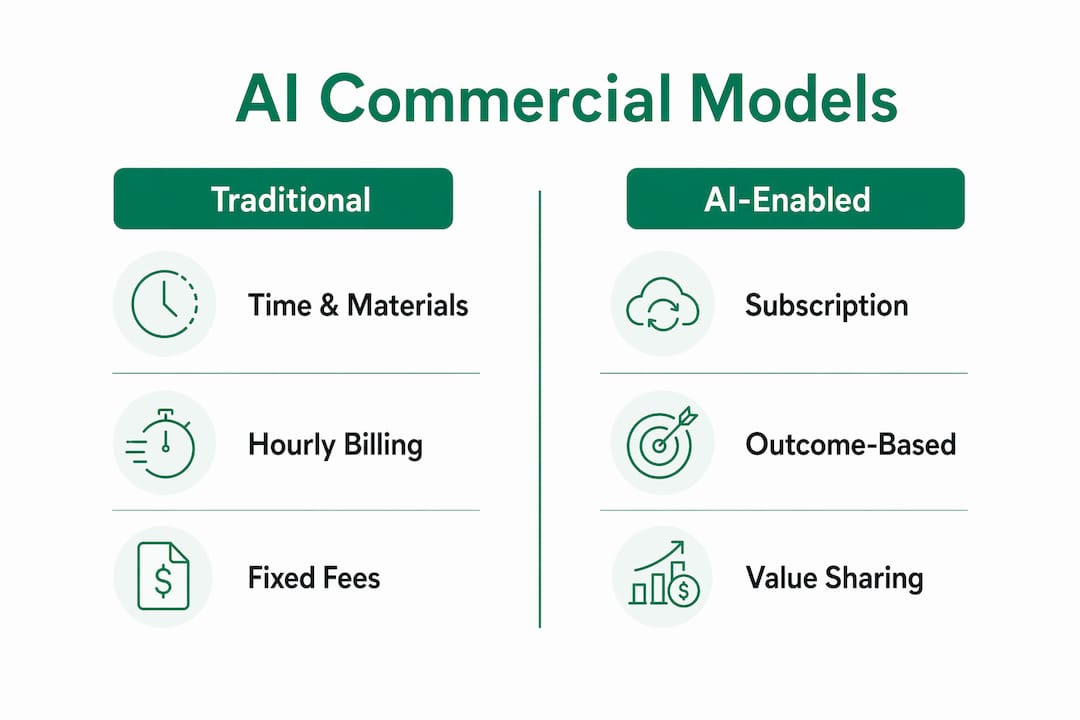
Leading firms are experimenting with three alternative structures:
| Commercial model | How it works | AI advantage |
|---|---|---|
| Time and materials | Billed by hours worked | Penalizes AI efficiency gains |
| Subscription | Fixed monthly fee for defined service scope | Rewards AI-driven delivery speed |
| Outcome-based pricing | Fee tied to a measurable client result | Aligns firm incentives with client value |
| Virtual FTE | Client pays for AI-augmented capacity as a headcount equivalent | Scales delivery without headcount growth |
Front-runner firms are moving fastest. 30% of leading firms use subscription pricing for AI-enabled offerings, compared to 14% across the market overall. That gap reflects a structural advantage. Firms that reprice AI-enabled services capture the efficiency gain as margin. Firms that do not reprice effectively subsidize their clients’ AI benefit.
The shift to outcome-based and subscription models also changes the client conversation. Clients no longer buy hours. They buy results. That requires firms to define deliverables precisely, measure outcomes consistently, and build the internal infrastructure to deliver at scale. The Services as Software model, where AI-enabled delivery is packaged and priced like a product, requires investment in operational infrastructure, not just AI tools.
Client transparency is also a factor. 60% of tax professionals and 67% of legal professionals say their clients do not know how AI is used in their work. Yet 74% of tax clients expect their providers to use generative AI. Closing that transparency gap is a sales and trust issue, not just an operational one.
What practical steps can firms take to integrate AI successfully?
AI maturity in professional services follows a predictable progression. Most firms overestimate where they sit on that curve. True integration requires governance, AI literacy, and measurable operational outcomes, not just a strategy document and a few active licenses.
The four stages of AI maturity are:
- Curious: Individual professionals experiment with AI tools independently. No firm-wide policy exists. Usage is inconsistent and ungoverned.
- Experimenting: The firm runs structured pilots in one or two practice areas. Success criteria exist but are not yet tied to firm-wide KPIs.
- Operational: AI is embedded in defined workflows across multiple teams. Governance policies are published. ROI is tracked quarterly.
- Strategic: AI informs recruitment, pricing, service design, and competitive positioning. Firms at this level report measurable productivity improvements and conduct quarterly AI performance reviews as standard practice.
Most mid-market firms sit between Curious and Experimenting. Moving to Operational requires three specific actions. First, identify two or three high-volume workflows where AI can reduce time-to-delivery by at least 30%. Second, assign a named owner for AI governance, even if that person is not a full-time role. Third, define what success looks like before the pilot starts, whether that is hours saved per matter, reduction in review cycles, or client satisfaction scores.
The Copilot coaching approach used by firms deploying Microsoft 365 Copilot illustrates this well. Firms that pair license deployment with structured workflow coaching see adoption rates that are materially higher than firms that deploy licenses alone. The tool is the same. The difference is the process built around it.
Pro Tip: Run your first AI pilot on a workflow that already has a measurable baseline. If contract review currently takes an average of 6 hours per matter, you can quantify the AI impact precisely. Pilots without baselines produce anecdotes, not evidence.
Key Takeaways
AI in professional services creates measurable value only when firms pair adoption with governance, ROI tracking, and deliberate workflow integration.
| Point | Details |
|---|---|
| Adoption is high but value is not | 62% of firms use AI in production, yet 91% say they fail to capture its full potential. |
| Strategy drives outcomes | Firms with a named AI strategy see 66% staff satisfaction with AI versus 22% in firms without one. |
| ROI measurement is rare | Only 18% of firms track AI ROI, making it impossible to identify what works and what wastes budget. |
| Commercial models must evolve | Time-based billing penalizes AI efficiency; subscription and outcome-based models capture the gain. |
| Maturity requires governance | Moving from experimentation to operational AI requires published policies, named owners, and quarterly reviews. |
The uncomfortable truth about AI maturity in professional services
Most firms I work with believe they are further along the AI maturity curve than they actually are. They have licenses. They have a few enthusiastic users. They may even have a slide deck titled “AI Strategy.” What they rarely have is a governance policy anyone has read, a workflow that has been rebuilt around AI rather than bolted onto it, or a single metric that proves the investment is paying off.
The firms that are pulling ahead are not the ones with the most tools. They are the ones that treated AI adoption as an operational problem, not a technology problem. They asked: what does this workflow look like when AI does the volume work? Then they rebuilt the workflow. They did not just hand professionals a new tool and hope for the best.
The talent risk is also underappreciated. When professionals experience AI that does not work well, or that creates more friction than it removes, they disengage. They find workarounds. They leave. The $232,000 replacement cost per departing professional is not a hypothetical. It is the cost of a poor implementation strategy expressed in human terms.
The firms that will define the next five years of professional services are the ones making deliberate, measured bets on AI right now. Not the biggest bets. The most disciplined ones. Start with a workflow that has a baseline. Measure the outcome. Build from there. That is not a slow approach. It is the only approach that compounds.
— Mad
How Gozera helps professional services firms get real ROI from AI
Mid-market professional services firms often have Microsoft 365 Copilot licenses sitting idle. The technology is deployed, but the workflows have not changed, the governance is absent, and the ROI is invisible.
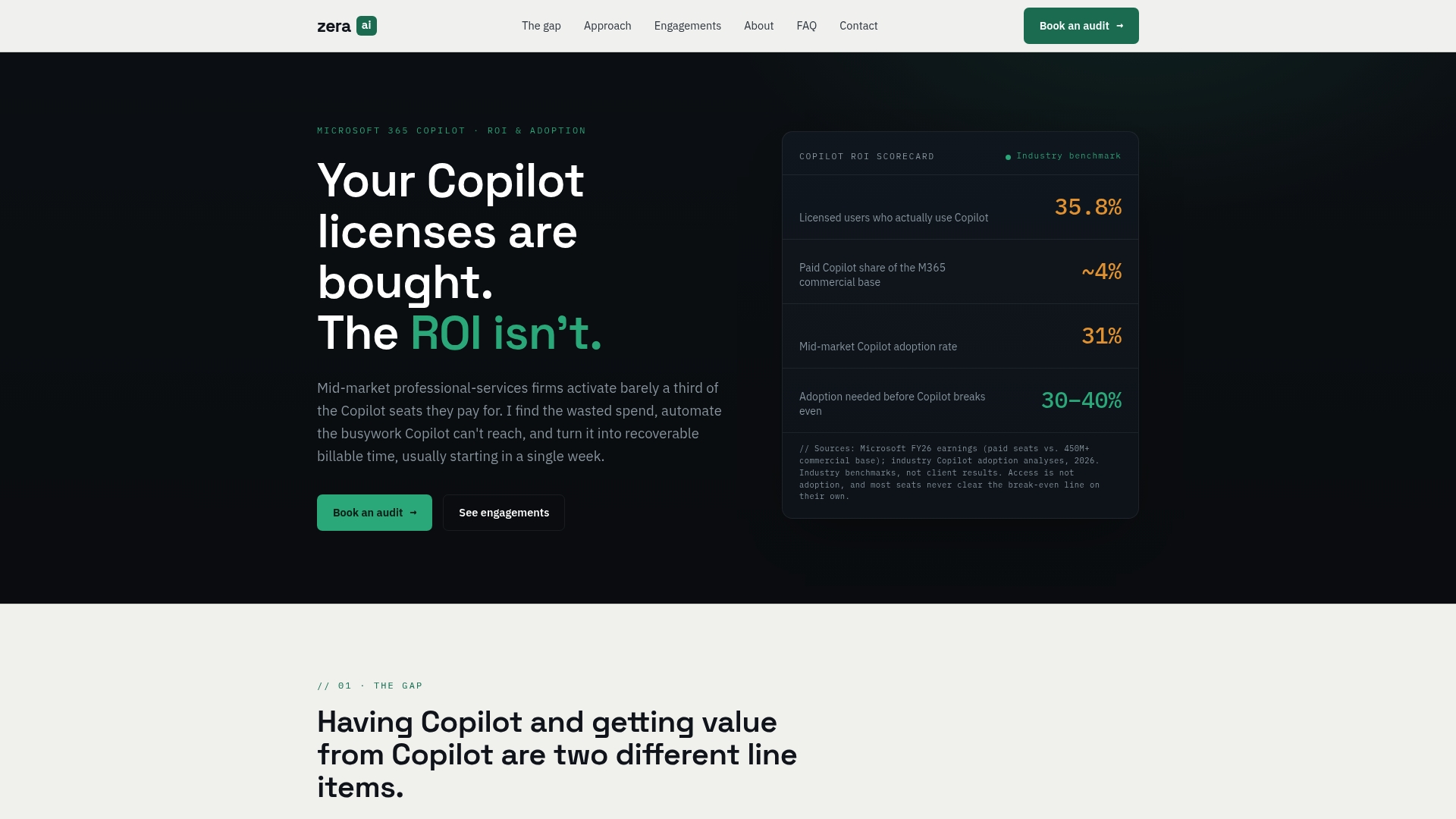
Gozera specializes in exactly this problem. Using telemetry to measure actual Copilot usage, identifying dormant licenses, and rebuilding workflows around AI-enabled delivery, Gozera turns a licensing cost into a productivity asset. The approach is data-driven and outcome-anchored, with measurable Copilot ROI tracked from day one. For firms ready to move from experimentation to operational AI maturity, Gozera provides the governance frameworks, workflow integration, and adoption coaching that make the difference between a tool that sits unused and one that generates recoverable billable time.
FAQ
What is AI in professional services?
AI in professional services is the application of artificial intelligence to automate routine tasks, accelerate analysis, and improve client outcomes in consulting, legal, accounting, and technical firms. It covers tools for document drafting, compliance monitoring, financial analysis, and research synthesis.
How widely is AI adopted in professional services in 2026?
62% of US professional and technical services firms use generative AI in production workflows in 2026, according to US Census Bureau data. That makes professional services the second-highest adopting sector in the country.
Why do most firms fail to capture AI’s full value?
91% of firms report that they fail to realize AI’s full potential, primarily because they lack a formal AI strategy, do not measure ROI, and deploy tools without rebuilding the workflows around them.
How should firms measure AI ROI?
Firms should establish a measurable baseline for target workflows before deployment, then track time saved, error rates, and client satisfaction scores after AI is introduced. Only 18% of professional services firms currently track AI ROI in any form.
What commercial model works best for AI-enabled professional services?
Subscription and outcome-based pricing models capture AI efficiency gains better than time-and-materials billing. Leading firms are 2x more likely to use subscription pricing for AI-enabled services than the market average.