
Co pilot coaching is defined as a structured partnership between a coach and a professional that uses proven performance frameworks to improve decision-making, output quality, and technology adoption. For mid-market teams running Microsoft 365 Copilot, this model solves a specific problem: licenses sit idle, productivity gains stay theoretical, and ROI never materializes. The industry term for this practice in leadership circles is “co-pilot coaching,” borrowed directly from aviation, where a co-pilot provides real-time support without taking the controls. Applied to Copilot adoption, it means pairing structured coaching with hands-on Copilot skill-building to turn a software investment into measurable business output.
What does co pilot coaching require to work in Microsoft 365 environments?
Technology and licensing
Microsoft 365 Copilot requires a Microsoft 365 E3 or E5 license plus a Copilot add-on license. Teams also need access to Microsoft Teams, SharePoint, and Outlook, since Copilot works across these surfaces. Without proper license assignment and data permissions configured in Microsoft Entra ID, Copilot cannot access the organizational data it needs to generate useful outputs.
Organizational readiness
A readiness assessment covers three areas: current workflow documentation, team digital literacy, and data governance hygiene. Teams that have not documented their core workflows cannot identify where Copilot adds value. Data governance matters because Copilot surfaces content based on existing permissions. If sensitive files are over-shared internally, Copilot will surface them to the wrong people.
Coach qualifications and tools
The coach must understand both executive performance frameworks and the specific capabilities of Microsoft 365 Copilot. Coaches who treat this as pure technology training miss the behavioral change component. Coaches who treat it as pure leadership coaching miss the tool-specific skill gaps. The best coaches hold both.
| Requirement | What to look for |
|---|---|
| Licensing | Microsoft 365 E3/E5 plus Copilot add-on per user |
| Data governance | Entra ID permissions reviewed and tightened |
| Workflow documentation | Core processes mapped before coaching begins |
| Coach profile | Combines performance framework knowledge with Copilot fluency |
| Reporting tools | Usage telemetry dashboards to track adoption rates |
Pro Tip: Run a telemetry pull before your first coaching session. Knowing which Copilot features your team has actually used in the past 30 days tells you exactly where to focus the first coaching cycle.
How to implement a co pilot coaching framework step by step

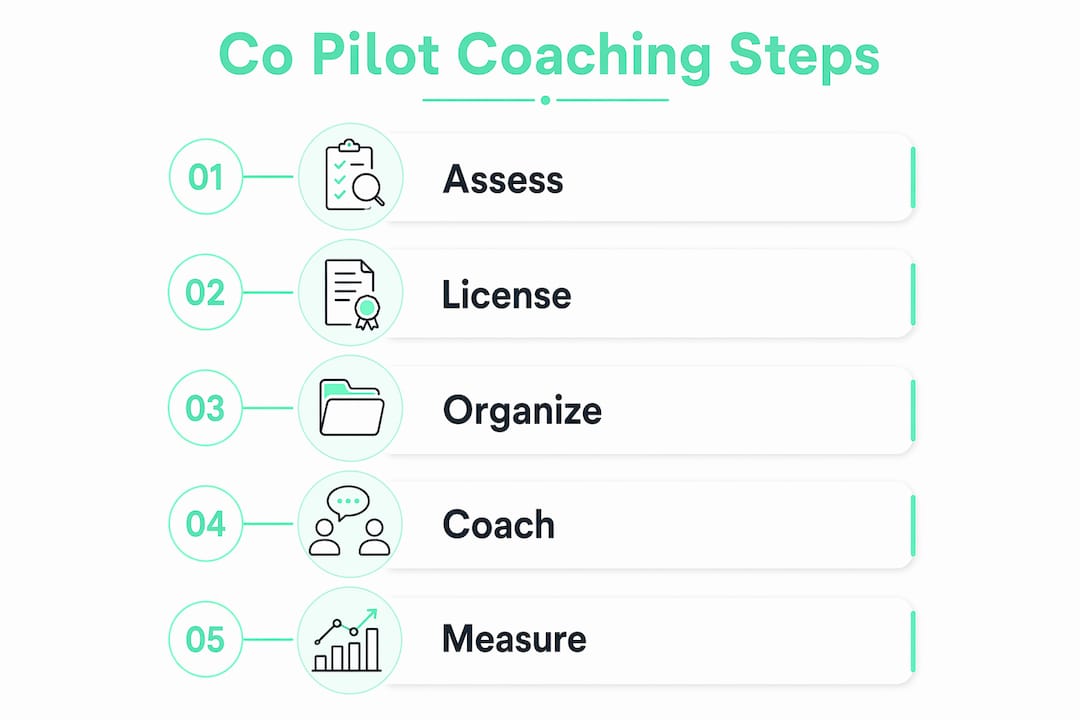
The most reliable structure for Copilot coaching comes from aviation: the PBED framework, which stands for Plan, Brief, Execute, Debrief. This closed-loop system connects strategic vision with tactical delivery and creates a repeatable cycle of improvement. Each phase has a distinct purpose and a specific output.
Set objectives aligned with business goals. Before any coaching begins, define what success looks like in measurable terms. For a law firm, that might mean recovering two billable hours per attorney per week through Copilot-assisted document drafting. For an accounting firm, it might mean cutting report preparation time by a defined percentage. Vague goals produce vague results.
Plan: Map coaching cycles to Copilot workflows. Each coaching cycle should target one or two specific Copilot capabilities, such as meeting summarization in Teams or email drafting in Outlook. Assign each capability to a workflow the team already runs. This prevents the common mistake of training people on features they have no immediate reason to use.
Brief: Align expectations before each session. The pre-session brief shares relevant usage data, sets the session agenda, and surfaces any blockers the team encountered since the last cycle. This step takes 15 minutes but prevents 45 minutes of wasted session time. Structured coaching engagements close the gap between what leaders intend and what teams actually execute.
Execute: Run the coaching session with a dual focus. The session covers both the behavioral skill (decision-making, communication, prioritization) and the Copilot skill (prompt construction, output review, workflow integration). Co pilot coaching improves output quality without requiring additional headcount. That combination is what makes it a productivity multiplier rather than a training cost.
Debrief: Analyze outcomes and refine the next cycle. The debrief is where ROI gets built. Teams review what Copilot outputs they used, what they discarded, and why. ROI from executive coaching depends directly on the rigor of this debrief process. Skipping it means repeating the same mistakes in the next cycle.
Repeat with updated data. Each completed cycle generates new telemetry. Feed that data into the next planning phase. Over three to four cycles, patterns emerge: which prompts produce usable outputs, which workflows benefit most, and which team members need additional support.
Pro Tip: Record a short screen capture during the Execute phase showing a real Copilot interaction. Reviewing it in the Debrief phase is far more useful than relying on memory or self-reported feedback.
What are the most common challenges in co pilot coaching adoption?
The biggest obstacle is not technology. It is perception. Teams that hear “coaching” often assume they are being flagged as underperformers. That framing kills adoption before the first session runs.
Positioning co pilot coaching as a strategic partnership rather than a remedial technical program significantly improves adoption and outcomes. The reframe is simple: this is not training for people who are behind. It is a performance edge for people who want to stay ahead.
Resistance to technology adoption shows up as passive non-use. Team members attend sessions, nod along, and then return to their existing workflows unchanged. The fix is accountability built into the debrief. When teams know they will review their actual Copilot usage data in the next session, passive non-use becomes visible and addressable.
Weak debrief practices are the second most common failure point. Organizations run the Plan, Brief, and Execute phases well, then skip or rush the Debrief. Without a structured debrief, performance feedback loops break down and coaching cycles do not compound. Each session becomes a standalone event rather than a building block.
Burnout risk is real in high-pressure professional services firms. Adding a coaching program on top of a full workload can feel like one more obligation. The solution is to position the coach as a pressure release, not a pressure source. Effective coaches help leaders maintain steadiness under pressure and protect against burnout by providing objective feedback rather than adding to the cognitive load.
- Reframe coaching as a performance advantage, not a remediation program
- Build usage telemetry review into every debrief so non-use becomes visible
- Keep sessions focused on one or two Copilot workflows per cycle to prevent overload
- Assign a single internal champion per team to sustain momentum between sessions
- Treat the coach as a sounding board, not an evaluator, to reduce defensiveness
How do you measure success and ROI from co pilot coaching?
The measurement framework separates leading indicators from lagging indicators. Leading indicators tell you whether the coaching program is running correctly. Lagging indicators tell you whether it is producing results.
High-performing leaders protect standards and guard against burnout by leaning on objective feedback. That same principle applies to measuring coaching programs: remove assumptions and measure what actually happened.
| Metric type | Specific metric | What it tells you |
|---|---|---|
| Leading | Copilot feature activation rate | Whether team members are using assigned features |
| Leading | Session attendance and debrief completion | Whether the coaching cycle is running as designed |
| Lagging | Billable hours recovered per user per week | Direct productivity impact in professional services |
| Lagging | Document drafting time reduction | Output efficiency improvement |
| Lagging | Self-reported cognitive load scores | Burnout risk reduction over time |
Zera measures Copilot adoption through telemetry pulled directly from Microsoft 365 usage data. This approach identifies dormant licenses, tracks feature activation by user, and maps usage patterns to specific workflows. The result is a clear picture of where coaching is working and where it is not.
Pro Tip: Set a 90-day measurement window for your first coaching cohort. Shorter windows do not capture the compounding effect of the PBED cycle. Longer windows make it hard to course-correct before bad habits solidify.
A useful scenario: a 20-person consulting firm runs three PBED coaching cycles over 12 weeks. By week 12, the team has shifted meeting summarization, email drafting, and proposal research to Copilot. The coach’s role is not to take control but to equip leaders with frameworks and the mental discipline needed for sustained high performance. That discipline shows up in the data as consistent feature use, reduced rework, and recovered time.
Key Takeaways
Effective co pilot coaching requires a structured PBED cycle, telemetry-based measurement, and a coach who treats Copilot adoption as a behavioral change program, not a software tutorial.
| Point | Details |
|---|---|
| Define measurable goals first | Set specific productivity targets before the first coaching session begins. |
| Use the PBED framework | Plan, Brief, Execute, and Debrief creates a repeatable cycle that compounds over time. |
| Reframe coaching as a performance edge | Teams adopt faster when coaching is positioned as a competitive advantage, not remediation. |
| Measure with telemetry | Usage data from Microsoft 365 removes guesswork and makes non-use visible. |
| Protect against burnout | A good coach reduces cognitive load rather than adding to it. |
What I have learned about co pilot coaching in professional services
The framing problem is the hardest part. Every mid-market firm I have seen struggle with Copilot adoption has the same root cause: the rollout was treated as an IT deployment, not a behavioral change program. People received licenses and a 30-minute demo. Then nothing changed.
What actually works is treating the coach like a co-pilot in the original aviation sense. The coach does not fly the plane. The coach monitors, calls out hazards, and pressure-tests the pilot’s decisions in real time. Coaching builds clarity, intentionality, and resilience rather than volume or surface-level confidence. That distinction matters enormously in a law firm or accounting practice where the quality of output, not the quantity, determines client value.
The PBED structure from aviation is not just a metaphor. It is a discipline. The Debrief phase in particular is where most organizations leave money on the table. Leaders are comfortable planning and executing. They are uncomfortable sitting with objective data about what did not work. A good coach makes that conversation productive rather than threatening.
Executive coaching is a proactive performance tool for leaders seeking an edge, not a rescue program for struggling ones. The organizations that internalize this framing get adoption rates that justify the Copilot investment. The ones that do not end up with idle licenses and frustrated partners.
Zera’s approach to Copilot adoption and coaching ROI
Mid-market professional services firms face a specific problem: Copilot licenses that cost real money but generate no measurable return because adoption never took hold.
Zera specializes in fixing exactly that. The team pulls telemetry from your Microsoft 365 environment to identify dormant licenses, maps your core workflows to specific Copilot capabilities, and builds a coaching program around the PBED cycle. Every engagement is anchored to recoverable billable time, not abstract productivity scores. If you want a clear picture of what your Copilot investment is actually returning, Zera’s consulting services give you the data and the structure to act on it. Learn more about Zera’s approach.
Related: Microsoft 365 Copilot User License: IT Manager’s Guide
FAQ
What is co pilot coaching in a Microsoft 365 context?
Co pilot coaching is a structured performance program that pairs executive coaching frameworks with hands-on Microsoft 365 Copilot skill-building. The goal is to improve both decision-making quality and Copilot adoption rates within a team.
How does the PBED framework apply to Copilot coaching?
PBED stands for Plan, Brief, Execute, Debrief. It creates a closed-loop coaching cycle where each session builds on telemetry and feedback from the previous one, compounding productivity gains over time.
How long does it take to see ROI from co pilot coaching?
A 90-day window covering three to four PBED cycles is the minimum needed to see compounding results. Shorter windows capture only initial behavior changes, not sustained workflow shifts.
Why do co pilot coaching programs fail?
The most common failure is skipping or rushing the Debrief phase, which breaks the feedback loop and prevents each cycle from improving on the last. Weak goal-setting and poor adoption framing are the next most frequent causes.
What metrics should teams track during co pilot coaching?
Track Copilot feature activation rates and session completion as leading indicators. Track recovered billable hours, document drafting time, and self-reported cognitive load as lagging indicators of real productivity impact.