
AI automation consulting is a strategic, execution-focused service that helps mid-market professional services firms identify, design, and implement AI workflows that automate high-impact business processes for measurable productivity and cost benefits. The industry term for this discipline is intelligent process automation consulting, though “AI automation consulting” has become the working shorthand across law, accounting, and consulting firms. Firms that apply this approach correctly report 40–90% cost reductions on targeted workflows and reclaim 10–20 hours per professional per week. That is not a rounding error. It is the difference between a firm that competes on capacity and one that competes on price. The NIST AI Risk Management Framework provides the governance backbone that responsible automation consultants build around, ensuring that speed does not come at the cost of compliance.
1. What are the critical phases in AI automation consulting?
Every credible AI automation consulting engagement follows a phased structure. The goal is to deliver working automation fast while managing risk at each gate.
Phase 1: Discovery (2–3 weeks)

The discovery phase is a fixed-price readiness assessment. Automation consultants map your current workflows, measure baseline cost and cycle time, and score each process for automation fit. The output is a prioritized roadmap covering 6–12 months of automation work, sequenced by ROI, risk, and team capacity. Readiness scoring produces this sequenced roadmap and prevents firms from committing budget to the wrong processes first.
Phase 2: Build (6–10 weeks)
The build phase delivers production-grade automation workflows with measurable KPIs baked in from day one. A well-run engagement deploys initial automation by week four, using a thin-slice approach. That means one real workflow runs in production early, generating actual data before the full build completes. This validates accuracy and builds internal confidence simultaneously.
Phase 3: Run and optimize (ongoing)
The optional run phase covers monitoring, retraining, and workflow expansion. Not every firm needs it. Firms with internal IT capacity often absorb this function after handoff.
Pro Tip: Never sign a build contract without a completed discovery phase. Skipping discovery is the single fastest way to automate the wrong process at full cost.
The most dangerous failure mode in AI automation consulting is the handoff gap. When a strategy team designs a solution and passes it to a separate build team, context evaporates. 60–70% of AI initiatives fail because of exactly this gap. The fix is simple: use the same team from discovery through deployment.
2. Which workflows are the best candidates for automation?
Not every workflow belongs in an automation program. The best candidates share three traits: high volume, a measurable cost or time baseline, and repetitive manual steps with low exception rates.
The highest-value targets in professional services firms include:
- Document review and contract analysis. Law and accounting firms spend enormous hours on first-pass document review. AI extracts clauses, flags anomalies, and routes exceptions to reviewers in a fraction of the time.
- Support triage and intake routing. Firms that handle high volumes of client inquiries benefit from AI classification that routes requests before a human ever reads them.
- Proposal drafting. AI pulls from past proposals, populates standard sections, and flags gaps for partner review. The professional still approves. The AI does the assembly.
- Data reconciliation. Matching entries across systems, flagging discrepancies, and generating exception reports are deterministic tasks that AI handles with high accuracy.
- Knowledge base retrieval. AI surfaces relevant precedents, templates, and prior work products during active engagements, reducing research time per matter.
Common automation targets across professional services consistently include document review, support triage, and data extraction. These are not coincidental choices. They share the traits that make automation reliable: structured inputs, clear success criteria, and low tolerance for ambiguity.
Pro Tip: Score every candidate workflow on three dimensions before committing: estimated ROI, exception density (how often the process breaks from the standard path), and reversibility (how easily you can roll back if the automation underperforms).
Avoid automating processes that are heavily exception-driven or that sit inside regulated decision points without a clear human review layer. Intelligent Process Automation works best when it orchestrates entire process flows, not just isolated tasks. A firm that automates only the data entry step of a five-step process captures a fraction of the available value.
3. How do automation consultants ensure measurable ROI?
ROI accountability starts before the build phase begins. Effective process automation consulting uses pre-commitment decision support: a structured evaluation of cost, throughput, and cycle time metrics that determines whether automation is worth pursuing at all.
The evaluation framework covers four areas:
| Evaluation area | What consultants measure |
|---|---|
| Cost baseline | Fully loaded labor cost per process execution |
| Cycle time | End-to-end time from trigger to completion |
| Exception rate | Percentage of cases that require human intervention |
| Integration complexity | Number of systems the workflow touches |
Vendor-neutral assessments prevent firms from committing to a platform before the data confirms it is the right fit. This matters because the most expensive mistake in automation is locking into a vendor before a thorough readiness assessment confirms scope and scalability. A good automation consultant will sometimes recommend not automating a process. That recommendation is worth as much as any build engagement.
KPI dashboards track automation impact against labeled baseline data sets. Firms measure reduction in labor hours, error rates, and cycle time before and after deployment. Success criteria and exit criteria are defined before the build starts, not after. This removes ambiguity about whether the engagement delivered value.
4. What technical architecture does AI workflow automation use?
Business leaders do not need to become engineers. They do need to understand the architecture decisions that affect cost, risk, and maintainability.
Most AI workflow automation consulting engagements today use a combination of large language models and deterministic automation. The LLM layer handles judgment-heavy steps: reading documents, classifying intent, drafting text. The deterministic layer handles rules-based steps: routing, data validation, system writes.
Model selection depends on the task. Claude, GPT, and Gemini each perform differently on structured extraction versus open-ended generation. Multi-LLM routing sends each task to the model best suited for it, rather than forcing one model to handle everything. This is a more maintainable architecture than single-model deployments.
Retrieval-Augmented Generation, known as RAG, connects AI models to firm-specific knowledge bases. Instead of relying on general training data, the model retrieves relevant documents from your own systems before generating a response. This is the architecture that makes AI useful for matter-specific legal research or client-specific accounting analysis.
Deployment surfaces include cloud APIs such as OpenAI API, AWS Bedrock, and Google Vertex AI, as well as self-hosted options for firms with strict data residency requirements. Integration with existing systems including CRMs, project management tools, and knowledge bases is non-negotiable for production-grade automation. Automation that cannot write back to your systems of record creates manual reconciliation work that erases the efficiency gain.
Governance design based on NIST AI RMF includes prompt versioning, audit logs, and human review queues. These are not optional extras for regulated industries. They are the minimum viable governance layer for any firm that handles client data.
5. How does Microsoft 365 Copilot fit into an AI automation strategy?
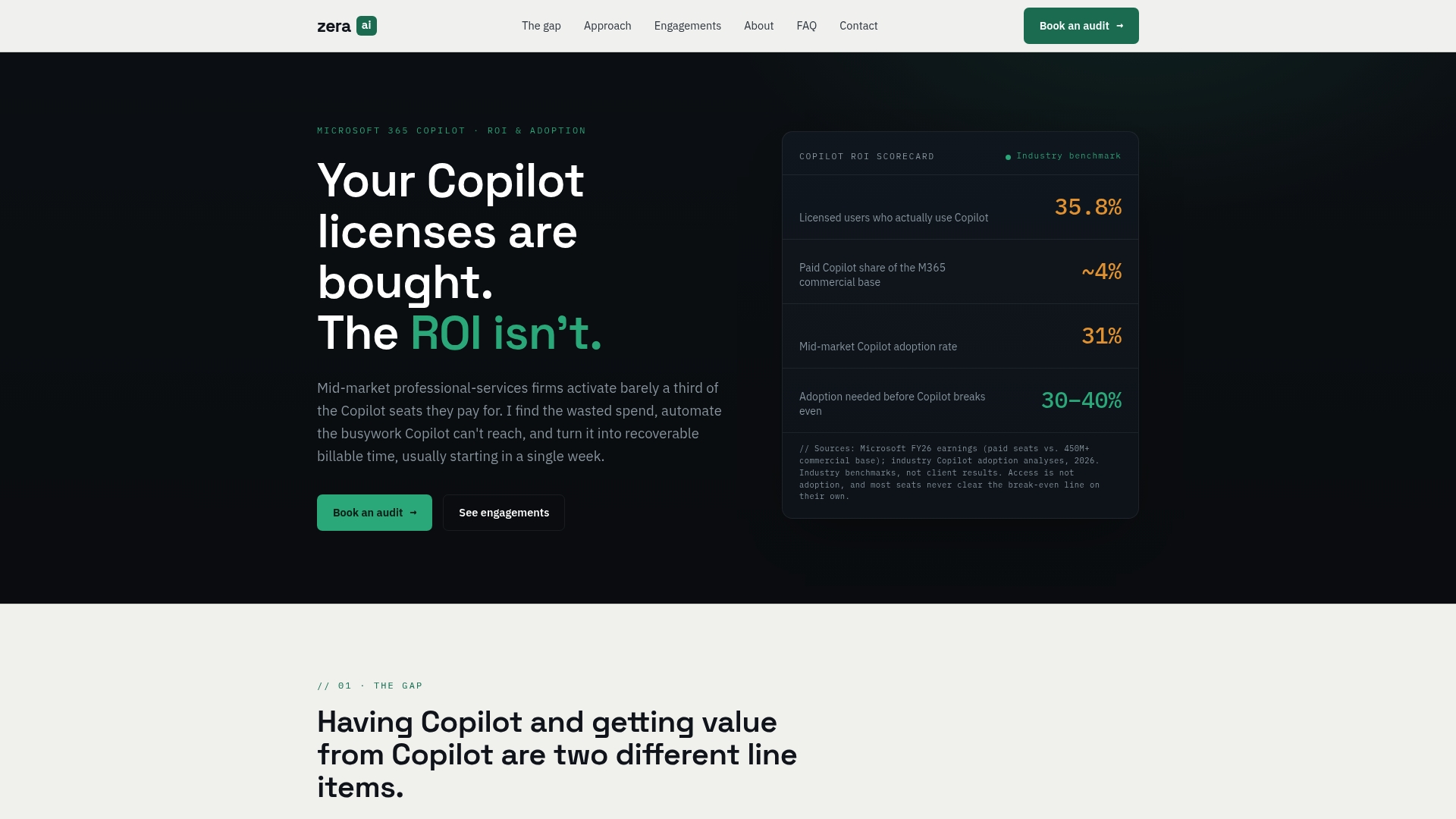
Microsoft 365 Copilot is the most widely deployed AI tool in mid-market professional services firms right now. Most firms have purchased licenses. Most of those licenses sit idle. That is not a Copilot problem. It is an adoption and workflow integration problem.
Effective Copilot adoption consulting treats Copilot as one component of a broader automation architecture, not as a standalone productivity tool. Copilot handles in-application tasks: drafting emails in Outlook, summarizing meetings in Teams, generating first drafts in Word. The automation layer around it handles the routing, triggering, and system integration that Copilot cannot do alone.
Telemetry is the measurement mechanism that separates firms that know Copilot is working from firms that assume it is. Microsoft Copilot telemetry tracks actual usage at the feature level, identifies dormant licenses, and surfaces which workflows are generating productivity gains. Without telemetry, license spend is unaccountable. With it, firms can redirect unused licenses to high-adoption users and build the ROI case for expansion.
The firms that extract the most value from Copilot are the ones that rebuild workflows around it, not the ones that hand out licenses and wait. Measuring Copilot ROI requires baseline data collected before deployment, not after.
Key takeaways
The most effective AI automation consulting model for mid-market professional services firms combines vendor-neutral readiness assessment, phased delivery by a single team, and governance built on NIST AI RMF standards to produce measurable, accountable ROI.
| Point | Details |
|---|---|
| Phase before you build | A 2–3 week discovery phase prevents costly wrong-scope automation commitments. |
| Same team, start to finish | Single-team strategy and delivery eliminates the handoff gaps that cause 60–70% of AI project failures. |
| Score workflows before committing | Evaluate every candidate by ROI potential, exception density, and reversibility before approving a build. |
| Governance is not optional | NIST AI RMF-aligned audit logs and review queues are the minimum standard for client-data environments. |
| Copilot needs workflow integration | Idle Copilot licenses become productive only when rebuilt workflows give them a defined role. |
The uncomfortable truth about AI automation consulting
Most AI automation consulting engagements fail before the build phase starts. The failure is not technical. It is structural. A strategy team produces a polished deck, hands it to a separate implementation team, and the context that made the strategy coherent disappears in the transfer. I have seen this pattern repeat across firms of every size. The deck says “automate contract review.” The build team delivers a document classifier. The partners expected something that drafts the summary memo. Nobody is lying. The handoff just destroyed the shared understanding.
The firms that get real results from AI automation consulting are the ones that insist on a single team owning discovery through deployment. They also insist on seeing production automation by week four, not a demo. A demo proves the technology works in a controlled environment. A thin-slice production deployment proves it works in yours.
The other pattern I find consistently undervalued is the recommendation to not automate. A good readiness assessment will identify processes that look like automation candidates but carry exception rates or regulatory constraints that make automation more expensive than manual handling. Firms that skip this step and go straight to build often spend $100,000 to automate a process that saves $20,000 annually. The math only works if someone did the math first.
Vendor neutrality is not a marketing position. It is a structural requirement for honest consulting. A consultant who sells a specific platform has a financial incentive to recommend that platform regardless of fit. Independent benchmarking of AI models and automation tools against your specific workflows is the only way to know what actually performs.
— Mad
Gozera’s approach to Microsoft 365 Copilot ROI
Mid-market professional services firms that have purchased Microsoft 365 Copilot licenses and are not seeing measurable productivity gains have a specific, solvable problem. Gozera’s Copilot ROI consulting starts with telemetry-based baseline measurement to identify exactly where licenses sit idle and where workflows can be rebuilt to generate recoverable billable time. The engagement is phased, data-driven, and designed to produce measurable outcomes without lengthy change management programs.
Gozera works with law firms, accounting practices, and consulting organizations with 50–500 employees. The focus is on turning existing Copilot investments into documented productivity gains, not on selling additional software. If your firm has licenses and is not measuring their impact, the first step is a readiness assessment that tells you exactly what you have and what it is worth.
FAQ
What is AI automation consulting?
AI automation consulting is a professional service that helps organizations identify, design, and implement AI-powered workflows to automate high-impact business processes. Engagements typically include a readiness assessment, workflow prioritization, and production deployment with measurable KPIs.
How long does an AI automation consulting engagement take?
A standard engagement runs 8–13 weeks: a 2–3 week discovery phase followed by a 6–10 week build phase. Initial production automation typically deploys by week four of the build phase.
How do automation consultants measure ROI?
Consultants establish baseline metrics for labor cost, cycle time, and error rate before deployment, then measure the same metrics after. The delta between baseline and post-deployment performance is the documented ROI.
What workflows are best suited for AI automation in professional services?
Document review, contract analysis, support triage, proposal drafting, and data reconciliation consistently deliver the highest ROI. These workflows share high volume, measurable baselines, and low exception rates.
Why do so many AI automation projects fail?
The primary cause is the handoff gap between strategy and delivery teams. When separate teams own design and build, context is lost and projects stall. Single-team engagements that own both phases reduce failure rates by 60–70%.