
Adopt Microsoft’s Copilot Control System as your governance framework, and start with three actions this month, not next quarter. The Control System organizes everything you need into three pillars: security and governance, management controls, and measurement and reporting. Skip any one of them and you either expose sensitive data or you burn licensing spend with no proof it did anything.
Here’s where to start, in order:
- Remediate oversharing first. Run a SharePoint and OneDrive site discovery to find content with excessive permissions before Copilot can surface it to the wrong person.
- Apply Purview guardrails second. Turn on sensitivity labels and Data Loss Prevention policies scoped specifically to Copilot interactions, not just general file sharing.
- Assign governance roles and telemetry third. Name an accountable owner for Copilot governance and switch on usage telemetry before you expand licensing further.
Foundational licensing (A3/E3/G3) covers a meaningful baseline. Optimized tiers (A5/E5/G5) unlock deeper Purview controls and richer analytics. Whichever tier you’re on, put a quarterly governance review on the calendar now. Waiting until an incident forces the conversation is the single most expensive mistake mid-market firms make with Copilot.
Key Takeaways
Effective Copilot governance requires the Copilot Control System’s three pillars, staged licensing, active telemetry, and a quarterly review cadence working together, not any single control alone.
| Point | Details |
|---|---|
| Remediate oversharing first | Run site discovery and fix permission sprawl before Copilot rollout expands, per Microsoft’s foundational blueprint. |
| Apply Purview guardrails | Configure sensitivity labels and DLP tuned specifically to Copilot interactions, not just email. |
| Measure before you scale | Baseline telemetry and Copilot Analytics before wider rollout so ROI numbers mean something later. |
| Assign explicit governance roles | Name an executive sponsor, governance lead, admin, data stewards, and compliance reviewer separately. |
| Pair governance with adoption work | Gozera combines telemetry, dormant-license remediation, and workflow automation to turn governed licenses into recovered billable time. |
Table of Contents
- What Is the Copilot Governance Framework, Exactly?
- Which Data Security Controls Should You Configure First?
- How Do You Manage Licensing, Agents, and Access at Scale?
- How Do You Measure Adoption and Prove ROI?
- Who Should Own Copilot Governance Inside Your Firm?
- What Does a 90 to 180 Day Rollout Actually Look Like?
- How Gozera Turns Governance Into Measured ROI
- How Do You Monitor Compliance and Respond to Incidents?
- How Should You Train Staff on Copilot Governance?
- How Does Copilot Governance Fit Your Existing IT Policies?
- How Do You Manage Change Without Stalling Adoption?
- Where to Go for Deeper Configuration Guidance
- Why Governance Frameworks Alone Won’t Save You
- Turn Governed Licenses Into Measured Returns
- Sources
What Is the Copilot Governance Framework, Exactly?
The Copilot Control System isn’t a single setting you flip. It’s a structure of three connected pillars, and mid-market firms tend to underestimate how much coordination each one requires across IT, legal, and operations.
Security & Governance covers data protection, compliance boundaries, and risk controls. This is where Purview sensitivity labels, Data Loss Prevention, and SharePoint Advanced Management live. The aim is straightforward: Copilot should never surface content a user couldn’t already see through normal permissions, and sensitive categories (client files, case documents, financial statements) need explicit protection before Copilot goes anywhere near them.
Management Controls governs who gets Copilot, what agents can do, and how the whole deployment scales. This pillar handles license assignment, agent approval workflows, and role-based access. For a 200-person accounting firm, this means deciding which practice groups get Copilot first and which custom agents (if any) get built and by whom.
Measurement & Reporting is the pillar most firms skip, and it’s the one that actually justifies the spend. It covers adoption tracking through Copilot Analytics, usage telemetry, and reporting cadences that tie Copilot activity back to business outcomes.
Mapped to Microsoft’s tools, the pillars break down like this:
- Security & Governance → Microsoft Purview (sensitivity labels, DLP, Data Security Posture Management for AI), SharePoint Advanced Management, Microsoft Entra for identity and conditional access.
- Management Controls → Microsoft 365 admin center for licensing, agent lifecycle tools within the Copilot Control System, Entra role assignments.
- Measurement & Reporting → Copilot Analytics dashboards, usage reports, and custom telemetry pulled into finance or operations reporting.
Each pillar should produce something concrete. Security & Governance produces a documented policy set and a remediated permissions baseline. Management Controls produces a license assignment matrix and an agent approval log. Measurement & Reporting produces a monthly or quarterly ROI report that a managing partner can actually read in five minutes. If a pillar isn’t producing a deliverable, it’s not being governed. It’s being assumed.
Which Data Security Controls Should You Configure First?
Oversharing is the risk that catches firms off guard, because it predates Copilot entirely. Permission sprawl accumulates for years, and Copilot’s semantic search is good enough to surface a mispermissioned file that a keyword search would have missed.
Work through these five steps in priority order:
- Run site and permission discovery across SharePoint and OneDrive. Identify sites with “everyone” or overly broad access, and flag owners who haven’t reviewed permissions in over a year.
- Remediate ownerless and overexposed sites before rollout. Microsoft’s foundational deployment guidance names this the first of three essential steps in a secure Copilot rollout, ahead of guardrails or compliance work.
- Apply Purview sensitivity labels tuned for Copilot, not just email. A label built for outbound email DLP won’t necessarily stop Copilot from summarizing a labeled contract into a chat response, so test labels against actual Copilot prompts.
- Set retention and eDiscovery rules for Copilot interaction history. Decide how long prompt and response logs persist, who can search them, and how a legal hold pulls in Copilot activity alongside email and documents.
- Configure Data Security Posture Management for AI to get continuous visibility into where sensitive data intersects with AI activity, rather than relying on a one-time audit.
On the AI-specific protections: Copilot ships with built-in defenses against prompt injection and harmful content generation, but those are baseline guardrails, not a substitute for your own DLP rules. Microsoft states plainly that prompts, responses, and Graph-accessed data are not used to train foundation LLMs, and Copilot carries certifications including GDPR, ISO 27001, HIPAA, and ISO 42001. That’s a real assurance for client-facing firms fielding data-handling questions from clients or regulators, but certification covers Microsoft’s side of the shared responsibility model. Your sensitivity labels, retention policies, and access reviews cover yours.
Pro Tip: Test your DLP rules against five real Copilot prompts your staff would actually type, not against a hypothetical email scenario. The failure modes are different, and you’ll usually find at least one label that doesn’t fire the way you expected.
One control worth flagging on licensing: detecting Copilot interactions inside Teams and other Microsoft 365 apps works through Communication Compliance at the foundational tier. But if you want visibility into non-Microsoft 365 connected AI activity, you need pay-as-you-go billing enabled, which is easy to miss during initial setup and leaves a monitoring gap most IT leads don’t discover until an audit asks about it.
How Do You Manage Licensing, Agents, and Access at Scale?
Foundational licensing (A3, E3, G3) gives you the controls most firms need to start safely: baseline DLP, sensitivity labels, standard retention, and core Copilot Analytics. Optimized licensing (A5, E5, G5) adds Data Security Posture Management for AI, more granular insider risk management, and advanced eDiscovery. Most 50 to 500 employee firms can run a defensible governance program on foundational tiers and upgrade specific users or groups to optimized tiers as risk or regulatory pressure demands it. Buying A5 for everyone on day one is usually money spent solving a problem you don’t have yet.
License assignment works better as a staged rollout than a firmwide switch-on:
- Start with a small pilot cohort of users across a few practice groups, chosen for high document volume and willingness to give real feedback.
- Map licenses to roles, not job titles. A paralegal doing heavy drafting may need different access than a partner doing client-facing review.
- Expand in waves tied to measured outcomes from the pilot, not a fixed calendar date.
- Hold a reserve pool of licenses for new hires and role changes so IT isn’t provisioning one-off requests every week.
Agent governance is the newer piece, and it’s where firms get caught flat-footed. Custom Copilot agents (built for a specific practice workflow, say, contract review or client intake) need the same rigor as any other software deployment. Require an approval flow before an agent goes live, restrict which connectors an agent can reach, and set runtime restrictions so an agent built for one practice group can’t silently pull data from another.
Metering closes the loop. Dormant-license detection matters as much as any security control, because a firm paying for 300 Copilot seats with 90 active users is bleeding money every month with no governance failure to blame, just an adoption failure. Pull usage reports monthly and reclaim licenses that sit untouched for 60 days. Reassign them to the waitlist instead of buying more.

How Do You Measure Adoption and Prove ROI?
Governance without measurement is a policy binder nobody reads. Measurement is what turns Copilot governance from a compliance function into something the managing partner asks about voluntarily.
Start collecting telemetry from day one of the pilot, not after full rollout. You need a “before” snapshot to make the “after” number mean anything, and firms that skip baselining end up trying to reconstruct it from memory six months later.
Track these KPIs at minimum:
- Active users per assigned license, tracked weekly, not just at renewal time.
- Prompt-to-result success rate, meaning how often a Copilot output gets used versus discarded.
- Estimated time saved per task category (drafting, summarizing, research) based on user-reported and telemetry-derived estimates.
- Estimated billable hours recovered, calculated from time saved on billable-adjacent tasks.
| Metric | Baseline (pre-rollout) | Target (90 days post-rollout) |
|---|---|---|
| Active users per license | Not applicable | Weekly active minimum |
| Prompt-to-result success rate | Not applicable | Trending upward month over month |
| Time saved per drafting task | Manual task time logged | Reduction logged via telemetry |
| Dormant license rate | Not applicable | Under a small percentage |
Present this to partners on a monthly cadence for the first two quarters, then move to quarterly once the numbers stabilize. Keep the report to one page: adoption trend, a dollar estimate of recovered time, and one action item. Partners don’t need a dashboard tour. They need a number and a decision to make.
Wherever possible, feed telemetry into an existing finance or operations dashboard rather than maintaining a separate Copilot report that nobody outside IT ever opens. A Copilot business case template built around these same metrics makes the partner conversation considerably easier, especially at renewal time when someone inevitably asks what the licenses are actually doing.
Who Should Own Copilot Governance Inside Your Firm?
Governance fails when it’s “everyone’s job,” because everyone’s job means no one’s job. Assign these roles explicitly, even if some are part-time responsibilities layered onto an existing role:
- Executive sponsor. Usually a managing partner or COO who owns the budget conversation and reports governance KPIs to the full partnership.
- AI governance lead. Owns the policy set, chairs review meetings, and is the single point of accountability when something goes wrong.
- Copilot admin. Handles the technical configuration: Purview policies, license assignment, agent approvals, and telemetry pipelines.
- Data stewards. Practice-group representatives who understand which documents and matters carry heightened sensitivity and flag them for labeling.
- Compliance reviewer. Signs off on retention settings, eDiscovery configuration, and any regulatory obligations specific to your industry.
Structure two standing bodies. A steering committee, meeting quarterly, sets policy direction and reviews the ROI report alongside adoption metrics. A change approval board, meeting as needed, reviews new agent requests, license tier changes, and connector approvals before they go live. Keep the approval board small (three to four people) so it doesn’t become a bottleneck.
Every policy needs a lifecycle: drafted by the governance lead, reviewed by compliance, approved by the steering committee, versioned with a date and owner, and revisited every quarter regardless of whether anything changed. A policy that hasn’t been reviewed in a year isn’t governance anymore. It’s an assumption.
Link the review cadence to strategic and financial objectives, not just security hygiene. The Harvard Law School Forum frames this as treating AI governance as a strategic operating function rather than a compliance checkbox, which is the right instinct: a board that sees governance KPIs tied to recovered billable hours pays attention in a way it never will to a security audit summary alone.
What Does a 90 to 180 Day Rollout Actually Look Like?
Sequence matters more than speed here. Firms that try to do everything in week one end up with a rollout that’s half-configured everywhere instead of fully configured somewhere.
Days 1 to 30 (immediate triage):
- Run high-risk site discovery across SharePoint and OneDrive, and apply temporary access restrictions to anything flagged as overexposed.
- Tag sensitive content categories (client files, matter documents, financial records) even before full labeling is in place.
- Enable baseline DLP rules and Purview sensitivity labels scoped to your highest-risk content categories.
- Turn on usage telemetry and Copilot Analytics so you have a working baseline before broader rollout begins.
Days 30 to 90 (staged expansion):
- Expand licensing to your second and third pilot cohorts based on results from the initial group.
- Stand up the agent approval workflow before anyone requests a custom agent, not after the first request lands.
- Configure retention and eDiscovery rules for Copilot activity logs.
- Run your first baseline ROI report, even if the numbers are rough. A rough number beats no number.
Days 90 to 180 (scale and optimize):
- Turn on Data Security Posture Management for AI to get continuous, rather than point-in-time, visibility into data and AI risk.
- Automate remediation where possible, meaning permission fixes and label application without a human clicking through each case.
- Formalize the quarterly governance review cadence with the steering committee.
- Reassess licensing tier decisions based on nine months of actual usage data, not projections made before rollout started.
Pro Tip: Resist the urge to run steps 1 through 4 and steps 5 through 8 at the same time just because your team is capable of it. The oversharing remediation needs to be substantially done before wider rollout, or you’re just expanding the blast radius of a problem you haven’t fixed yet.
For a firm juggling this alongside daily operations, a governance and AI playbook built for iterative review helps keep the quarterly cadence from sliding into “we’ll get to it next quarter” indefinitely.
How Gozera Turns Governance Into Measured ROI
Governance frameworks tell you what controls to configure. They don’t tell you whether the resulting deployment actually produces work product, and that gap is where most firms lose the thread after go-live.
Gozera’s approach starts with baseline telemetry, measuring actual Copilot usage against assigned licenses before touching anything else. From there, the work moves to dormant-license remediation (reclaiming seats that sit idle), workflow rebuilds targeting the highest-value repetitive tasks in a practice group, and automation using Python and n8n to close gaps Copilot alone doesn’t solve.
Typical engagements follow a pattern:
- An adoption audit (two to three weeks) establishing baseline usage and identifying the highest-value automation targets.
- An integration sprint (four to six weeks) rebuilding one or two priority workflows and wiring in automation.
- A monthly optimization retainer for ongoing measurement, license reallocation, and workflow refinement as usage patterns shift.
A firm with 150 Copilot licenses and 40% weekly active usage isn’t a governance failure. It’s an adoption failure with a governance framework sitting on top of it, doing nothing to close the gap between licenses purchased and value delivered.
Illustrative scenario: a 120-person accounting firm with Copilot deployed firmwide but no workflow integration typically sees adoption cluster around email drafting and little else, leaving research and reconciliation workflows untouched. Rebuilding two or three of those workflows around Copilot, paired with light automation for repetitive data pulls, is where the recovered billable time usually shows up.
The consistent lesson: governance controls protect the deployment. Workflow rebuilds and automation are what make the deployment worth protecting.
How Do You Monitor Compliance and Respond to Incidents?
Ongoing compliance monitoring for Copilot needs a different rhythm than traditional IT security monitoring, because the risk surface (what data Copilot can see and summarize) shifts every time someone’s permissions change, not just when a policy changes.
Set a monthly cadence for reviewing DLP policy match rates and sensitivity label coverage, watching for a rising number of blocked or flagged Copilot interactions, which usually signals a permissions problem rather than a policy problem. Review Communication Compliance alerts for Copilot interactions in Teams weekly, since these surface faster than quarterly audits catch.
For incident response specifically, define what counts as a Copilot incident before you need the definition. A user seeing content they shouldn’t through a Copilot summary is a different incident than a jailbreak attempt against the model, and your response playbook should distinguish them. The first triggers a permissions and labeling review; the second triggers a security review of prompt-injection defenses and possibly a Microsoft support case.
Log every incident, however minor, in the same register you use for other IT security incidents rather than a separate Copilot-only log. Feed a quarterly summary to the compliance reviewer and steering committee, and treat any repeat incident type as a signal that a control (not just a single user) needs fixing.
How Should You Train Staff on Copilot Governance?
Training that only covers “how to write a good prompt” misses the governance half entirely, and it’s the half that prevents incidents rather than just improving output quality.

Build training around three layers. General awareness (all staff, one session) covers what Copilot can and can’t see, what happens to prompts and responses, and how to flag content that seems mislabeled or overexposed. Role-specific training (practice groups, tailored) covers workflow-specific use cases and the sensitivity labels relevant to that group’s document types. Admin and steward training (the governance team) covers the technical side: how DLP rules fire, how to interpret Purview alerts, and how to run permission reviews.
Timing matters as much as content. Train the pilot cohort before their licenses activate, not during week one of usage, and repeat a short refresher every time a policy changes materially, rather than relying on a single onboarding session to cover a year of policy evolution. Firms that skip refreshers tend to see policy drift within two or three quarters, where staff revert to habits formed before the last policy update.
Tie training completion to license activation where feasible. It’s a small friction point, but it ensures nobody starts using Copilot on sensitive matters without having seen the guardrails at least once.
How Does Copilot Governance Fit Your Existing IT Policies?
Copilot governance shouldn’t run as a parallel program next to your existing information security and data governance policies. It should sit inside them, using the same risk categories and the same approval bodies wherever possible.
Map Copilot-specific controls to your existing policy structure rather than writing a standalone Copilot policy from scratch. If your firm already has a data classification policy, extend it with Copilot-specific handling rules instead of creating a second classification scheme. If you already have a change approval board for IT systems, add agent approvals to its existing agenda rather than standing up a separate Copilot approval process.
The identity layer is where this integration matters most practically. Microsoft Entra should already be the backbone of your access control policy, and Copilot governance should extend Entra role assignments and conditional access rules rather than introduce a separate identity model. The same goes for retention: if legal already owns retention policy for email and documents, Copilot interaction history belongs under that same retention schedule, not a separate one IT invents independently.
This integration also solves a political problem. A standalone “AI policy” invites the question of why AI needs different rules than everything else. Folding Copilot governance into existing frameworks answers that before anyone asks it.
How Do You Manage Change Without Stalling Adoption?
The biggest change management risk with Copilot governance isn’t resistance. It’s over-restriction that kills adoption before it starts, leaving you with a fully governed deployment nobody actually uses.
Communicate guardrails as enablement, not restriction. A sensitivity label that blocks Copilot from summarizing a client contract isn’t Copilot failing. It’s the control working as designed, and staff need to hear that framing directly or they’ll assume Copilot is broken and stop trying.
Sequence rollout communication around the pilot cohort’s real experience, not a generic firmwide announcement. Feedback from the first 20 users, including the friction points, should shape how you introduce the next 50. Firms that broadcast a single firmwide launch message tend to see a spike in support tickets and a slower recovery in confidence than firms that expand in visible, communicated waves.
Give practice-group leads a role in the rollout beyond just receiving licenses. A partner who helped choose which workflows get automated first becomes an advocate; a partner who was simply told “you have Copilot now” becomes, at best, indifferent. This is also where an implementation guide built for IT leaders helps translate technical rollout steps into language a non-technical partner will actually engage with.
Where to Go for Deeper Configuration Guidance
- Copilot Control System security and governance for the full pillar breakdown and licensing tiers.
- Foundational deployment blueprint for the step-by-step secure rollout sequence.
- Microsoft 365 Copilot privacy for data handling and compliance certification detail.
- OECD Due Diligence Guidance for Responsible AI for higher-level governance alignment across regulatory regimes.
Why Governance Frameworks Alone Won’t Save You
The industry treats Copilot governance and Copilot adoption as separate problems, one owned by IT security, the other by whoever champions the rollout. That split is the mistake. A firm can nail every control in the Copilot Control System, pass every compliance review, and still have 60% of its licenses sitting dormant, because governance controls what Copilot can touch, not whether anyone bothers to use it well.
The conventional advice, “govern first, measure later,” has the sequence backward for a mid-market firm with limited IT headcount. Measurement should start at pilot launch, running parallel to the security work, because the ROI data is what keeps a managing partner funding the governance program past its first budget cycle. Security work with no visible payoff gets deprioritized the moment something else competes for attention, and something else always does.
If there’s one thing to prioritize above the rest, it’s this: treat the measurement pillar with the same urgency as the security pillar from day one, not as a phase-two nicety. A governed deployment nobody uses protects data that was never at risk of being misused in the first place.
— Mad
Turn Governed Licenses Into Measured Returns
Gozera is the practical next step once your governance framework is in place, but adoption still lags. Where a governance consultant stops at policies and controls, Gozera measures actual usage against every license you’re paying for, then rebuilds the workflows that turn Copilot from a dormant line item into recovered billable hours.
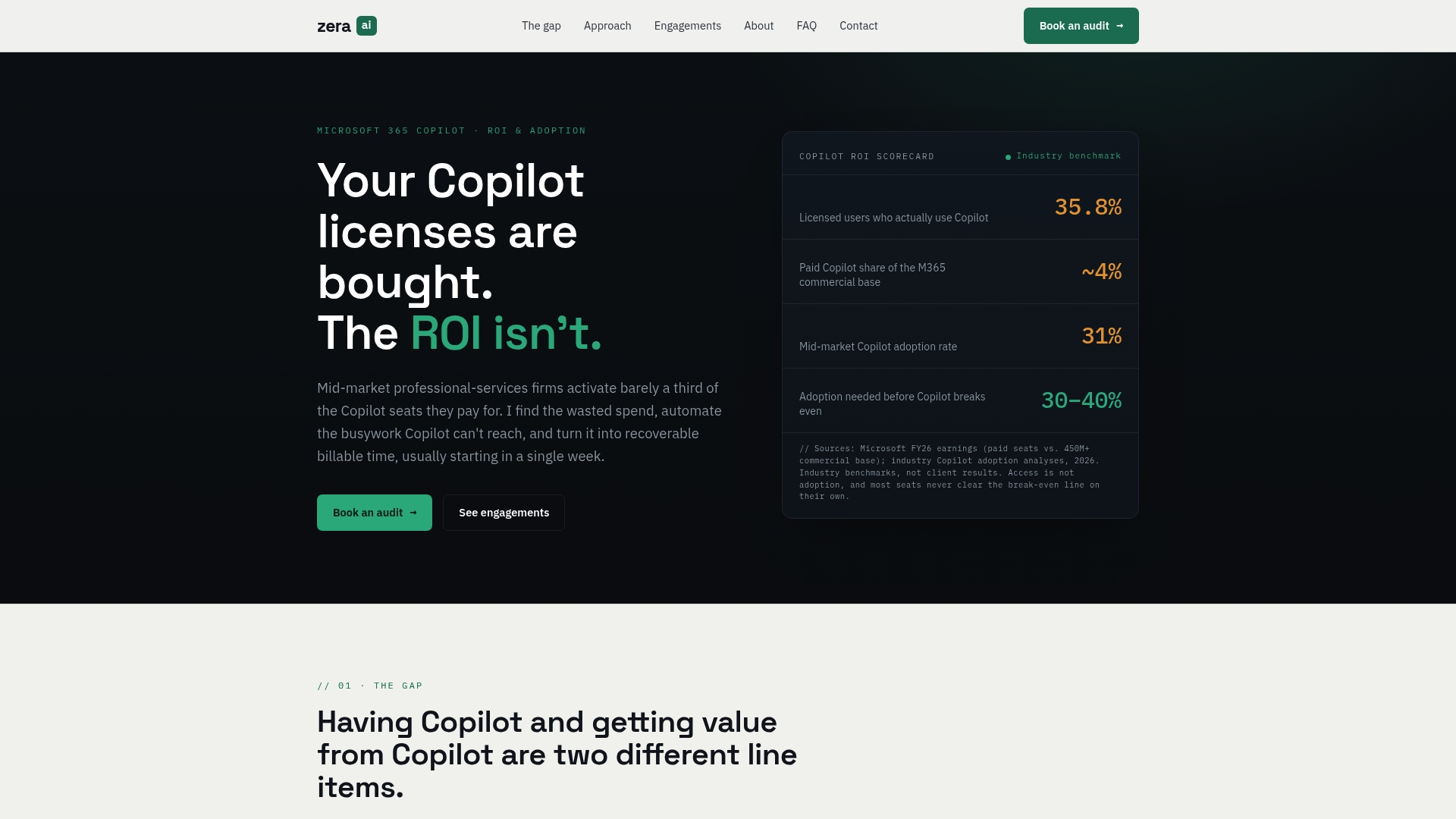
The firms that get the most from Copilot pair governance with an outcome-anchored adoption path: telemetry to find dormant licenses, workflow rebuilds targeting the highest-value tasks, and automation with Python and n8n to close the gaps Copilot leaves behind. That’s the exact work Gozera does for mid-market law, accounting, consulting, and engineering firms, without the extended change-management timelines a larger consultancy would propose. If your governance framework is solid but your adoption numbers aren’t where they should be, start with a Copilot adoption audit to see exactly where your licenses are underperforming and what recovering that value would look like.
Sources
- Copilot Control System security and governance – Microsoft Learn
- Secure & Governed Data Foundation for Microsoft Copilot – Foundational Deployment Guidance | Microsoft Learn
- Microsoft 365 Copilot privacy – Microsoft Learn
- OECD Due Diligence Guidance for Responsible AI (2026)