
An AI Center of Excellence (AI CoE) is the internal team that owns AI strategy, governance, and reusable infrastructure so adoption doesn’t happen ad hoc across departments. The single best first move is securing an executive sponsor and drafting a charter that names the mission, decision rights, and the first three metrics you’ll report on. Everything else, staffing, operating model, tooling, follows from that one decision.
TL;DR:
- Establishing an AI CoE requires securing executive sponsorship and drafting a clear charter focused on mission, decision rights, and initial metrics.
- Staffing should include an executive sponsor, AI strategy lead, technical specialists, and legal or compliance reps to ensure balanced oversight and effective deployment.
- Transition from centralized control to an advisory model gradually, with a focus on embedding standards in workflows and maintaining oversight for high-risk use cases.
- Early pilot projects should focus on automating routine workflows with measurable before-and-after impact, avoiding high-complexity or uncertain-use cases initially.
- Measuring license utilization and active adoption is crucial, as low engagement indicates workflow issues that need fixing before governance or strategic scaling.
Table of Contents
- What Is an AI Center of Excellence?
- Why Build an AI Center of Excellence Now?
- Who Should Sit on the AI Center of Excellence Team?
- Centralized, Federated, or Hybrid: Which Operating Model Fits?
- How Do You Structure an AI Governance Committee Charter?
- How Do You Build an AI Center of Excellence Step by Step?
- What Technology Stack Should the CoE Provide?
- How Do You Measure Whether the CoE Is Working?
- When Should the CoE Shift From Control to Advisory?
- What Templates and Next Steps Should You Use First?
- Gozera’s Approach to AI CoEs for Professional-Services Firms
- The Part Nobody Tells You About AI CoEs
- Sources
What Is an AI Center of Excellence?
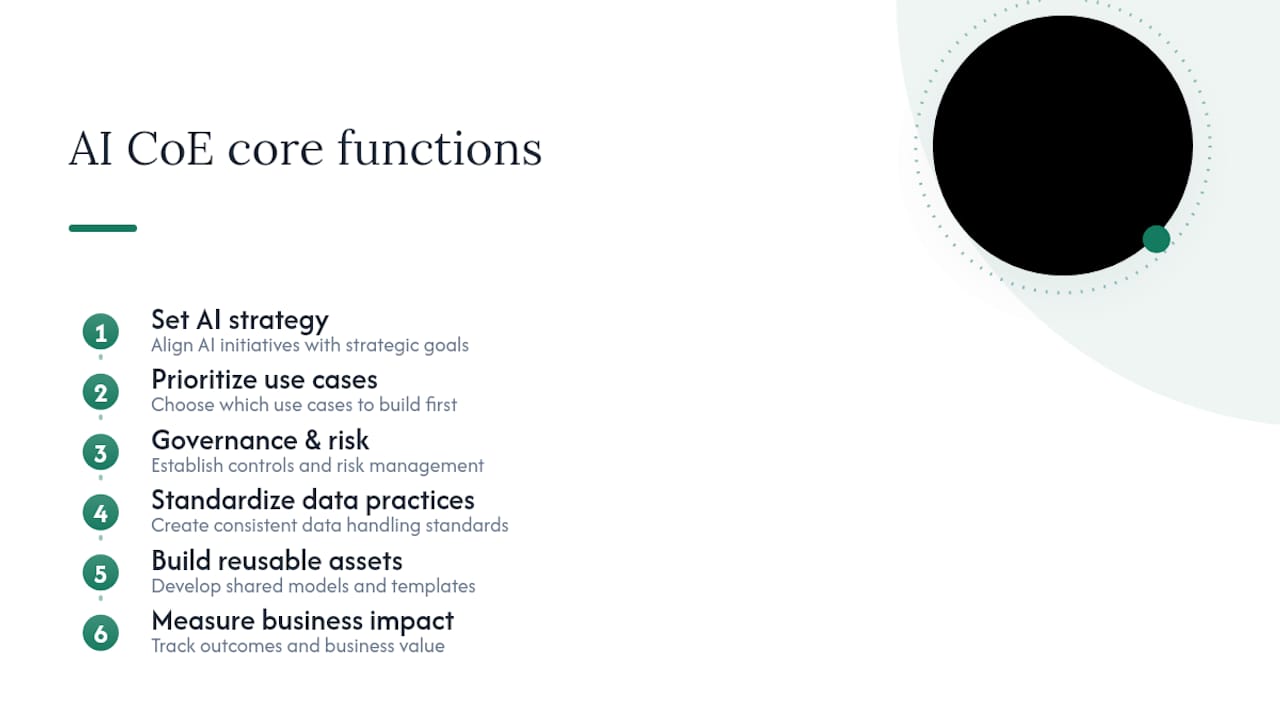
An AI CoE is the group inside your organization responsible for turning scattered AI experiments into a governed, repeatable capability. IBM defines it as a hub for expertise, governance, and best practices that aligns AI initiatives with strategic goals, and that definition holds up in practice.
The core functions are consistent across industries: set the AI strategy, prioritize which use cases get built first, establish governance and risk controls, standardize data practices, build reusable assets, and measure business impact. Microsoft’s Cloud Adoption Framework frames the CoE as the mechanism that prevents fragmented, ungoverned AI adoption, where every department buys its own tool and nobody tracks results.
Without a CoE, you get shadow AI: employees pasting client data into consumer chatbots, teams duplicating the same automation five different ways, and IT discovering a new AI vendor contract during the annual budget review. The CoE closes that gap by giving strategy a delivery mechanism.
Why Build an AI Center of Excellence Now?
The business case isn’t theoretical anymore. A 2024 industry observation cited by AWS found that 37% of large US companies have already established an AI/ML Center of Excellence, and that number keeps climbing as boards ask harder questions about AI spend.
A CoE typically delivers on four fronts:
- Faster time from pilot to production because teams reuse vetted templates instead of rebuilding governance from scratch
- Lower compliance risk through consistent data handling, access controls, and audit trails
- Reduced duplicate spend when departments stop buying overlapping tools independently
- Clearer ROI reporting tied to specific business outcomes rather than license counts
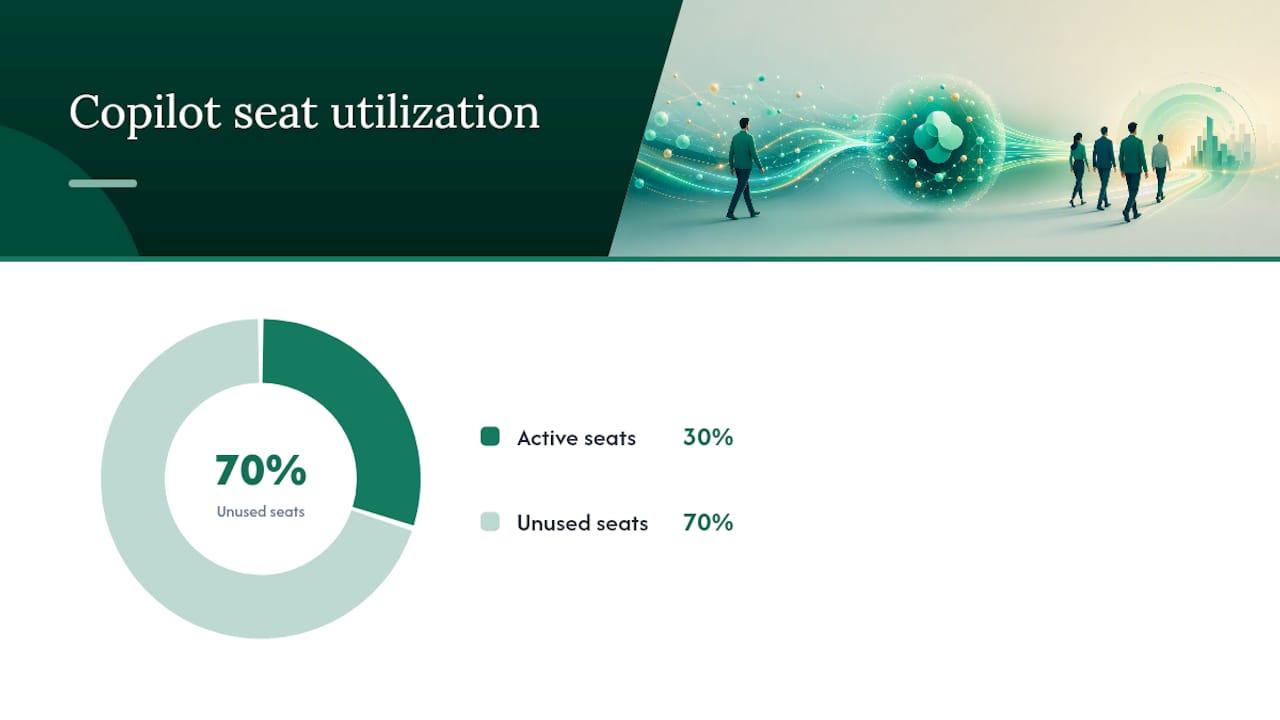
Pro Tip: Track cost-per-automated-task alongside license utilization from day one. A firm paying for 200 Copilot seats but seeing active use in only 60 has a utilization problem, not an AI strategy problem, and that distinction changes what you fix first.
For a professional-services firm with 50 to 500 employees, the fastest proof point usually isn’t a flashy generative AI pilot. It’s recovering billable hours lost to manual drafting, document review, and status reporting, work Copilot already touches every day if it’s configured and adopted correctly.
Who Should Sit on the AI Center of Excellence Team?
Staffing a CoE doesn’t require a dozen new hires. Most mid-market firms run lean, cross-functional teams pulled from existing staff plus a few targeted additions.
- Executive sponsor: A managing partner or C-level leader who unblocks budget and resolves cross-department disputes; without this role, the CoE has no teeth.
- AI strategy lead: Owns the roadmap, prioritizes use cases, and reports outcomes to leadership.
- Data and platform specialists: Handle data quality, integration, and the technical plumbing behind any automation (this is often where Python and workflow tools like n8n enter the picture).
- Security and compliance representative: Reviews data handling, access controls, and regulatory exposure before anything touches client data.
- Legal counsel or risk officer: Especially critical for law and accounting firms handling privileged or regulated information.
- Business champions: Practice-area leads who translate technical capability into workflows people actually use, and who catch adoption friction early.
Skip any of these roles and you’ll find out the hard way. Firms that launch without legal or compliance involvement tend to discover data-handling problems only after a client asks pointed questions.
Centralized, Federated, or Hybrid: Which Operating Model Fits?
Responsibilities split into a few consistent buckets regardless of model: governance and risk, platform and infrastructure, use-case intake and prioritization, and training. How you distribute those buckets across the organization determines whether you’re running a centralized, federated, or hybrid CoE.
- Centralized: One team owns everything, strategy, platform, and delivery. Works best for firms under roughly 150 employees or those just starting out, since it keeps governance tight while nobody has built local AI muscle yet.
- Federated: Practice groups run their own AI projects, but the central CoE sets standards, approves risk thresholds, and provides shared infrastructure. Fits larger firms with distinct practice areas (say, litigation versus transactional law) that need different workflows.
- Hybrid: Central team owns governance and platform; delivery teams embedded in each department own execution. This is where most firms land within 18 to 24 months, because pure centralization becomes a bottleneck once demand outpaces the CoE’s bandwidth.
Responsibilities evolve as maturity increases. A firm two years into its AI program should be pushing more delivery authority to business units while keeping governance, security review, and KPI tracking centralized. Trying to centralize everything indefinitely usually produces a backlog nobody’s happy with.
How Do You Structure an AI Governance Committee Charter?
A governance committee is what turns “we have AI principles” into something an auditor can actually verify. Neither ISO 42001 nor the EU AI Act names a specific committee structure, but both require demonstrable accountability, and a chartered committee is the most efficient way organizations satisfy that requirement, a point reinforced by adoption research tying executive sponsorship directly to program success.
A working charter should specify:
- Authority and scope: What the committee can approve versus what escalates to the board
- Membership and quorum: Permanent seats (legal, security, IT, a business unit lead) plus rotating members for specific reviews
- Meeting cadence: Monthly is typical for active programs; quarterly for mature, stable ones
- KPIs the committee tracks: Adoption rate, incident count, model performance drift, cost per use case
- Escalation thresholds: What risk level or spend amount triggers mandatory committee review before launch
Aona AI’s committee charter template offers a ready structure covering membership, authority, and KPIs that firms can adapt rather than build from scratch. University governance models offer a useful parallel too: the University of Washington’s AI governance committee was built specifically to define human oversight and transparency policies, which is close to what a mid-market firm needs for client-data handling.
Pro Tip: Document every committee decision, even the “no” decisions, with a one-line rationale. Auditors and regulators care less about what you approved and more about whether you can show you had a consistent process for evaluating risk.
How Do You Build an AI Center of Excellence Step by Step?
The first 90 days should focus on foundations, not features. Here’s a realistic sequence:
Days 1 to 30:
- Secure an executive sponsor and get budget authority in writing
- Draft the charter (mission, scope, decision rights) and get it signed
- Inventory every AI tool already in use, including shadow deployments nobody officially approved
- Stand up the governance committee with at least legal, IT, and one business unit represented
Days 30 to 90:
5. Build an intake form scoring use cases on business value versus implementation complexity
6. Select two or three pilot use cases that score high on value and low on complexity
7. Run pilots with defined success criteria set before launch, not after
Months 4 to 12:
8. Move successful pilots to production with governance controls embedded, not bolted on afterward
9. Publish a 90-day results summary to leadership showing adoption numbers and early ROI
10. Expand intake to a second wave of use cases and start building reusable templates
Enterprise playbooks consistently recommend classifying risk early and building reusable MLOps templates so pilots don’t stall in a governance review that should have happened before the pilot even started.
Watch for these traps:
- Picking pilots that are technically interesting but have no clear business sponsor
- Skipping the intake criteria and letting the loudest department jump the queue
- Declaring success without a baseline measurement to compare against
Pro Tip: Your first pilot should be boring. Pick the use case with the clearest before/after metric, hours saved on a specific task, not the one that sounds most impressive in a board deck.
What Technology Stack Should the CoE Provide?
The CoE doesn’t need to build every tool itself, but it should own the standards everyone else builds against.
- Reference architectures: A documented pattern for how retrieval-augmented generation (RAG), model access, and data pipelines connect, so every team isn’t reinventing plumbing
- A shared model and use-case catalog: A living inventory of what’s approved, what’s in pilot, and what’s retired
- MLOps and monitoring: Tooling to track model performance, drift, and failure rates over time
- Access controls and data guardrails: Role-based permissions so sensitive client data never flows into an unapproved tool
- Cost tracking with showback or chargeback: Visibility into which department is driving AI spend, tied back to the value it’s generating
For firms already running Microsoft 365, this often means governing Copilot access alongside any custom automation built with tools like Python or workflow platforms such as n8n, rather than treating them as separate systems with separate rules.
How Do You Measure Whether the CoE Is Working?
KPIs split into two categories: technical health and business outcome. Track both, because a technically flawless pilot that nobody uses is still a failure.
- Adoption rate: Percentage of licensed users actively engaging with the tool weekly, not just logged in
- Time-to-production: How long it takes a use case to move from pilot to live deployment
- Cost-per-inference or cost-per-task: What each automated action actually costs versus the manual alternative
- Model quality and drift: Whether output accuracy holds steady over time
- Business outcome metrics: Hours recovered, error rates reduced, client turnaround time improved
The 37% adoption figure for large-company AI CoEs cited by AWS is a useful benchmark, but the number that actually matters to your board is your own baseline. Measure license utilization and task-level telemetry before you launch anything new, so the “after” number means something.
Report to executives monthly during the first year, then shift to quarterly once the program stabilizes. A one-page dashboard showing adoption trend, top three use cases by ROI, and open risk items beats a 40-slide deck every time.
When Should the CoE Shift From Control to Advisory?
Centralized control makes sense early because nobody else has built the muscle to manage AI risk yet. That changes as practice groups build their own literacy and track record.
Microsoft’s Cloud Adoption Framework recommends shifting from centralized control to an advisory model once business units demonstrate consistent, compliant delivery on their own. The signals to watch: pilots consistently passing governance review on the first submission, business units requesting fewer hands-on interventions, and incident rates staying flat even as usage grows.
The transition itself should be gradual. Start by embedding CoE-approved standards directly into platform teams’ existing workflows, so compliance becomes default behavior rather than a separate checkpoint. Keep the governance committee’s review authority intact for high-risk use cases (anything touching client-privileged data or regulated decisions) even after delivery authority moves outward. Auditability doesn’t disappear just because control does. It just moves from manual review to automated guardrails and periodic spot checks.
What Templates and Next Steps Should You Use First?
You don’t need to build every artifact from scratch. A governance charter template, an intake scoring form, and a one-page pilot checklist cover most of what a new CoE needs in its first quarter.
Three starter projects tend to prove ROI fastest for professional-services firms: automating a recurring status report, streamlining first-pass document review, and cleaning up meeting-to-action-item workflows. Each has a clear before/after time metric that’s easy to defend to a partner group skeptical of AI spend.
For governance grounding beyond the charter itself, ISO 42001 compliance guidance offers a practical framework for aligning CoE policies with recognized management-system standards, useful groundwork before your first audit ever happens.
Gozera’s Approach to AI CoEs for Professional-Services Firms
Most AI CoE advice is written for enterprises with dedicated data science teams. Mid-market law, accounting, and consulting firms don’t have that luxury, and they shouldn’t try to copy that playbook wholesale.
Gozera’s approach starts narrower: measure actual Copilot usage through telemetry before building anything new. We routinely find firms with dozens of dormant licenses sitting alongside teams that never got workflow support to use the tool well. That gap, not a lack of AI strategy, is usually the first problem worth solving. Our Copilot playbook for governance walks through how mid-market firms structure oversight without hiring a compliance department.
A typical 90-day engagement starts with a usage audit and license utilization baseline, moves into rebuilding two or three high-value workflows around Copilot, and closes with automation (often built with Python or n8n) to handle the gaps Copilot can’t close alone. The deliverable partners care about isn’t a strategy deck. It’s recovered billable hours and a dashboard showing exactly where they came from.
If your firm has more Copilot seats than active users, that’s the CoE conversation worth having first. Talk to Gozera about a Copilot ROI audit built for firms your size.
The Part Nobody Tells You About AI CoEs
Most AI CoE guidance treats governance and adoption as sequential: build the committee, write the charter, then worry about whether anyone actually uses the thing. That order is backwards for mid-market firms, and following it is why so many CoEs stall out after an impressive launch memo.
Here’s the uncomfortable truth: a law firm with 150 employees doesn’t have the luxury of a six-month governance runway before showing results. Partners want to see recovered hours or reduced errors within a quarter, not a well-documented risk framework. That doesn’t mean skip governance. It means run adoption measurement and governance design in parallel, with the same urgency, instead of treating governance as the prerequisite that delays everything else.
The other thing the standard playbooks underweight: license utilization is a leading indicator of CoE health, not a side metric. If half your Copilot seats sit idle six months after rollout, no charter or committee cadence will fix that. The problem is workflow integration, not oversight. Fix utilization first. Governance sticks better once people are actually using the tool you’re governing.
— Mad
Sources
- Establishing an AI/ML center of excellence
- Establish an AI Center of Excellence – Cloud Adoption Framework
- What Is an AI Center of Excellence? (IBM)
- AI Governance Template: Committee Charter (2026), Free Download | Aona AI