
Yes, your firm needs a written AI time entry policy, full stop, if any timekeeper uses AI-assisted capture or drafting. Three requirements are non-negotiable: a defined scope of where AI touches time capture, mandatory human verification on anything flagged as material, and an immutable audit trail with version history. A one-line policy sample: “AI may draft time narratives and flag anomalies, but a named human reviewer must approve any entry the system marks as high risk before it reaches billing.”
- Scope must name exactly which AI functions are covered: capture, inference, scoring, recommendations.
- Human review is mandatory for flagged entries, not optional guidance.
- Every entry needs a timestamped, versioned audit trail.
Frameworks like the EU AI Act and GDPR Article 22 already govern automated decisions touching workers; SOX governs the audit trail for public-company billing records. Firms like Gozera build this governance into Microsoft 365 Copilot rollouts from day one, not after an audit finding.
Key Takeaways
An enforceable AI time entry policy requires defined scope, mandatory human review of flagged entries, an immutable audit trail, and telemetry that measures whether any of it is actually happening.
| Point | Details |
|---|---|
| Three non-negotiables | Scope definition, human verification on material flags, and versioned audit trail. |
| Compliance drivers | EU AI Act Annex III (August 2026), GDPR Article 22, and SOX audit-trail rules all apply to scored time entries. |
| Point-of-entry controls beat post-hoc fixes | Duplicate detection, calendar alignment, and narrative templates catch problems before billing. |
| Rollout takes weeks, not months | Pilot for 2 weeks, then measured expansion with go/no-go checkpoints. |
| Telemetry makes enforcement real | Gozera’s Copilot telemetry baseline shows actual usage versus deployed licenses before policy enforcement begins. |
Table of Contents
- Why an AI Time Entry Policy Matters for Professional Services Firms
- Core Elements Every AI Time Entry Policy Must Include
- What Point-of-Entry Controls Stop Bad Entries Before Billing?
- How Long Does Policy Rollout Take?
- How Does Telemetry Make an AI Time Entry Policy Enforceable?
- Sample Policy Clauses You Can Adapt Today
- What Metrics Prove the Policy Is Working?
- What Are the Biggest Risks and How Do You Mitigate Them?
- What Do Firms Consistently Get Wrong About Rollout?
- How Gozera Helps Firms Operationalize an AI Time Entry Policy
- Frequently Asked Questions
- Sources
Why an AI Time Entry Policy Matters for Professional Services Firms
Unreviewed AI-generated time entries create three overlapping risks: rejected timesheets that delay billing, compliance exposure, and client trust damage if a narrative misrepresents work performed.
- Fewer rejected entries and faster approval cycles when AI drafts are checked at the point of creation.
- Compliance triggers under the EU AI Act’s Annex III high-risk rules apply to systems that score or rank worker productivity starting August 2, 2026.
- GDPR Article 22 constrains fully automated decisions with legal or significant effect, which can include AI-scored time entries tied to billing or promotion.
- SOX requires an intact audit trail for any record touching financial reporting.
Modern AI-assisted time tracking already improves billable-hour accuracy and reduces administrative burden by nudging staff about missing entries before they become a bigger problem downstream. Skip the policy, and you inherit the compliance exposure without the accuracy gain.
Core Elements Every AI Time Entry Policy Must Include
A usable policy is short, specific, and testable. Vague language like “use AI responsibly” satisfies no one, including your auditors.
- Scope: name every AI touchpoint in the workflow, capture, inference, scoring, and recommendations, and state explicitly which are covered.
- Data use and lawful basis: document what data feeds the model, how long it’s retained, and the lawful basis for processing it.
- Human verification and override rules: define what counts as “material” (dollar threshold, client sensitivity, unusual duration) and assign reviewer roles with SLAs, typically 24 to 48 hours for flagged items.
- Required fields and templates: standardize narrative fields so AI drafts populate consistent, auditable language, plus a short attestation line submitters click to certify accuracy.
- Audit trail requirements: capture a per-entry why-trail, the model version used, and every override with a timestamp. Retention should align with SOX’s seven-year floor where billing touches financial reporting.
- Access controls: restrict who can view or export audit logs to compliance and named reviewers only.
An enterprise-grade approach treats AI timesheet scoring as an audit-and-compliance layer, not a black box, producing the anomaly flags and why-trails regulators and clients will eventually ask to see.
Pro Tip: Write clauses narrow enough that a vendor’s compliance team can sign off on them in one meeting. “The system must log model version and timestamp for every override” is testable. “The system must be transparent” is not.
What Point-of-Entry Controls Stop Bad Entries Before Billing?
The cheapest place to catch a bad time entry is before it’s submitted, not after a partner reviews the invoice.
- Required narrative templates and controlled picklists cut down on free-text drift that makes entries hard to audit later.
- Automated validation at submission checks for duplicate entries, calendar misalignment, and durations outside plausible minimums or maximums.
- Client-matter mapping rules catch entries logged against the wrong engagement before they reach billing.
- Nudge patterns tied to Copilot prompts and telemetry reduce missed entries by prompting staff at natural workflow breakpoints rather than at month-end panic.
- High-risk flags should gate submission entirely, routing to a named reviewer instead of auto-approving.
Pro Tip: Favor explainable rule-trace checks (if duration exceeds X and calendar shows no matching meeting, flag it) over opaque model scoring you can’t explain to a client or an auditor. Rule-trace logic is easier to defend when someone asks why an entry got rejected.
How Long Does Policy Rollout Take?
A phased rollout beats a firm-wide mandate on day one. Start small, measure, then expand once the numbers hold up.
| Phase | Duration | Key Activity |
|---|---|---|
| Pilot | several weeks | Volunteer team, selected matters, baseline telemetry |
| Vendor readiness review | a few weeks | Collect AI Act/GDPR statements, model version logs |
| Training | about one week | Submitter and reviewer training, SLA definition |
| Measured expansion | several weeks | Broader rollout with go/no-go checkpoints |
| Full enforcement | Ongoing | Policy gate live, continuous monitoring |
- Track timesheet completion rate, approval time, flagged-entry ratio, and recoverable billable hours throughout rollout.
- Set go/no-go criteria before the pilot starts, not after you see the results.
Firms already running Copilot adoption programs can fold this rollout into existing telemetry work instead of standing up a separate initiative.
How Does Telemetry Make an AI Time Entry Policy Enforceable?
A policy without measurement is a document nobody checks. Telemetry turns the policy into something you can actually enforce and report on.
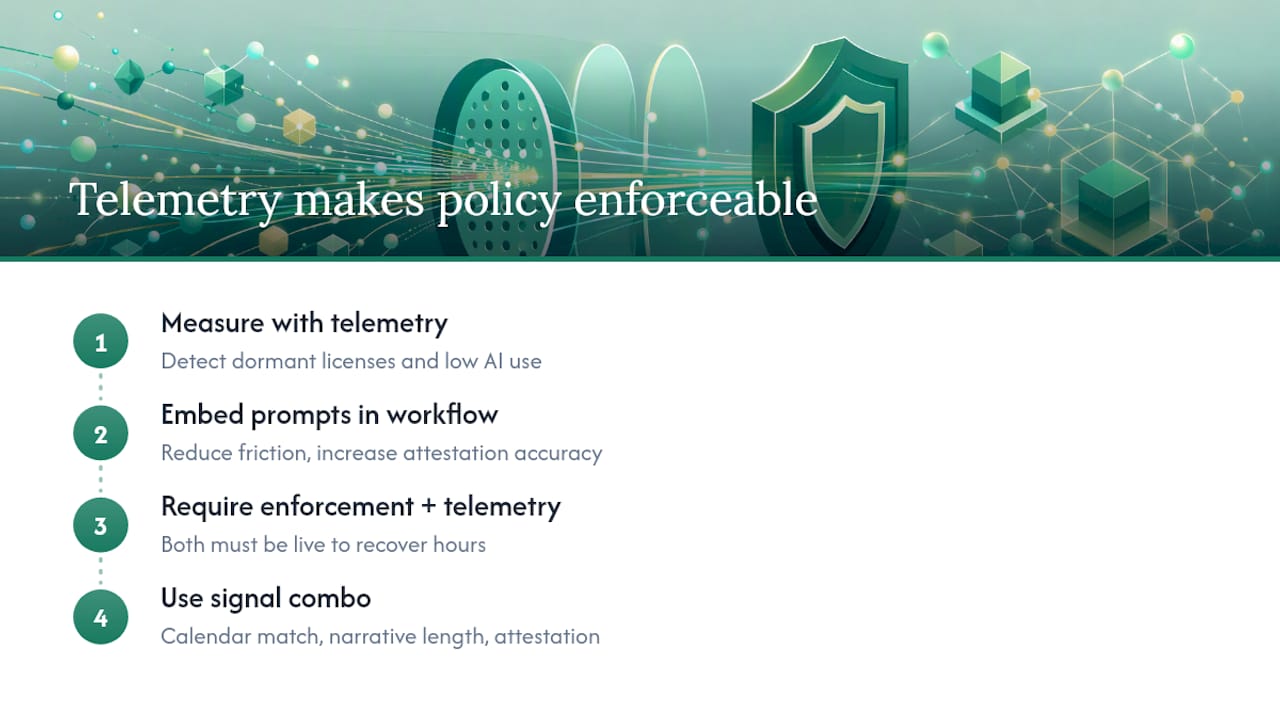
Baseline telemetry on Copilot usage typically surfaces two things firms don’t expect: a large share of licenses sitting dormant, and a smaller-than-assumed share of time entries actually using AI drafting even where it’s available. You can’t fix adoption you haven’t measured.
Copilot prompts embedded directly in the time-entry workflow reduce friction and increase accurate self-attestation, because staff draft narratives in the same tool they’re already using rather than switching context. Automation paired with governance controls recovers billable hours and improves project profitability, but only once enforcement and telemetry are both live, not just one or the other.
Pro Tip: The signal combination that correlates most with accurate entries is calendar match plus narrative length plus submitter attestation together. Any single signal alone produces too many false positives.
Sample Policy Clauses You Can Adapt Today
Four clauses cover most of what a first draft needs.
- Scope clause: “This policy governs AI-assisted time capture, narrative drafting, and anomaly scoring. It does not extend to general Copilot use outside the time-entry workflow.”
- Submitter attestation: “I certify that this AI-drafted entry accurately reflects work performed and duration logged.”
- Human oversight clause: “Entries flagged as high-risk require review by a designated timekeeping supervisor within 48 hours before billing release.”
- Audit-retention clause: “Per-entry records, including model version and override timestamps, are retained for seven years in line with financial reporting requirements.”
Adjust language for local law and client confidentiality terms; a clause that works for a domestic accounting practice may need revision for a firm with EU clients under GDPR.
What Metrics Prove the Policy Is Working?
Six KPIs cover most of what auditors and managing partners will ask about.
| Metric | Purpose |
|---|---|
| Timesheet completion rate | Indicates adoption is happening |
| Flagged-entry rate | Indicates frequency of AI anomaly detection |
| Human-override rate | Measures frequency of reviewer overrides |
| Approval SLA | Measures speed of flagged entry review |
| Recoverable billable hours | Links policy to financial outcomes |
| Model-drift alerts | Detects changes in scoring accuracy over time |
- Export per-entry why-trails and model version logs regularly so they’re ready for an audit request, not assembled under deadline pressure.
- Set drift-monitoring thresholds in the first 12 months rather than waiting for a visible failure.
What Are the Biggest Risks and How Do You Mitigate Them?
| Risk | Mitigation |
|---|---|
| Unreviewed AI-scored entries affecting billing or promotion | Human-in-loop review plus a contestation path |
| Privacy or data-protection violations | Narrow data capture, documented lawful basis, worker notices |
| Audits can’t reproduce scoring | Model-version logging and exportable why-trail |
| Overbilling or ghost entries | Calendar alignment checks and duplicate detection |
Privacy-conscious tracking that keeps activity local until a user submits it gives staff more control and reduces the “surveillance” objection that derails policy adoption.
What Do Firms Consistently Get Wrong About Rollout?
The gap I see most often isn’t technical, it’s expectation versus telemetry reality. Firms assume adoption is high because licenses are deployed, then discover through actual usage data that most staff never opened the tool. Start small, measure honestly, then scale, and tie every enforcement decision back to what telemetry actually shows, not what the rollout plan assumed.
How Gozera Helps Firms Operationalize an AI Time Entry Policy
Writing the policy is the easy part. Enforcing it against real Copilot usage, with evidence you can hand an auditor, is where most firms stall.
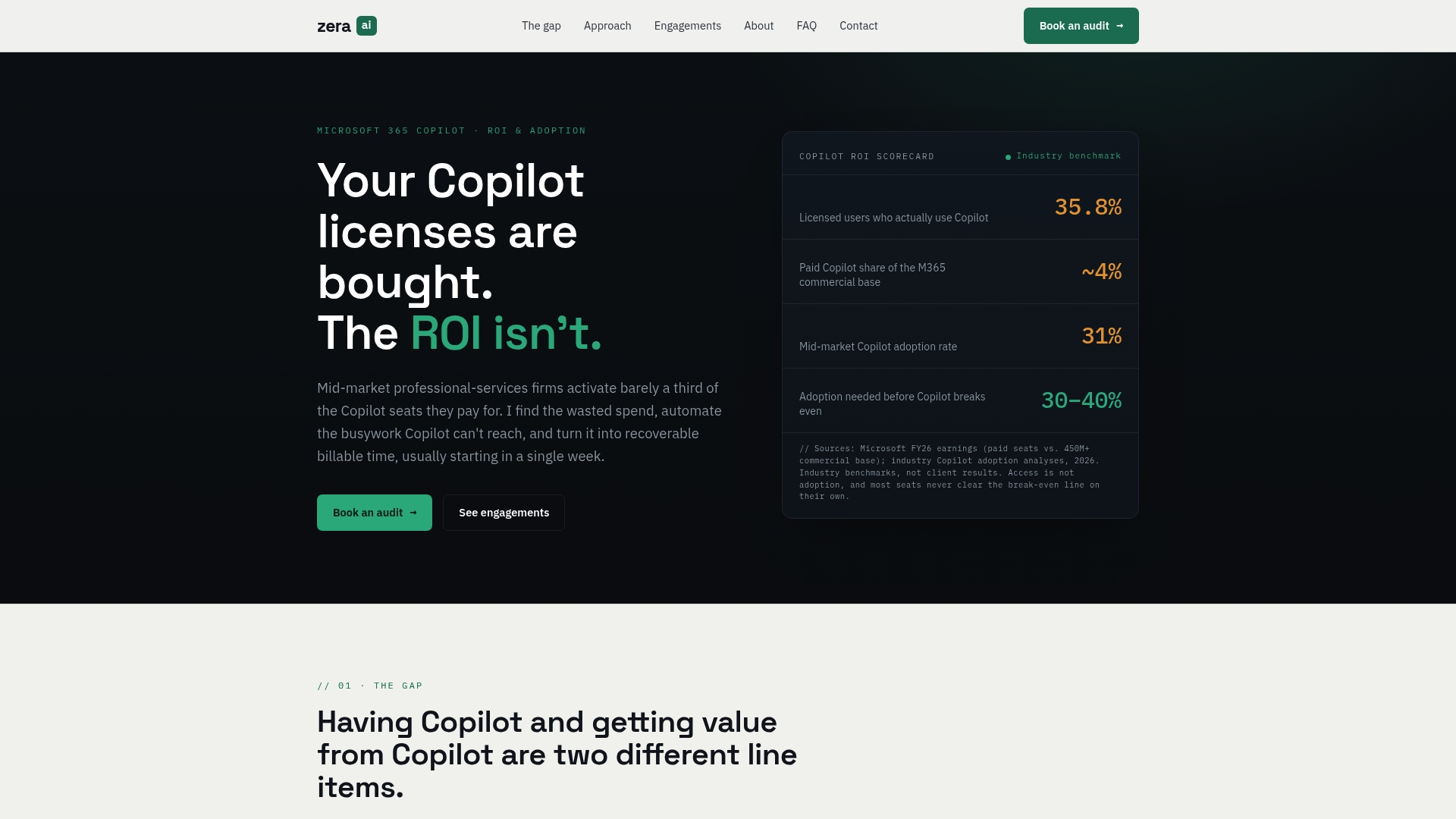
Gozera runs a Copilot telemetry baseline first, measuring which licenses sit dormant and which time-entry workflows actually use AI drafting today. From there, a policy implementation sprint turns the clauses above into working controls, wired into your existing Microsoft 365 environment with automation built in Python and n8n to close the gaps between what Copilot offers and what your billing system needs. Deliverables include a telemetry report, customized policy templates, and an automation playbook your IT team can maintain. Firms get faster ROI without a lengthy change-management program. If your firm is ready for a policy readiness audit or a Copilot adoption sprint, start with Gozera’s Microsoft 365 Copilot consulting to see where your dormant licenses and recoverable billable hours actually are.
Frequently Asked Questions
Does every firm using Copilot for time entry need a written policy?
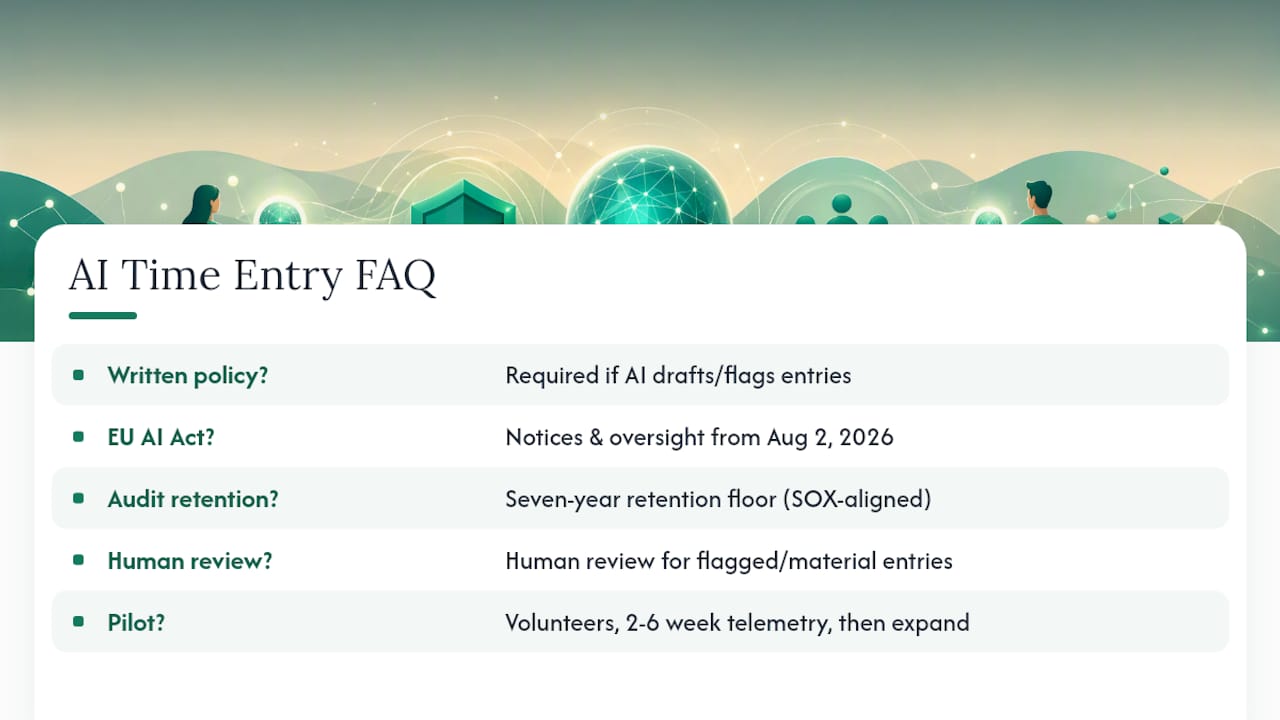
Yes, if AI drafts, scores, or flags time entries in any way, a written policy is necessary to define scope, review requirements, and audit retention.
What triggers EU AI Act obligations for time-tracking AI?
Systems that score, classify, or rank worker productivity fall under Annex III high-risk rules starting August 2, 2026, requiring transparency notices and human oversight.
How long should audit trails for AI time entries be retained?
A seven-year retention floor aligned with SOX is a common baseline for firms whose billing touches financial reporting, though local requirements may extend this.
Can AI fully automate time entry approval without human review?
No. Flagged or material entries need human review to satisfy GDPR Article 22 concerns around automated decisions with significant effect.
What’s the fastest way to pilot an AI time entry policy?
Start with a volunteer team on select matters, run baseline telemetry for two to six weeks, then expand once completion rates and flagged-entry ratios stabilize.
Sources
- EU AI Act Time Tracking Compliance Checklist 2026 | gStride