
Stand up an invite-only Copilot Champions hub, enroll in Microsoft 365 Champions resources, and launch a 90-day nurture plan this week. That is the single move that separates firms with active Copilot adoption from those paying for dormant licenses. Here is the immediate checklist to get moving:
- Identify a small team of founding Champions across your highest-value practice areas
- Send a personalized invite and welcome communication via Teams or email
- Deploy a baseline poll to gauge Copilot familiarity and scenario preferences
- Schedule a kickoff call with executive sponsor introductions within the first 7 days
- Enroll the program lead in the Microsoft 365 Champions program on Day 1
Your IT director or adoption lead owns the first 7 days. Everything else flows from that kickoff.
Key Takeaways
A Copilot Champions program succeeds when it combines invite-only recruitment, a structured 90-day nurture plan, and telemetry-backed ROI measurement tied to license utilization and billable time saved.
| Point | Details |
|---|---|
| Start invite-only | Recruit Champions by influence and function coverage, not enthusiasm; target roughly 1 Champion per 50 employees. |
| Baseline telemetry first | Pull your Microsoft 365 usage report before launch so you can prove the program’s impact against a real pre-program snapshot. |
| Run the hub-and-spoke model | Core team owns assets and governance; Champions tailor delivery to their specific team’s workflows and language. |
| Measure what leadership tracks | Tie KPIs to dormant license counts, active Copilot sessions, and a billing-rate ROI formula segmented by practice area. |
| Gozera closes the gap | Gozera audits dormant licenses, rebuilds Copilot workflows, and delivers a documented ROI model for mid-market professional-services firms. |
Table of Contents
- What is the Copilot Champions program?
- Why a Champions program matters for Copilot adoption and ROI
- Who should you recruit as a Copilot Champion?
- Onboarding checklist for the first 30 days
- Training and enablement path for Champions
- How does the hub-and-spoke operating model work?
- Measurement and telemetry: KPIs and a simple ROI formula
- Sample 90-day nurture plan
- Common pitfalls and how to fix them
- When should you hire an external Copilot adoption consultant?
- How do you get leadership to sponsor a Champions program?
- How does this program fit into your broader Microsoft 365 adoption strategy?
- Keeping Champions engaged after the first 90 days
- Closing the feedback loop from Champions to your adoption team
- Recognition beyond badges: what actually motivates Champions
- What the data actually tells you about Champions programs
- Gozera accelerates your Copilot Champions program with measurable results
- Sources
What is the Copilot Champions program?
A Copilot Champions program is an internal peer-enablement network where selected employees, called Champions, learn Microsoft 365 Copilot deeply and then teach, demo, and advocate for it within their own teams. It is not an IT help desk extension. Champions handle peer coaching, role-specific workflow demos, and feedback routing back to IT and product teams.
The program connects directly to the Microsoft 365 Champions ecosystem, a free global community offering training materials, monthly community calls, and adaptable best practices. Champions complete Microsoft Learn Copilot training modules as their baseline curriculum, then deliver that knowledge through role-specific sessions. Viva Engage serves as the cross-org community platform where Champions share wins, surface blockers, and keep momentum alive between formal sessions.
Why a Champions program matters for Copilot adoption and ROI
Centralized IT communications rarely change behavior at the workflow level. A peer who shows a billing attorney exactly how Copilot drafts a demand letter in 4 minutes moves the needle faster than any all-hands email.
The practical outcomes that justify the investment:
- License utilization rises when Champions identify dormant users and run targeted micro-sessions to get them active
- Time-saved signals become measurable once Champions log demo attendance and Copilot session frequency per role
- Feedback loops close faster because Champions surface real friction points to IT before they become adoption blockers
- Behavior change accelerates through peer-to-peer engagement, which contextualizes Copilot for specific job tasks rather than generic use cases
- Leadership gets credible ROI data from telemetry tied to Champion activity, not just anecdotal reports
Microsoft Digital’s own Copilot Champs framework confirms this shift from centralized comms to role-specific enablement as the core mechanism driving adoption.
Who should you recruit as a Copilot Champion?
Influence matters more than title. A mid-level analyst who peers trust and ask for help is a better Champion than a senior manager who rarely collaborates. The Copilot Champs framework recommends starting invite-only, which keeps quality high and avoids diluting Champion influence with headcount.

A practical starting ratio is approximately one Champion per team for every 50 employees, with at least one representative per major function or workflow.
Useful persona profiles for professional services:
- Practice lead advocate: A senior associate who runs client engagements and can demo Copilot in Word and Teams during real work, not staged scenarios
- Power-user analyst: Someone already deep in Excel who can show Copilot’s forecasting and data-summarization flows to peers
- Operations liaison: The person who manages internal processes and can champion Copilot in Outlook and SharePoint for scheduling and document management
- Change-friendly introvert: Often overlooked, but highly credible in small-group settings; effective in 1:1 coaching and Viva Engage posts rather than large demos
Cross-functional and geographic coverage matters. A Champion in your Chicago office cannot effectively coach a team in Dallas.
Onboarding checklist for the first 30 days
The Copilot Champs Community Framework maps the first month clearly. Execute in this order:
- Week 1: Send personalized welcome communication via Teams or email; include links to the Champions hub, baseline training, and the community channel
- Week 1: Hold a kickoff call with the executive sponsor; cover program goals, time expectations, and the first 90-day plan
- Week 1: Deploy a baseline poll covering Copilot familiarity (scale of 1–5), preferred scenarios by app, and weekly time availability
- Week 2: Complete baseline Microsoft Learn modules; use the AI Fluency: Get Started with Microsoft Copilot module as the starting point
- Week 3: Run the first demo session; keep it under 30 minutes and focused on one scenario the Champion’s peers actually use
- Week 4: Collect initial feedback from peers who attended; log it in the Champions Teams channel for IT review
Pro Tip: Keep the baseline poll to 5 questions or fewer. Long surveys kill response rates, and you only need three data points at this stage: current familiarity, top scenario interest, and available hours per week.
Training and enablement path for Champions
Champions need a clear curriculum, not a library dump. The recommended sequence:
- Baseline modules: Complete the AI Fluency module on Microsoft Learn, then the role-based learning path Draft, Analyze, and Present with Microsoft 365 Copilot, which covers Word, Excel, PowerPoint, Teams, and Outlook across 7 modules
- Role-specific skill labs: Each Champion picks 2–3 app flows most relevant to their practice area; a lawyer focuses on Word drafting and Teams meeting summaries, an accountant on Excel and Outlook
- Train-the-trainer session: A 90-minute facilitated session where Champions practice delivering a 15-minute demo to each other before going live with peers
Badges matter for social proof. When a Champion completes a module, that achievement should appear on their Viva Engage profile. Set a renewal cadence of every 6 months to keep credentials current as Copilot features evolve. The Microsoft 365 Champions program provides ready-made assets and monthly community calls that Champions can attend to stay current without burdening your internal team.
How does the hub-and-spoke operating model work?
The core team (IT, adoption lead, executive sponsor) acts as the hub: it owns the asset library, messaging, and governance. Champions are the spokes: they tailor delivery to their specific team’s workflows and language.
Channel setup:
- Viva Engage community: Cross-org sharing, win posts, and peer Q&A; this is where social proof accumulates
- Teams Champions channel: Operational coordination, asset distribution, and escalation to SMEs
- SharePoint resource library: Version-controlled decks, demo scripts, and onboarding materials
Recommended cadence per the Copilot Champs hub-and-spoke model: active Champions run 1–2 demo sessions per week, the full community holds a monthly call, and leadership receives a quarterly update with telemetry data. Champions should expect to commit a few hours per week. Escalation path: Champion surfaces a blocker in the Teams channel, the adoption lead triages, and a subject-matter expert responds within 48 hours.
Measurement and telemetry: KPIs and a simple ROI formula
Track these core KPIs from Microsoft 365 usage reports and Copilot telemetry:
| KPI | Data Source | Target Signal |
|---|---|---|
| Active Copilot users (weekly) | M365 Admin Center usage reports | Rising trend vs. baseline |
| Copilot sessions per user | Copilot telemetry dashboard | Frequency increase by role |
| Demo session attendance | Champion logs / Teams attendance | Majority of invited peers attend |
| Champion engagements logged | Teams channel records | 4+ per Champion per month |
| Dormant Copilot licenses | License assignment vs. activity report | Decreasing count month over month |
A compact ROI formula: multiply average hours saved per user per week by the billing rate proxy for that role, then by the number of active users. For a 10-person litigation team saving 1.5 hours per attorney per week at a $350/hour billing rate, that is $5,250 per week in recoverable time. Segment by practice area because billing rates vary significantly across law, accounting, and consulting.
Pro Tip: Pull your baseline telemetry report before the Champions program launches, not after. Without a pre-program snapshot, you cannot prove the program moved the needle. See Copilot ROI measurement guidance for a practical template.
Sample 90-day nurture plan
| Week | Activity | Owner | Output |
|---|---|---|---|
| — | Identify Champions, send invites, baseline poll | Core team | Confirmed Champion roster |
| 1 | Kickoff call, welcome comms, hub setup | Core team + Champions | Active Teams channel and SharePoint library |
| 2–3 | Baseline Microsoft Learn modules completed | Champions | Completion records, badge assignments |
| 4 | First demo sessions (1 per Champion) | Champions | Attendance log, peer feedback |
| 5–8 | Weekly demos, Viva Engage posts, feedback collection | Champions | Engagement data, blocker list |
| 9 | Mid-point telemetry review, dormant license audit | Core team | Updated KPI dashboard |
| 11 | Leadership ROI update, recognition event, next-quarter planning | Core team + Sponsor | Quarterly report, renewed Champion commitments |
Common pitfalls and how to fix them
- Poor recruiting: Selecting volunteers instead of vetted influencers produces low-quality demos and peer skepticism. Fix: revert to invite-only and re-screen using influence criteria, not enthusiasm
- No leadership recognition: Champions who feel invisible quit. Fix: executive shout-outs in all-hands meetings and visible badge displays on Viva Engage profiles restore motivation within 30 days
- One-and-done training: A single onboarding session followed by silence is the fastest way to kill a program. Fix: monthly community calls and train-the-trainer refreshers keep Champions current
- No measurable goals: Without KPI targets, Champions have no feedback on whether their work matters. Fix: assign each Champion a specific dormant-license reduction target or demo attendance goal for the quarter
A 30–60 day corrective plan should include a re-recruitment sprint, a recognition event, and a fresh telemetry review to reset the baseline.
When should you hire an external Copilot adoption consultant?
Three signals suggest you need outside help: license utilization has stalled despite 60+ days of internal training, your team lacks bandwidth to run telemetry audits alongside day-to-day IT operations, or leadership is demanding ROI proof you cannot yet produce.
A qualified consultant should deliver: a baseline telemetry audit identifying dormant licenses and usage gaps, rebuilt Copilot workflows mapped to your highest-value practice areas, automation of repetitive gaps using tools like Python and n8n, a documented ROI model tied to billing rate proxies, and an enablement playbook Champions can run independently. For a mid-market firm, expect an audit sprint of 2–4 weeks followed by a 90-day optimization engagement. See Copilot adoption services for a detailed breakdown of engagement models.
How do you get leadership to sponsor a Champions program?
Executives sponsor what they can measure. Lead with the dormant license cost: if 40 of your 100 Copilot licenses are inactive, that is a quantifiable monthly spend producing zero return. Frame the Champions program as the mechanism to recover that spend, not as a training initiative.
Practical tactics: present a one-page telemetry snapshot at the next leadership meeting, name a specific executive as the program sponsor with a defined role (quarterly update attendance and one all-hands mention per quarter), and tie the program’s first 90-day KPIs to a metric the executive already tracks, such as billable utilization or client delivery speed.
How does this program fit into your broader Microsoft 365 adoption strategy?
A Copilot Champions program works best when it runs alongside, not instead of, your broader Microsoft 365 adoption initiatives. Champions should be aware of any active Teams, SharePoint, or Viva rollouts so they can connect Copilot to tools employees already use daily. The Microsoft 365 Copilot implementation guide maps how Copilot governance fits within a broader M365 deployment.
Practically, this means Champions attend the same governance calls as your M365 adoption team, share a common SharePoint library, and report KPIs in the same dashboard. Siloed programs compete for employee attention; integrated ones reinforce each other.
Keeping Champions engaged after the first 90 days
Engagement drops when communication becomes one-directional. Rotate the format: one month is a live demo, the next is a written Viva Engage case study, the next is a peer panel. Variety prevents the program from feeling like a recurring obligation.

A monthly newsletter to Champions, summarizing new Copilot features, top peer wins, and upcoming community calls, takes under an hour to produce and significantly reduces the “what am I supposed to be doing this month?” confusion that kills mid-program momentum. Pair it with a standing 30-minute monthly call and Champions stay oriented without heavy coordination overhead.
Closing the feedback loop from Champions to your adoption team
Champions are your best source of ground-level product intelligence. Build a structured feedback channel: a monthly 5-question form in Microsoft Forms covering what scenarios are working, what is confusing peers, and what features are missing or broken. Route responses directly to your adoption lead and, where relevant, to your Microsoft account team.
This loop does two things. It gives Champions a sense that their observations matter, which is a retention lever. It also gives IT and leadership early warning on adoption blockers before they show up in telemetry as flat usage curves.
Recognition beyond badges: what actually motivates Champions
Badges are a starting point, not a program. The Champions who stay engaged longest are those who receive visible, public recognition from leadership and who see their feedback translated into real changes.
Effective recognition beyond badges: a named mention in the firm’s internal newsletter, a “Champion of the Quarter” spotlight in Viva Engage with a brief write-up of their impact, early access to new Copilot features as beta testers, and a seat at the table in quarterly adoption planning meetings. That last one is underused. Champions who help shape the program’s next quarter feel ownership, not obligation.
What the data actually tells you about Champions programs
Most firms treat the Champions program as a soft initiative and measure it loosely. That is a mistake. The programs that survive past 6 months are the ones with hard KPIs tied to license utilization and time-saved metrics, not just demo attendance counts.
Peer enablement works because colleagues contextualize Copilot for specific job tasks in ways that centralized IT communications cannot. A Champion who shows a tax manager exactly how Copilot summarizes a 40-page IRS notice in 90 seconds is more persuasive than any adoption email. The Microsoft Digital Copilot Champs write-up documents this dynamic directly. The firms that treat Champions as a measurement asset, not just a training resource, are the ones that can walk into a partner meeting with a real ROI number.
Gozera accelerates your Copilot Champions program with measurable results
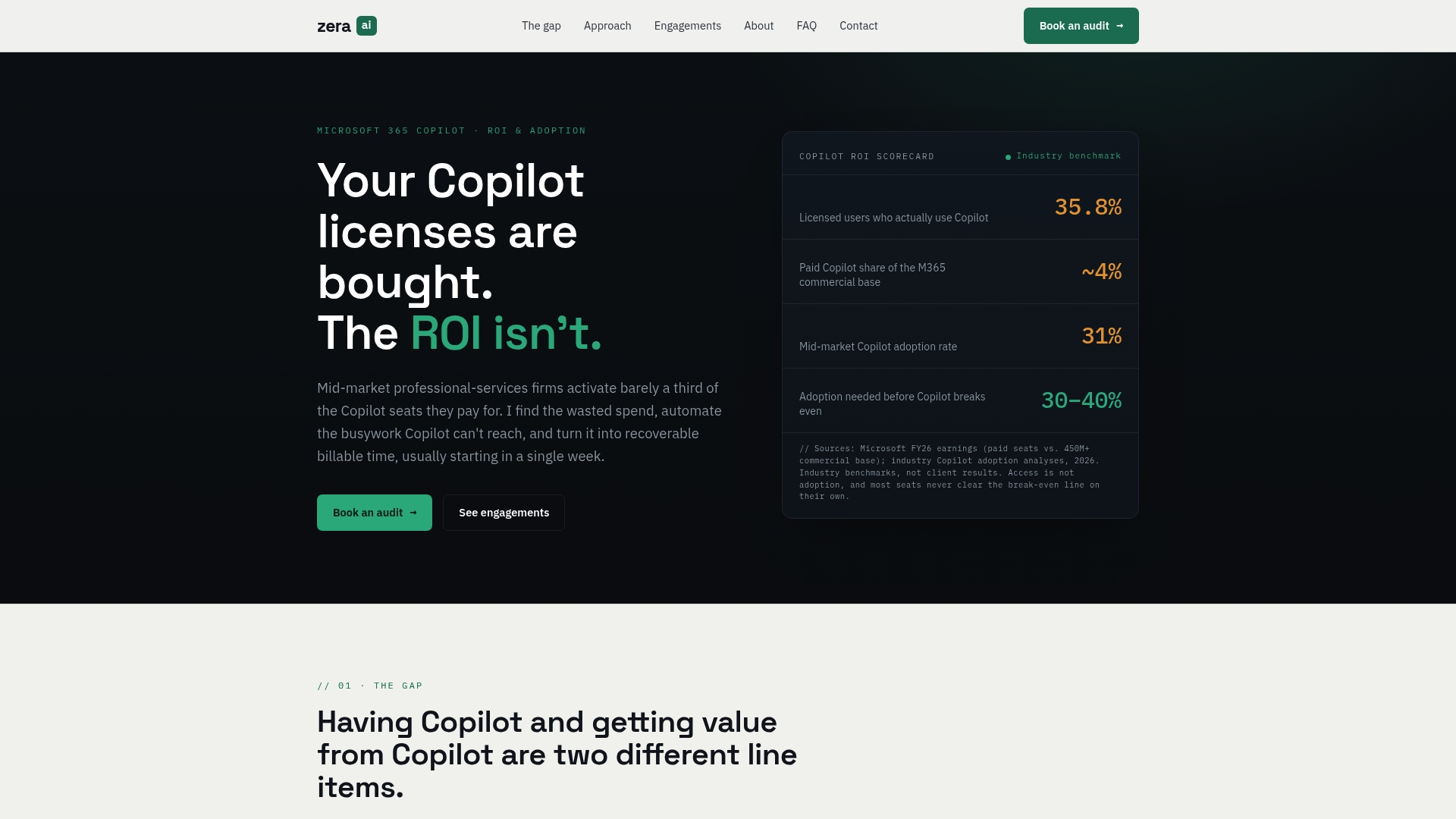
Firms that run the Champions program without a telemetry baseline often cannot prove ROI when leadership asks. Gozera solves that gap directly: we audit your Copilot license utilization, identify dormant seats, rebuild high-value workflows for your specific practice areas, and deliver a documented ROI model your partners can act on. The engagement starts with a 2–4 week audit sprint, followed by a 90-day optimization retainer that runs alongside your Champions program, not instead of it.
Gozera works exclusively with mid-market professional-services firms in the U.S., including law, accounting, consulting, and engineering practices with 50–500 employees. If your Copilot licenses are underperforming, the fastest path to recovery is a baseline audit that shows exactly where the gap is. Book a Copilot adoption audit with Gozera and get a clear picture of your ROI opportunity within the first two weeks.
Sources
- Become a Champion – Microsoft Adoption
- Champion Program Best Practices – Join the Microsoft 365 Champions program | Microsoft Learn
- Driving Microsoft 365 Copilot adoption with our Copilot Champs Community