
Yes, Microsoft 365 Copilot can draft client memos, but only when three things are in place: a firm-approved memo template, section-by-section prompting inside Copilot in Word or Copilot Chat, and a mandatory human verification step before anything reaches a client. Skip any one of those, and you are trading a drafting bottleneck for a malpractice exposure problem.
Here is what to do this week, before you read another word of theory:
- Run a small, controlled pilot. Pick a few matters and a small group of lawyers or paralegals. Do not roll Copilot out firm-wide on day one.
- Lock the output format to your memo template. Copilot should populate your firm’s existing structure, not invent its own.
- Require human sign-off and citation checks on every draft. Every unverified legal claim gets flagged and confirmed against a primary source before it leaves the building, consistent with the Canadian Bar Association’s guidance on AI use.
That is the whole strategy in miniature. The rest of this guide is the detail: how Copilot actually fits into a memo, the exact prompts to run, the compliance checklist, and how firms like the ones Gozera works with turn pilot results into a defensible adoption plan.
Key Takeaways
Copilot becomes safe and productive for client memos only when firms pair it with a locked template, section-by-section prompting, and a mandatory human verification step before delivery.
| Point | Details |
|---|---|
| Pilot small before scaling | Test with a small number of matters and users over a several-week period before firm-wide rollout. |
| Skeleton first, prompt second | Build memo headings in your template before running any Copilot prompt, section by section. |
| Verify every flagged claim | Check all [VERIFY]-tagged citations and conclusions against primary sources before attorney sign-off. |
| Track adoption with telemetry | Monitor Copilot runs per matter, reviewer sign-offs, and recoverable billable hours to prove ROI. |
| Bring in Gozera for the audit | Zera.ai’s Copilot adoption audits identify dormant licenses and rebuild memo workflows for measurable, recoverable billable time. |
Table of Contents
- What Is Copilot for Client Memos and When Should You Use It?
- How Does a Client Memo Map to Copilot’s Strengths?
- What Is the Step-by-Step Copilot Workflow for Drafting a Memo?
- What Prompts Work Best for Drafting Memo Sections?
- What Verification and Compliance Steps Protect Client Confidentiality?
- How Do You Roll Out Copilot and Measure Adoption ROI?
- What Are the Most Common Copilot Mistakes in Memo Drafting?
- Why Governance, Not the Tool Itself, Determines Whether Copilot Pays Off
- How Gozera Helps Firms Turn Copilot Into Recoverable Billable Time
- Frequently Asked Questions
- Sources
What Is Copilot for Client Memos and When Should You Use It?
Microsoft 365 Copilot is an AI assistant built into the Microsoft 365 apps your firm already runs, and it draws on the files stored in SharePoint, OneDrive, and Outlook to generate context-aware drafts. Microsoft describes it as file-aware, meaning it can read a matter folder and reference the actual documents inside it rather than working from a blank prompt. For memo work, three surfaces matter most: Copilot in Word for drafting and revising the document itself, Copilot Chat for quick research framing and summarization tasks outside a single file, and Copilot Studio for building custom agents when a firm wants a repeatable, governed workflow rather than ad hoc prompting.
Not every memo task belongs in Copilot’s lane. The product is genuinely good at three things: structuring a document around your firm’s template, drafting a plain-language executive summary from dense source material, and pulling facts and dates out of a matter file to build a timeline. Microsoft’s own Copilot Scenario Library for legal teams documents these exact use cases, and they map closely to the repetitive, format-heavy parts of memo drafting that eat associate hours without requiring judgment.
What Copilot should never own: the actual legal conclusion, the choice of which authority controls a fact pattern, and any prediction about how a court or regulator will rule. Those calls sit with a licensed lawyer, full stop. Treat Copilot as an extremely capable paralegal who has read everything in the file folder but has never sat for the bar exam. It can hand you a clean first draft of the background section in minutes. It cannot tell your client whether they will win.
How Does a Client Memo Map to Copilot’s Strengths?
A client memo has a fairly rigid architecture, and that rigidity is exactly what makes it a good candidate for AI-assisted drafting. Most firms use some version of this structure: a heading block identifying the matter and parties, a short executive summary, background and facts, issue framing, legal analysis following a rule-application-conclusion pattern, options, recommendations, and a list of open items or next steps. Effective memos favor plain language over legalese, and they give a clear bottom line for a non-lawyer reader, since the client reading the memo is often a business owner, not another attorney.

Copilot’s usefulness varies sharply by section. The executive summary is where it earns its keep fastest: feed it the completed analysis and ask for a plain-language bottom line, and you often get a workable draft in one pass. The background section is similarly strong, since Copilot can assemble a chronological timeline from emails, contracts, and notes already sitting in the matter’s SharePoint folder. The analysis section is where things slow down deliberately. Copilot can produce an initial rule statement and a first pass at applying it to the facts, but every citation and every conclusion in that section needs a human check before it counts as final.
| Memo Section | Copilot’s Role | Reviewer’s Responsibility |
|---|---|---|
| Executive summary | Draft plain-language bottom line from finished analysis | Confirm tone, accuracy, and client-appropriate framing |
| Background and facts | Assemble timeline and fact pattern from matter files | Spot-check dates and confirm no facts were misread |
| Legal analysis | Draft initial rule and application language | Verify every citation and legal conclusion independently |
| Recommendations | Draft options based on analysis provided | Own the final recommendation and risk judgment |
Two practical notes worth flagging before you build a prompt library:
- Copilot performs assembly and drafting; it does not perform legal judgment, and treating its analysis draft as final is the single most common way firms get burned.
- The tighter your firm’s template, the less time Copilot output needs in reformatting, because it will match structure it can already see in your files.
What Is the Step-by-Step Copilot Workflow for Drafting a Memo?
Before anyone drafts a word, IT needs to confirm three things: every intended user has an assigned Copilot license, the relevant matter files are actually accessible to Copilot through SharePoint or OneDrive permissions, and conditional access plus data loss prevention settings are configured to match your confidentiality obligations. Microsoft’s admin documentation covers the configuration side of this in detail, and it is worth having IT walk through it before the first pilot user opens Word.
Once access is confirmed, the drafting flow itself runs in a consistent sequence:
- Create a dedicated matter folder in SharePoint and drop in every source document the memo will reference.
- Skeleton the memo headings first in Word, using your firm’s template, before writing a single word of content.
- Run Copilot section by section, not as one sprawling prompt covering the whole document.
- Map each cited fact or authority back to its source file as you go, rather than leaving citation checking for the end.
- Export the finished draft into the firm’s standard memo template and confirm formatting matches house style.
Permissions and audit trail matter just as much as the drafting mechanics. Build a short checklist your pilot team actually follows:
- Confirm only lawyers and staff assigned to the matter have access to the SharePoint folder Copilot will read from.
- Label any privileged draft clearly as Attorney-Client Privileged / Work Product before it leaves Word.
- Turn on audit logging so you can see who ran Copilot, on which files, and when, which matters if a draft’s provenance is ever questioned later.
Pro Tip: Skeleton the headings in your firm’s template before opening Copilot Chat. A blank prompt against a blank document produces generic structure; a blank prompt against a pre-built skeleton produces something that already looks like your memo.
What Prompts Work Best for Drafting Memo Sections?
Section-by-section prompting beats one giant request almost every time, because a narrow prompt with a clear output format gives Copilot less room to guess. Here are working templates for the sections that benefit most:
Executive summary prompt: “Using the analysis in [SharePoint file path], write a three-sentence plain-language executive summary for a business client with no legal background. State the bottom-line risk and recommended next step first.”
Background and timeline prompt: “Review [contract file] and [email thread file] and build a chronological timeline of events relevant to [issue]. Flag any date you cannot confirm from the source documents with [VERIFY].”
Analysis prompt: “Draft an initial rule-application-conclusion paragraph on [specific issue] based only on [attached authority and facts]. Mark any legal conclusion or citation you are not fully certain of with [VERIFY], and list those flags separately at the end.”
Citation mapping prompt: “List every legal authority and factual claim in this draft, and map each one to its source document or note that it could not be traced to a source file.”
Run the analysis prompt on a routine contract-interpretation issue, and a typical output looks like this: a clean rule statement, a paragraph applying it to the facts, and a line reading “[VERIFY: confirm this interpretation against the controlling clause in Section 4.2 of the agreement].” That flag is the entire point. It tells the reviewing attorney exactly where to spend their five minutes of scrutiny instead of rereading four pages cold.
A few prompt habits separate teams that get clean output from teams that get mush. Keep each prompt narrow and tied to one section. Attach or reference the exact source document rather than trusting Copilot’s general knowledge of the law. And always ask for a verification flags list as a separate output, so reviewers have a punch list instead of having to hunt through prose for uncertainty.
What Verification and Compliance Steps Protect Client Confidentiality?
Every AI-assisted memo needs a verification pass before it becomes a client deliverable, and the Canadian Bar Association’s guidance on AI use is explicit that firms should run multi-stage checks: inline flagging of unverified claims, targeted citation confirmation against primary sources, and a final human sign-off before delivery. That sign-off is not a formality. It is the line between a productivity tool and a liability.
Build your checklist around these stages:
- Confirm every [VERIFY]-flagged item has been checked against a primary source, not another summary.
- Have a second reviewer spot-check citations Copilot did not flag, since flagging is not infallible.
- Require the drafting attorney to sign off in writing (even a simple approval email or matter-management note) before the memo goes to the client.
- Label every AI-assisted draft as Attorney-Client Privileged / Work Product from the first save, not just the final version.
- Include client-facing disclaimer language for any section discussing predicted outcomes, using measured phrasing like “based on currently available facts” rather than definitive predictions.
Pro Tip: Enforce a strict “verify-first” rule on any AI-suggested controlling authority, and require a one-paragraph written justification whenever the memo includes an outcome prediction. If a reviewer cannot write that paragraph in under two minutes, the prediction is not ready to go out.
This guide offers general information about using Copilot in a legal workflow. It is not legal or professional-responsibility advice, and firms should confirm current ethics obligations with their governing bar association or outside counsel before finalizing any AI use policy.
How Do You Roll Out Copilot and Measure Adoption ROI?
Pick five to ten low-stakes matters, recruit three to five power users across different roles (not just associates), and run a pilot lasting several weeks with short daily check-ins on what worked and what stalled. That window is long enough to surface real friction points but short enough that the firm is not carrying a stalled initiative into the next fiscal quarter.

Telemetry decides whether the pilot becomes a firm-wide rollout or gets quietly shelved. Track these metrics from day one:
| Metric | Why It Matters |
|---|---|
| Copilot runs per user per week | Shows whether adoption is real or a handful of people carrying the average |
| Memo sections drafted with Copilot | Reveals which sections are actually getting automated versus ignored |
| Time saved per draft (self-reported plus timekeeping) | The raw input for calculating recoverable billable hours |
| Verification flags per memo | Tracks how much reviewer time verification is genuinely consuming |
| Dormant licenses (zero or near-zero usage) | Identifies wasted license spend before renewal decisions |
| Reviewer sign-offs completed | Confirms the compliance workflow is actually being followed, not skipped |
Three of those numbers matter more than the rest for proving ROI: Copilot runs per matter, reviewer sign-offs completed, and recoverable billable hours calculated from self-reported time savings. If runs per matter are climbing but sign-offs are not keeping pace, you have an adoption number that looks good and a compliance gap that does not.
Rolling this out firm-wide takes a deliberate sequence, not a single training day:
- Segment training by role: paralegals need document-assembly prompts, associates need analysis-drafting workflows, and partners mostly need a fifteen-minute overview of what to expect in review.
- Set governance checkpoints at 30, 60, and 90 days to review telemetry and adjust templates based on what the data shows.
- Identify low-adoption users early and address the cause directly, whether that is a confusing template, insufficient training, or a role where Copilot genuinely adds less value.
- Recalculate dormant license counts before each renewal cycle so unused seats get reassigned or cut rather than quietly renewed.
A firm’s Copilot workflow playbook for professional services can shortcut a lot of this trial and error if you want a template to start from, rather than building the pilot structure from scratch.
What Are the Most Common Copilot Mistakes in Memo Drafting?
The single most common failure is the mega-prompt: asking Copilot to “write a memo on this issue” in one shot instead of skeletoning the structure first and drafting section by section. Mega-prompts produce generic structure, bury citation problems inside dense prose, and make verification far harder because reviewers cannot easily tell what came from the source files versus what Copilot inferred. The fix is mechanical: build the headings in your template first, then run one focused prompt per section with the exact source documents attached.
A close second is skipping the firm template entirely and letting Copilot generate its own document structure. That looks fast at first, but it shifts the formatting burden onto whoever reviews the draft, and it produces visibly inconsistent memos across the firm. Enforce export into the standard template as a non-negotiable last step of every drafting session.
The third recurring problem is treating Copilot’s first draft as close to final rather than as a genuine first draft requiring full review. This is where hallucinated or misapplied authority slips through, particularly in the analysis section. The mitigation is the [VERIFY] tag discipline covered earlier: any legal authority Copilot did not extract directly from a file you provided gets flagged automatically, and flagged items get checked against a primary source before anyone signs off. No exceptions, even under deadline pressure, since that is exactly when shortcuts turn into malpractice exposure.
Why Governance, Not the Tool Itself, Determines Whether Copilot Pays Off
Most of the skepticism about AI drafting in legal practice is really skepticism about ungoverned AI drafting, and those are different problems. A firm that hands out Copilot licenses with no template, no prompt discipline, and no verification checkpoint will get inconsistent, occasionally wrong output. A firm that treats Copilot strictly as a format and assembly layer, with legal judgment staying firmly in human hands, tends to see real time savings within a few weeks.
The overlooked piece is that templates do more governance work than most firms give them credit for. A tight template constrains what Copilot can produce, which means less time spent reformatting and, just as important, fewer places for an unverified claim to hide inside a wall of unstructured prose. Telemetry is the other half of the equation nobody wants to build because it takes discipline to track. But without it, you cannot tell the difference between a pilot that is genuinely saving billable hours and one that just feels productive because a few enthusiastic users are running it constantly.
The firms getting real ROI from Copilot are not the ones with the cleverest prompts. They are the ones who built the guardrails first and let the productivity gains show up as a side effect of good process.
How Gozera Helps Firms Turn Copilot Into Recoverable Billable Time
Most firms already own the Copilot licenses this guide describes. What they lack is the audit that shows which ones sit idle, the workflow rebuild that ties Copilot into how memos actually get drafted, and the telemetry that proves the investment worked. That is the gap Gozera closes.
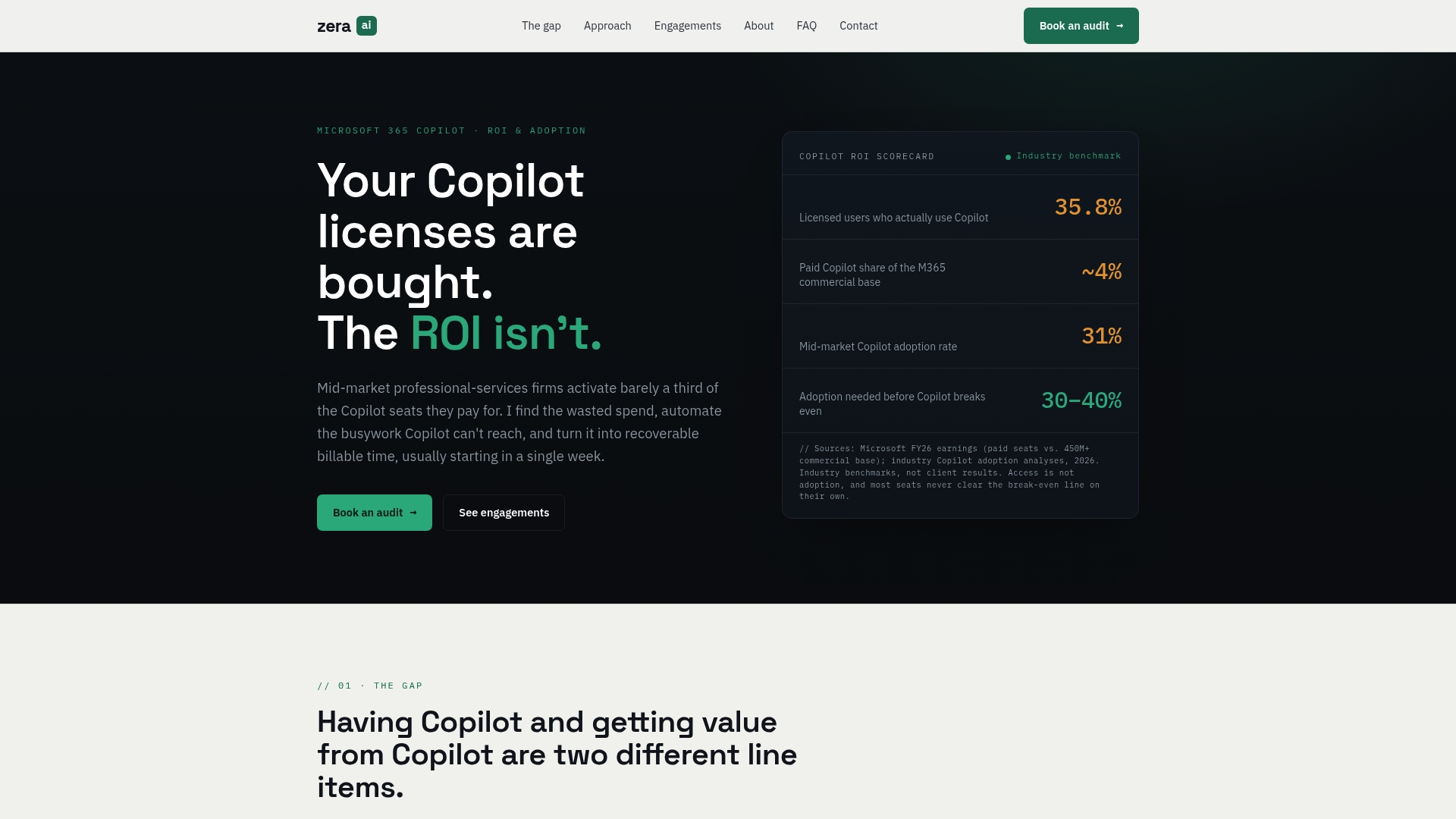
Zera.ai’s consulting engagements start with a Copilot adoption audit that measures actual usage against licensed seats, flags dormant licenses before your next renewal, and identifies where memo drafting and other high-volume document work can be rebuilt around Copilot instead of bolted on as an afterthought. From there, Gozera integrates the workflow directly into your SharePoint and Word environment, fills automation gaps with tools like Python and n8n where Copilot alone falls short, and delivers ROI reporting tied to recoverable billable hours, not vague productivity claims. Mid-market law, accounting, and consulting firms in the 50 to 500 employee range tend to see the clearest results, since that is exactly the size where Copilot licenses get purchased broadly but adoption tracking rarely gets built. If your firm wants a scoped audit or a pilot design rather than another generic rollout, Gozera.
Frequently Asked Questions
Can Copilot draft an entire client memo on its own?
Copilot can produce a full first draft, but it should never be treated as final without a verification pass. Use it to handle structure, background assembly, and initial analysis language, then require a lawyer to check every citation and conclusion before the memo goes to a client.
Is it safe to upload confidential client files for Copilot to read?
It can be, provided your firm has confirmed the right SharePoint and OneDrive permissions, conditional access settings, and data loss prevention policies are in place first. Have IT verify these settings before any pilot user opens a matter file in Copilot, and label AI-assisted drafts as privileged from the first save.
What is the biggest mistake firms make when adopting Copilot for memos?
Running one large “write the whole memo” prompt instead of skeletoning the template first and drafting section by section. Mega-prompts bury citation errors inside dense prose and make verification far harder for the reviewing attorney.
How long should a Copilot pilot run before firm-wide rollout?
Six to eight weeks with three to five users on a handful of low-stakes matters gives most firms enough telemetry to decide whether to scale, adjust, or pause. Shorter pilots rarely generate enough usage data to be conclusive.
What telemetry actually proves Copilot adoption is working?
Copilot runs per matter, completed reviewer sign-offs, and self-reported time savings converted into recoverable billable hours are the three metrics most directly tied to ROI. Dormant license counts matter too, since they show wasted spend before your next renewal.
Sources
For readers who want to go straight to primary documentation rather than a summary, these sources cover the product capabilities, legal use cases, and ethics guidance referenced throughout this guide:
- Microsoft 365 Copilot | AI Productivity Tools for Work
- Using Copilot in Legal (Copilot Scenario Library)
- Microsoft Copilot documentation