
Most mid-market firms are not ready for Microsoft 365 Copilot, and the gap almost always comes down to permissions and licensing, not the AI itself. A proper copilot readiness assessment ends with three things: a prioritized fix list, a pilot plan, and measurable ROI targets. The immediate next step is simple. Run the Microsoft Copilot Readiness report in the admin center or an automated tenant scan today, before you assign another license.
TL;DR:
- Most firms are held back by permissions and licensing issues, not the AI capabilities, making readiness assessments crucial before deployment.
- Ensuring all users have the correct licenses, accounts are in Exchange Online, and network endpoints are unblocked is essential for a smooth Copilot experience.
- Permissions and content hygiene heavily influence Copilot’s answer quality, as it only surfaces content users can already access through existing permissions.
- Automated scans using APIs from Graph, Defender XDR, and Purview provide faster, more objective readiness evaluations than manual checklists.
- Effective pilots require deliberate task-based measurements, involving both enthusiastic and skeptical users, to generate meaningful usage data and ROI.
Table of Contents
- What Are the Minimum Technical Prerequisites for Copilot?
- How Does the Semantic Index Affect Copilot’s Answers?
- Building a Reproducible Readiness Scoring Model
- Should You Automate the Assessment or Run It Manually?
- How Do You Design a Pilot That Produces Real Signal?
- What Should You Fix First, and How Long Does It Take?
- A Data-Driven Way to Turn an Assessment Into ROI
- The Overlooked Truth About Readiness Scores
- Ready to Turn Your Readiness Score Into Measurable ROI?
- Sources
What Are the Minimum Technical Prerequisites for Copilot?
Copilot has non-negotiable technical gates, and missing any one of them produces a degraded or broken experience rather than a clean failure. That’s worse than an outright block, because users blame the AI when the real problem is infrastructure.
Microsoft’s own documentation lays out the baseline clearly. Every user needs a qualifying Microsoft 365 base plan and a Copilot add-on license, plus a handful of identity and mailbox conditions that get overlooked constantly during rollout planning.
- A qualifying Microsoft 365 or Office 365 base plan (E3/E5, Business Standard/Premium, or equivalent) with the Copilot add-on assigned.
- A primary mailbox hosted in Exchange Online. Hybrid or on-premises mailboxes silently degrade grounding.
- An active Microsoft Entra ID account tied to the tenant.
- A supported client on a current update channel, meeting minimum desktop OS, browser, and mobile OS versions.
- Unblocked network endpoints for Copilot and Microsoft Graph traffic.
Firms mid-migration to Exchange Online are the most common failure case. Users technically hold a license, but their mailbox sits on-premises, so Copilot can’t ground responses in their email or calendar history. The result looks like a bad product. It’s actually a sequencing problem, and it’s why pilot users should be pulled from tenants already fully migrated, not from whichever department volunteers first.
How Does the Semantic Index Affect Copilot’s Answers?
Copilot’s answer quality depends almost entirely on what it can see, not on the model behind it. Microsoft builds a tenant-level semantic index for Copilot from SharePoint Online content, and that index, combined with Microsoft Graph, is what grounds a response in your actual documents, emails, and chats instead of generic training data.
The permission model is the part IT teams underestimate. Copilot only surfaces content a user can already access through their existing SharePoint and OneDrive permissions. It doesn’t grant new access. That sounds safe, but it means years of oversharing (link-shared folders, “everyone” groups, stale project sites) turn into instantly discoverable answers the moment Copilot goes live.
Pro Tip: If a partner at your firm has never audited who can open a client folder, assume Copilot will find and surface it. Grounding exposes bad permission hygiene faster than any manual audit ever did.
Well-tagged libraries and consistent metadata improve scoped query results measurably, since the index can match intent to content more precisely. Admins have real levers to pull here: sensitivity labels, Restricted Content Discovery to exclude specific sites, Purview DLP policies, and IRM protections, though IRM-protected files carry their own indexing caveats worth testing before rollout. Microsoft confirms that semantic indexing does not train foundation models on your content and stays inside your tenant boundary, which matters when legal asks the obvious question.

Building a Reproducible Readiness Scoring Model
A copilot readiness checklist only earns its keep if it produces a number someone can act on, not just a pile of observations. The most useful models score across seven pillars and map the total to a rollout decision.
- Licensing — Percentage of intended pilot users with a qualifying base plan and Copilot add-on assigned.
- Identity & access — Entra ID hygiene, conditional access coverage, and multifactor enforcement.
- Permissions & content — Rate of overshared sites, orphaned permissions, and external sharing links.
- Purview & DLP — Sensitivity label coverage and active DLP policies on regulated content types.
- Security posture — Defender findings tied to identity and endpoint risk.
- Power Platform governance — Environment strategy and data loss prevention policies for connected apps.
- Adoption & telemetry — Baseline usage data and a plan to capture it during pilot.
Readiness scorecards commonly weight these pillars and translate the total into four tiers: Not Ready, Pilot Only, Controlled Rollout, and Strong Readiness. A firm scoring low on permissions but strong everywhere else typically lands in Pilot Only. A firm with clean identity and content controls but no telemetry plan still can’t justify Controlled Rollout, because nobody will be able to prove the ROI afterward.
Each pillar needs a pass or fail check with evidence you can export to CSV or Excel, not a gut feeling from the IT director. Reassess quarterly, and report the delta to managing partners in the same format each time, so a shrinking overshare count or rising license utilization rate becomes a visible trend rather than a one-off snapshot.
Should You Automate the Assessment or Run It Manually?
Automated, API-driven scans beat manual checklists on every dimension that matters to a governance committee: speed, objectivity, and reproducibility. Microsoft’s own automated readiness assessment tool pulls from Graph, Defender XDR, and Purview to analyze licensing, identity, permissions, and Power Platform governance in one pass, then exports a timestamped report.
- Microsoft Graph for license assignment and identity data.
- Defender XDR for security posture and risk signals.
- Purview DLP for sensitivity labels and policy coverage.
- Copilot admin APIs for readiness and usage metrics.
A practical setup runs a PowerShell or Python orchestrator that calls each API in sequence, normalizes the output, and writes a dated CSV or Excel file. Pro Tip: Keep every scan output. A timestamped trail is what lets you prove remediation actually worked, instead of just asserting it in a slide.
Manual review still matters for anything contextual: judging whether a shared client folder should stay open, or whether a department’s workflow justifies an exception. Automation finds the problems; humans still decide the policy.
How Do You Design a Pilot That Produces Real Signal?
A pilot that just hands out licenses and waits produces almost no usable data. Effective pilots need structure from day one, borrowing from Microsoft’s own adoption planning checklist, which recommends an executive sponsor, a mix of enthusiasts and skeptics, and task-based measurement rather than open-ended exploration.
- Pick departments deliberately. Include at least one group likely to resist, not just your most enthusiastic team. Skeptics surface friction that champions miss.
- Assign 2 to 3 measurable tasks per group. Meeting summaries, first-draft client deliverables, or email triage work well because they’re easy to time before and after.
- Track a defined KPI set: active users, weekly retention, time saved per task, and license-to-active-user conversion.
- Pull telemetry from Teams, Outlook, and Word, not self-reported surveys.
- Review the Readiness and Usage tabs weekly. The Copilot readiness report covers a rolling 28-day window and flags a quarter of nonlicensed users as suggested candidates, though the dashboard can lag up to 72 hours.
Export the CSV each week and compare cohorts, not just aggregate numbers. A department stuck at low retention after week three is telling you something training alone won’t fix.
What Should You Fix First, and How Long Does It Take?
Remediation has a natural order, and skipping ahead wastes effort. Fix the fast, mechanical items first; save the slow, political ones for later.
- Priority 1, days not weeks: Correct license assignments and confirm every pilot user’s mailbox sits in Exchange Online. This is a data cleanup task, not a project.
- Priority 2, one to three weeks: Find, contain, remediate. Run a Purview data risk assessment to locate overshared sites, apply Restricted Content Discovery to keep them out of Copilot immediately, then fix ownership and inheritance underneath.
- Priority 3, four to eight weeks: Sensitivity labels and DLP policy rollout. This needs business input from legal and practice leads, so build in review time rather than treating it as an IT-only task.
Pro Tip: Contain before you rewrite. Applying site-level exclusions while you sort out permissions is faster and safer than attempting a wholesale permission overhaul before you actually know where the damage is.
Re-run the automated scan after each priority tier closes. Improved grounding quality and rising pilot adoption are your two honest signals that remediation worked.
A Data-Driven Way to Turn an Assessment Into ROI
An assessment only earns its cost if it changes what happens next. Gozera’s approach starts with baseline telemetry, identifies dormant licenses draining budget, rebuilds the two or three workflows that actually matter to billable work, and closes remaining gaps with targeted automation using Python and n8n.
- Baseline usage measurement before touching a single workflow.
- Dormant license identification tied to real cost recovery.
- Workflow rebuilds around high-value, repeatable tasks.
- ROI reporting that maps directly back to the readiness score.
DIY works when governance gaps are minor and someone internal has bandwidth. A consultancy earns its fee when governance is genuinely messy or leadership needs measurable ROI on a fixed timeline.
The Overlooked Truth About Readiness Scores
The conventional advice treats a copilot readiness assessment like a compliance gate: pass it, deploy, move on. That framing misses the point entirely. A high score on licensing and identity hygiene tells you almost nothing about whether Copilot will generate recoverable billable hours at a law firm or an engineering practice. Those are two separate questions, and most vendors collapse them into one report because a single number is easier to sell.

What the research actually supports is a two-stage view. Technical readiness (licensing, Entra ID, mailbox placement, permissions) is a gate you either clear or you don’t. Adoption readiness (whether a mixed pilot group of skeptics and enthusiasts produces measurable time savings on real tasks) is a separate, ongoing measurement problem that never fully closes. Firms that treat the second stage as an afterthought end up with a clean readiness score and a stack of idle licenses six months later.
Prioritize the boring stuff first: mailbox migration, permission cleanup, sensitivity labels. Then measure adoption like you’d measure any other operational change, with real telemetry, not survey sentiment. The score gets you in the door. It doesn’t buy you the ROI.
— Mad
Ready to Turn Your Readiness Score Into Measurable ROI?
Gozera is the alternative to guessing whether your Copilot investment is working: instead of a generic checklist, you get a data-driven scan that traces licenses, permissions, and usage to actual billable-hour recovery for professional-services firms.
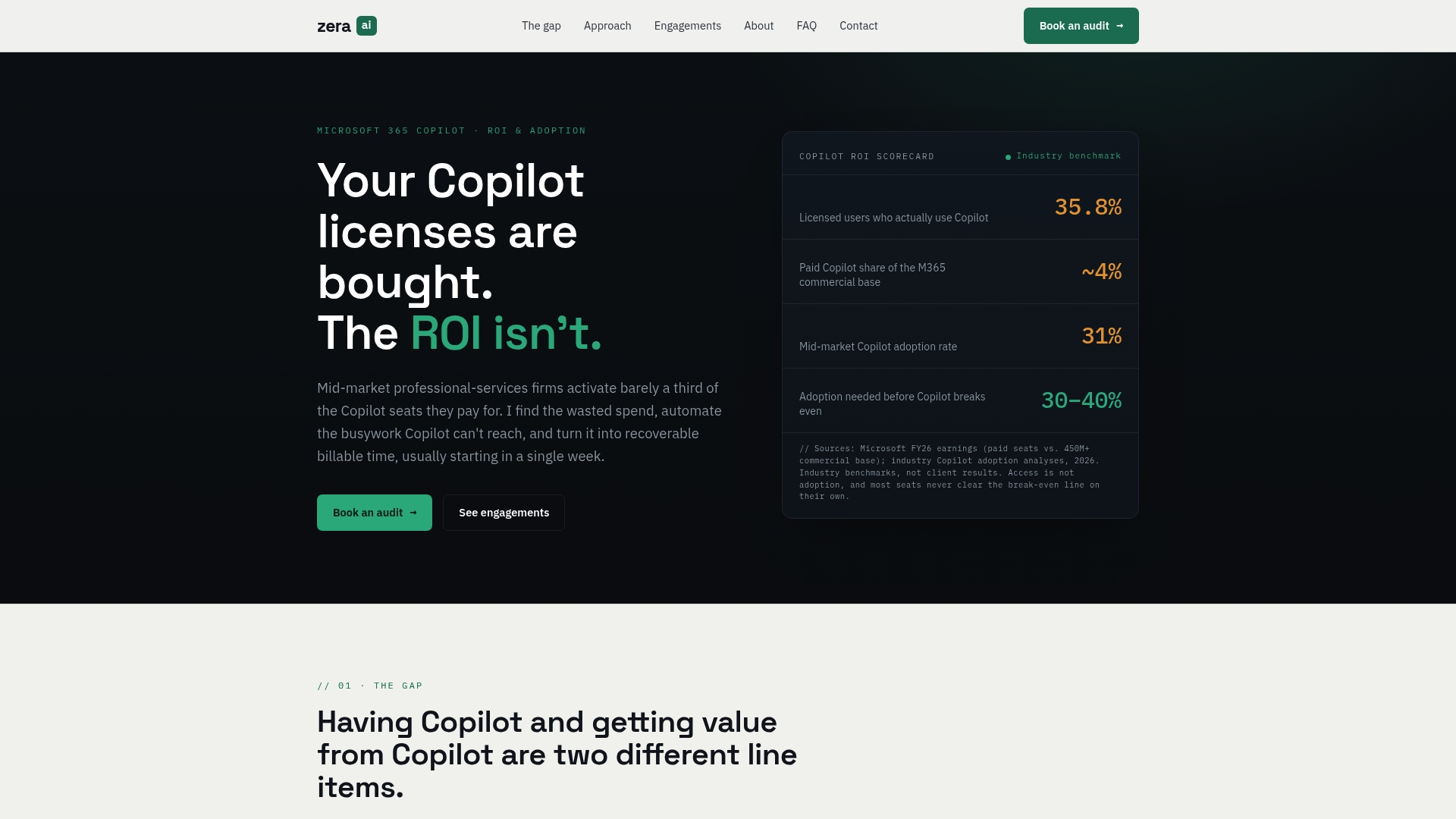
The engagement covers a full tenant scan, a prioritized remediation plan mapped to the pillars above, a pilot design built around your practice groups, and ROI reporting that tracks time saved against license cost. Gozera also builds on findings from a detailed Copilot license audit and telemetry instrumentation work already published for IT managers running similar rollouts. Firms comparing tooling ecosystems for their broader AI stack can also look at partners like Prowl for market-intelligence tooling that complements a Copilot deployment.
Request a scoping call at Gozera to get a sample deliverable and a straight answer on where your firm actually stands before you renew another batch of Copilot licenses.