
Cutting wasted Copilot spend comes down to three moves: measure who actually uses their license, reclaim the seats sitting dormant, and reassign the freed-up budget to roles where drafting, summarizing, and analysis happen daily. Firms that skip the measurement step almost always overspend, because unused $30 seats are invisible until someone pulls the usage report.
TL;DR:
- Focus pilot programs on high-value workflows like drafting, summarizing, and Excel analysis before scaling to gain quick ROI and build credibility.
- Run a permissions audit to fix outdated sharing links, restrict sensitive file access, and ensure proper classification before expanding Copilot deployment.
- Measure license efficiency using active user rates and prompts submitted, with automated APIs enabling weekly reporting to inform reallocations.
- Calculate ROI by comparing time saved, billed rates, and billable days, aiming for workflows where time savings exceed license costs within a month.
Table of Contents
- What Steps Optimize Copilot Spend This Quarter?
- How Do You Measure Copilot Usage Reliably?
- How Do You Reclaim Dormant Copilot Licenses Without Disrupting Teams?
- Where Does Copilot Actually Produce Billable-Time ROI?
- What Governance Gaps Should You Fix Before Scaling Copilot?
- How Do You Calculate Copilot ROI and Break-Even?
- The Zera Perspective on Optimizing Copilot Spend
- Fixed-Price Copilot Audit: What Zera Delivers and How to Start
- Sources
What Steps Optimize Copilot Spend This Quarter?
You do not need a six-month change program to stop the bleeding. A tight 30 to 90 day push, run by IT with Ops handling communication, gets most of the waste out of the system.
- Pull the Copilot usage export and flag every license with zero activity in the reporting window.
- Notify license holders and run a transparent pause or reassign process, no surprise cutoffs.
- Launch a 2 to 6 week role-based pilot around three high-value workflows, not a company-wide rollout.
- Lock down oversharing on flagged sites and apply sensitivity labels where content is sensitive.
- Stand up a weekly adoption dashboard and a one-page executive ROI snapshot.
- Assign ownership clearly: IT owns measurement, Ops owns communication, partners set expectations with their teams.
Pro Tip: Run the pilot on the three workflows with the most repetitive written output first, drafting templates, meeting summaries, client intake, before you touch anything else. That’s where the fastest, most visible ROI shows up, and it buys you credibility for the harder rollout decisions later.
How Do You Measure Copilot Usage Reliably?
Start in the Microsoft 365 admin center. The Copilot usage report shows Enabled Users, Active Users, Active User Rate, Prompts Submitted, and Adoption by App, and it exports to CSV, which matters when finance wants an audit trail. Data typically refreshes within 48 hours, so this is not a real-time feed, but it’s close enough for weekly decisions.
A few definitions matter more than people assume:
- Enabled users hold a license, whether or not they’ve opened the app.
- Active users submitted at least one prompt in the reporting period.
- Active user rate is the ratio between the two, and it’s the number that should drive your reclaim decisions.
- Prompts per user and active days tell you whether use is habitual or a one-time curiosity click.
For a strategic view across roles and time, the Copilot Dashboard inside the Copilot Control System pulls in Viva Insights data and lets you customize metrics against your own operational benchmarks, not just Microsoft’s defaults.
If you want this automated instead of pulled manually every Friday, Microsoft Graph’s Copilot usage APIs return user-level detail, including last activity date and prompts submitted, which you can schedule into your own reporting pipeline. That single change turns license audits from a quarterly scramble into a standing report someone glances at every Monday.
How Do You Reclaim Dormant Copilot Licenses Without Disrupting Teams?
Set a dormancy threshold before you touch a single seat. Sixty days with zero prompts submitted is a reasonable line for most professional-services firms, tight enough to catch waste, loose enough to avoid punishing someone who was on parental leave or a slow month.
- Identify every license below the threshold using the usage export.
- Notify the license owner directly, explain why, and give them a short window to respond.
- Pause licenses with no response, don’t delete access outright.
- Reassign or re-provision the freed seat to a pilot workflow or a waitlisted team member.
Log every action. Keep the exports. Offer a 30-day reactivation window for anyone who genuinely needs the seat back. Reclaiming licenses without this kind of paper trail is how firms lose staff trust fast, people assume IT is coming for their tools next, and adoption stalls everywhere else in the building.
Where Does Copilot Actually Produce Billable-Time ROI?
License spend only pays off when it lands on roles doing the same kind of writing over and over. That’s paralegals drafting motions, junior associates summarizing depositions, audit staff writing findings memos, and proposal teams assembling boilerplate-heavy documents. Practitioner analysis of professional-services deployments consistently points to drafting, meeting summarization, and Excel narrative generation as the workflows with the clearest payoff, far more than general-purpose chat use.
The rollout sequence that works:
- Pick the workflow first, not the department. “Meeting summaries for client-facing partners” beats “give Copilot to the litigation team.”
- Time the task before Copilot touches it. You need a baseline, five timed samples of the same task with the same person is enough to get a usable average.
- Run short, hands-on enablement sessions built around that specific task, not a generic product tour.
- Name two or three champions per department who answer questions in real time instead of routing everything to IT.
- Build sample prompt templates tied to the actual document types your teams produce, engagement letters, findings memos, client update emails.
Pro Tip: Skip the “explore what Copilot can do” training session entirely. Show one associate cutting a 90 minute summary down to 20 minutes in a live demo, and the rest of the team asks for training on their own.
What Governance Gaps Should You Fix Before Scaling Copilot?
Copilot surfaces whatever it can access, which means permission debt you’ve ignored for years suddenly becomes visible and uncomfortable. Run a permissions audit before you expand beyond the pilot group.
- Check for broken inheritance in SharePoint and Teams sites, old sharing links nobody remembers granting.
- Find anonymous or “anyone with the link” shares and shut them down.
- Review broad security groups, especially ones like “All Employees” that got attached to sensitive libraries years ago and never got trimmed.
- Apply sensitivity labels and Microsoft Purview rules so Copilot cannot surface classified client files, HR records, or unfiled deal documents in a summary or search result.
- Clean up overshared libraries as a precondition, not a follow-up, to any firm-wide rollout.
This is also where a governance guide focused on document and permission hygiene is worth a read, since the same principles that keep AI tools from surfacing the wrong file apply directly to how Copilot indexes your firm’s content. Skipping this step is the single most common reason professional-services firms stall Copilot adoption after a promising pilot.
How Do You Calculate Copilot ROI and Break-Even?
Three numbers decide whether a license pays for itself: time saved per workflow, the billing rate of the person doing the work, and how many billable days a month that workflow actually runs. Forrester’s Total Economic Impact analysis frames license and implementation cost as a real, material line item, but finds it’s outweighed by measured productivity gains when firms actually define their use cases instead of deploying blind.
The break-even formula is simple:
(Minutes saved per user per day × billing rate × billable days per month) ≥ license cost per user per month
A paralegal saving 20 minutes a day at a $150 billing rate, across 20 billable days, generates roughly $1,000 a month in recoverable time against a license that costs a fraction of that. That math is why targeting the right roles matters more than expanding seat count.
Track these on a fixed cadence:
- Weekly: adoption dashboard, active user rate by role.
- Monthly: ROI check against the break-even formula.
- Quarterly: executive review tying license spend to recovered billable time.
A tool like Zera’s workflow tooling breakdown can help you track which integrations actually move these numbers instead of guessing.
The Zera Perspective on Optimizing Copilot Spend
Most firms treat Copilot licensing as a set-and-forget purchase, then wonder eighteen months later why adoption never climbed past 20%. An expert consulting firm’s view, shaped by experience with mid-market professional-services firms, is that the license itself was never the product. The workflow rebuild around it is.

Baseline telemetry comes first, always, before a single training session gets scheduled. From there, targeted pilots on two or three workflows, backed by automation built in Python and n8n for the gaps Copilot leaves behind, tend to move active-use rates faster than firm-wide rollouts ever do. The pattern that shows up repeatedly: dormant licenses drop first, then time recovered on priority workflows becomes measurable within weeks rather than quarters, and that evidence is what actually gets a managing partner comfortable approving the next phase.
The mistake isn’t overspending on licenses. It’s underinvesting in the fifteen hours of workflow redesign that would have made those same licenses worth every dollar.
— Mad
Fixed-Price Copilot Audit: What Zera Delivers and How to Start
A consulting firm runs an alternative to open-ended change management for firms trying to optimize Copilot spend, offering a fixed-price audit with a defined scope and a defined end date, not a retainer that drags on for a year while adoption stays flat.
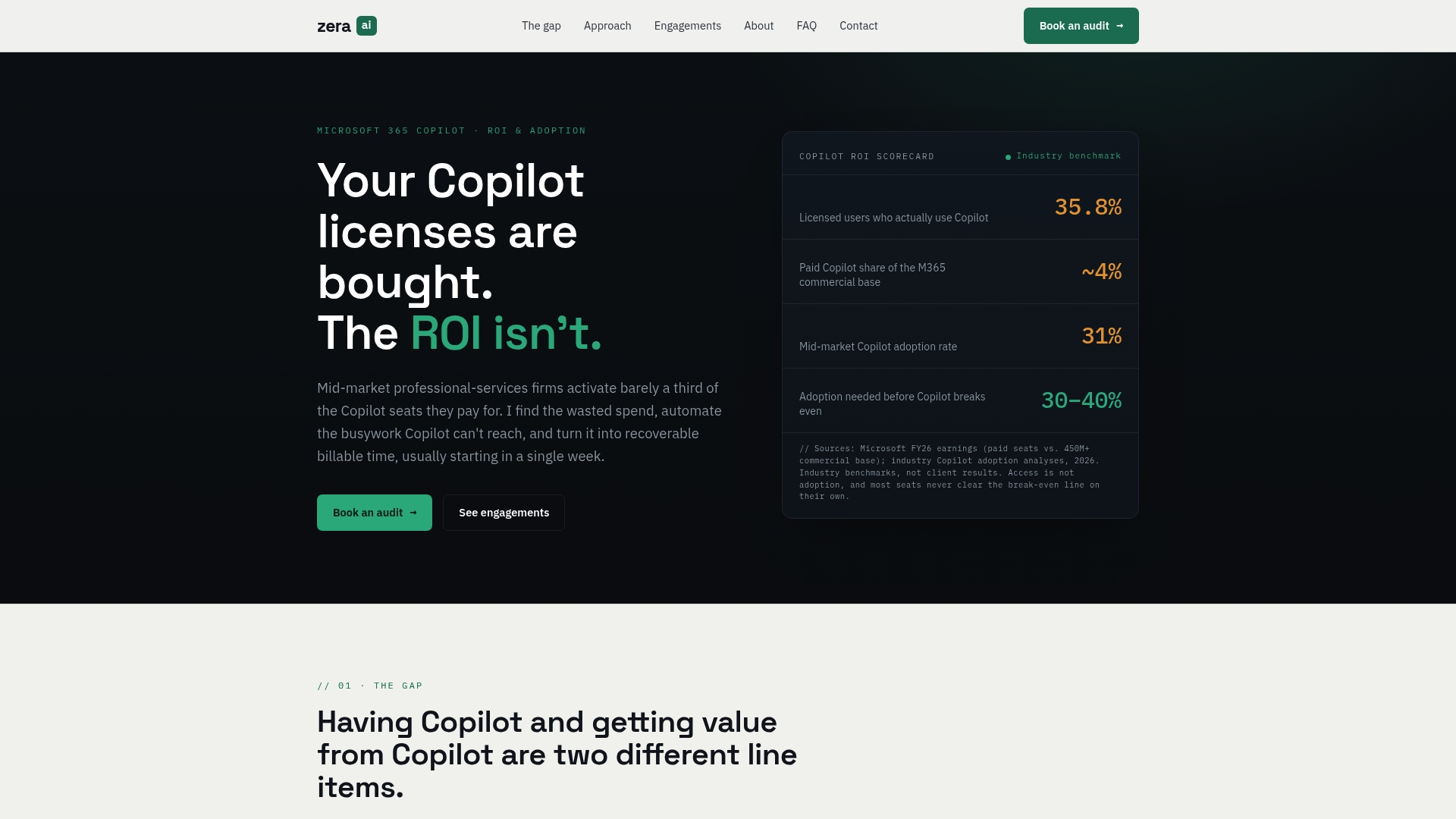
The engagement pulls your telemetry export, builds a dormant-license report, and identifies three priority workflows with a real ROI estimate attached to each one, drafting, summarization, analysis, whatever fits your practice mix. You walk away with a CSV export of current usage, a list of recommended seat actions, a pilot roadmap, and a time-to-value estimate you can bring straight to a partner meeting. No guessing at what a rollout should look like six months from now.
Before requesting the audit, pull your current license count, your most recent usage export if you have one, and a short list of the two or three roles you suspect are getting the least value from their seats. Visit the Zera Copilot consulting page to request the audit and see what a fixed-price engagement looks like for a firm your size.
Sources
- Microsoft 365 Copilot usage – Microsoft Learn
- Forrester TEI: Microsoft 365 Copilot (sponsored analysis)