
Copilot for accounting works best as a productivity layer inside tools your team already uses: Excel, Outlook, Teams, and, through Finance Agent, your ERP. It won’t close your books or replace a CPA’s sign-off, but it will cut hours off reconciliation, variance write-ups, and collections outreach when paired with human review. The fastest path to value is a single pilot, not a firmwide rollout: pick one recurring workflow, like bank reconciliation or AR follow-ups, and test one prompt against a real (but isolated) dataset this week.
TL;DR:
- Using Copilot for reconciliation can save hours by matching bank statements with general ledger data and flagging exceptions for manual review.
- Effective prompts require specifying objectives, frameworks, periods, and audiences to produce useful, actionable outputs without heavy rework.
- Governance measures, including data controls and human review checkpoints, are essential for CPA compliance and protecting client information during AI-assisted workflows.
- Rollout success depends on measuring baseline processes, identifying idle licenses, and automating workflows, with a focus on re-billable time recovery.
- Most firms discover unused licenses and fragmented data after initial implementation, making telemetry analysis vital to maximizing ROI and adoption.
Table of Contents
- Top Copilot Use Cases for Accounting and Finance Teams
- How Does Copilot Integrate With Microsoft 365 and Finance Systems?
- Practical Workflows and Example Prompts for Common Accounting Tasks
- What Are the Risks and Governance Requirements for CPAs?
- Getting Started: A Compact Adoption and ROI Playbook
- What We’ve Learned Rolling Out Copilot at Mid-Market Firms
- How Zera Helps Firms Turn Copilot Licenses Into Billable Hours
- Sources
Top Copilot Use Cases for Accounting and Finance Teams
The tasks that eat the most staff hours also happen to be the ones Copilot handles well, because they follow patterns: pull data, compare it, flag exceptions, write a summary. Here’s where mid-market accounting and finance teams see the fastest returns.
- Reconciliation and bank statement matching. Feed Copilot an Excel export of the bank statement and the general ledger extract; it returns a matched summary and a flagged exception list for manual review.
- Variance and trend analysis. Ask for a month-over-month comparison against budget, and Copilot drafts both the chart and a plain-language explanation of what moved and why, as well as strategies covered in Month End Close Automation: Cut Days Off Your Close.
- Accounts receivable collections. Copilot ranks overdue accounts by risk and age, drafts outreach emails, and can suggest payment plan language based on account history.
- Accounting document evaluation and standards updates. When a standard changes, Copilot can summarize requirements, locate affected documents, and draft the necessary edits, a workflow Microsoft’s own adoption scenario library walks through step by step.
- Technical memos and audit narratives. Give it the facts and the audience, and it produces a first draft of a technical memo or client communication in the right tone and format.
- Meeting recaps and action items. Pulled directly from Teams calls or Outlook threads, so nothing said in a client call gets lost by Thursday.
None of these replace judgment. They replace the blank page and the first hour of manual data-wrangling that usually precedes it.
How Does Copilot Integrate With Microsoft 365 and Finance Systems?
Microsoft Copilot for Finance is the role-specific layer built for this exact job. It connects to Dynamics 365 and SAP and surfaces workflow automation and recommendations directly inside Outlook, Excel, and Teams, rather than living in a separate app your team has to remember to open.
The specific component doing ERP work is Finance Agent. It acts as a query layer over your invoice and payment data, and it lets finance staff ask natural-language questions about AR and AP status directly inside Copilot chat instead of running a report and exporting it. Behind the scenes, Finance Agent and similar tools increasingly rely on the Model Context Protocol (MCP), an emerging standard for connecting AI assistants to external data sources and systems without custom integration work for every connector.
Not every Copilot experience is the same one, though, and this distinction trips up a lot of firms during rollout:
- Copilot Chat is the general-purpose assistant, useful for drafting and summarizing but with limited direct access to your line-of-business systems.
- Microsoft 365 Copilot adds in-document actions inside Word, Excel, and Outlook, with broader tenant data access governed by your existing permissions.
- Finance Agent sits on top of either, purpose-built for ERP queries, and often requires separate licensing.
One licensing detail firms miss: Finance Agent and some Copilot for Finance capabilities may require additional licenses and admin-level tenant configuration beyond a standard Microsoft 365 Copilot seat. Confirm exact availability with Microsoft or your reseller before promising the capability to a partner or client, since role-based permissions also determine what each employee’s Copilot can actually see.
Practical Workflows and Example Prompts for Common Accounting Tasks
A good Copilot prompt for accounting work needs four things almost every time: the objective, the accounting framework, the period, and the intended audience. Skip any one of those and you tend to get a generic answer that sounds confident and says nothing useful. Here are six recipes worth keeping on hand.
- Bank reconciliation. Input: bank statement CSV plus GL extract. Prompt: “Match these two extracts by date and amount, list unmatched items over $500, and flag likely timing differences.” Output: a matched summary and a short exception list.
- Variance analysis. Input: actuals vs. budget by account. Prompt: “Compare actuals to budget for Q1 2026 under U.S. GAAP, flag variances over a $10,000 materiality threshold, and explain the top three drivers in plain language for a non-finance partner.” Output: a written variance narrative plus a chart.
- Accounting document update. Input: the policy document and the new standard summary. Prompt: “Summarize what changed in this standard, identify which sections of our policy document need edits, and draft the revised language.” Output: tracked-change suggestions.
- Collections email sequence. Input: AR aging report. Prompt: “Rank accounts over 60 days by balance, and draft a three-email escalation sequence, professional tone, for the top ten.” Output: prioritized list plus draft emails.
- Monthly close summary. Input: close checklist status and key metrics. Prompt: “Summarize close progress for the controller, flag open items, and estimate days to complete.” Output: a status memo.
- Board or partner-ready executive summary. Input: financial statements and prior period comparison. Prompt: “Draft a one-page summary for managing partners, focused on cash position and margin trend, no jargon.” Output: an executive brief.
Pro Tip: Start a new Copilot conversation for each distinct task. Long threads that mix reconciliation questions with drafting requests tend to drift, and Copilot starts pulling context from the wrong task.
Always name the framework (IFRS or U.S. GAAP), the exact period, and a materiality threshold in the prompt itself. Vague context is the single most common reason accounting professionals get outputs that need heavy rework.
What Are the Risks and Governance Requirements for CPAs?
Copilot drafts. It does not exercise professional skepticism, and it does not sign anything. CPA Canada’s guidance is blunt on this point: Copilot can increase efficiency, but it does not replace professional obligations, and firms need to build governance and human review into the workflow, not bolt it on afterward.
That means every Copilot-assisted output needs a documented human checkpoint before it reaches a client or regulator. A workable structure: Copilot drafts, a senior accountant performs technical review and records acceptance or revision, and only the licensed professional’s final signature makes it a deliverable. Automate the repeatable handoffs between those steps, never the approval itself.
A governance checklist worth adopting before scaling past a pilot:
- Tenant-level access controls that match each role’s actual data needs, not blanket access.
- Data minimization: don’t feed client PII into prompts when a redacted extract will do.
- A written retention policy for AI-assisted drafts and the prompts that generated them.
- Client disclosure where AI assistance materially shaped a deliverable.
- An audit trail linking each AI-assisted output to its human reviewer.
One licensing note that matters more than firms expect: for anything touching client financial data, use organization-grade Copilot experiences with enterprise data protection, not personal or consumer versions. The difference isn’t marketing language. It determines whether your prompts and data stay inside your tenant’s compliance boundary.
Getting Started: A Compact Adoption and ROI Playbook
Most Copilot rollouts fail the same way: licenses get purchased, a training webinar happens, and adoption quietly plateaus. A telemetry-driven pilot avoids that trap by measuring instead of guessing.
- Pick one workflow. Reconciliation and AR collections are the two fastest wins, because their inputs are structured and their time cost is easy to measure.
- Baseline before you touch anything. Time the current process by hand for two weeks before introducing Copilot, so your ROI claim later has a real comparison point.
- Find the dormant licenses. Usage telemetry, not survey responses, tells you which of your existing Copilot seats are sitting idle, which is where most firms are already losing money.
- Map the workflow to specific Copilot actions, using the prompt recipes above as a starting template rather than building from scratch.
- Automate the handoffs Copilot doesn’t cover, using tools like n8n or Python scripts to move data between systems Copilot can’t reach directly.
- Measure and report. Track time saved per workflow, reduction in close-cycle days, and license utilization rate, then expand to the next workflow only once the first shows a measurable result.
Pro Tip: Track “recovered billable time,” not just “time saved.” A partner who reclaims four hours a week only creates value if that time gets rebilled or reinvested in client work, not absorbed into longer lunch breaks.
and belong here once your pilot completes, because a specific before-and-after number does more to win partner buy-in than any vendor pitch deck.
What We’ve Learned Rolling Out Copilot at Mid-Market Firms
The biggest blocker isn’t the AI. It’s undocumented spreadsheets built by one person who left three years ago, and firms that skip telemetry never find out which licenses are actually idle. Reconciliation and AR collections deliver the fastest wins, but governance has to come before scale, not after.
— Mad
How Zera Helps Firms Turn Copilot Licenses Into Billable Hours
Gozera exists for the exact gap most firms hit after go-live: licenses purchased, adoption stalled, and no clear number to show for the spend. We start with telemetry to find which Copilot seats sit unused, then run focused workflow sprints, reconciliation, AR collections, document review, mapped to the prompt patterns covered above and automated where needed with Python and n8n.
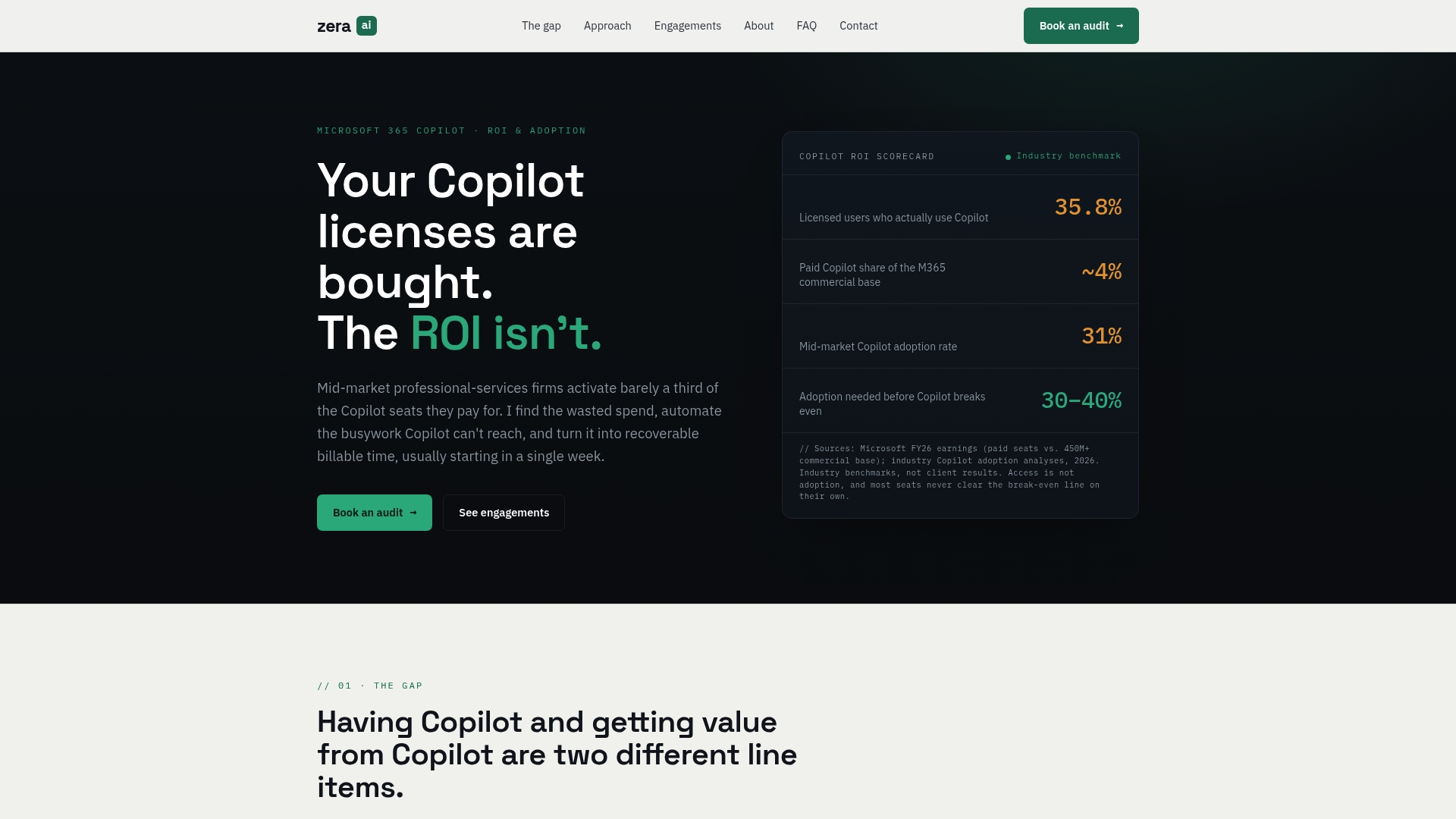
An initial engagement gets you three concrete things: a usage baseline, a recommended pilot workflow chosen from your actual data, and an estimated ROI figure your managing partners can evaluate before committing further. If your firm has more Copilot seats than active users, that’s the signal worth acting on. Book an audit with Zera to see where your licenses are actually going.
Sources
- Finance agent in Copilot chat — Microsoft Learn
- Accounting document evaluation (Copilot Scenario Library) — Microsoft Adoption
- Getting the Most Out of Microsoft Copilot as a CPA — CPA Canada