
Microsoft 365 Copilot works well as a first-pass contract review assistant for summaries, clause extraction, and side-by-side comparisons — when it runs inside governed Microsoft 365 workflows and every output gets human verification before it moves forward. It is not a substitute for legal judgment, and it should not touch final legal advice, high-value M&A, or litigation-sensitive documents without specialist oversight.
The conditions that change the answer quickly:
- Document sensitivity: Confidential third-party data and privileged communications need tenant-level data controls confirmed before any Copilot query runs against them.
- Jurisdictional legal advice: Copilot has no jurisdiction-specific legal training. Any clause interpretation that carries legal consequence needs a qualified lawyer to verify it.
- Audit trail requirements: High-stakes reviews that need defensible, source-linked extraction logs require a specialist legal-AI platform, not Copilot alone.
Pro Tip: The fastest recoverable billable-time ROI comes from routine, high-volume contracts: NDAs, vendor agreements, and standardized service agreements. These are low-risk, structurally predictable, and exactly where Copilot’s summarization and clause-extraction capabilities cut first-pass review time most reliably.
Key takeaways
Copilot is a practical first-pass contract review assistant when it runs inside governed Microsoft 365 workflows and every output gets human verification before it moves forward.
| Point | Details |
|---|---|
| Best contract types for Copilot | NDAs, vendor MSAs, and standardized service agreements deliver the fastest, lowest-risk ROI. |
| Human review is non-negotiable | Every Copilot output must be verified against the source document before use in a negotiation or opinion. |
| Governance before deployment | Confirm tenant permissions, audit logging, DPA terms, and sensitivity label controls before any legal workflow goes live. |
| Measure recoverable billable hours | Track per-user first-pass review time and rewrite-cycle reduction, not a vague firm-wide “time saved” figure. |
| Gozera’s role | Gozera audits dormant licenses, rebuilds intake workflows in Word/SharePoint/Teams, and delivers a documented ROI report for managing partners. |
Table of Contents
- What can Microsoft 365 Copilot do for contract review?
- What are the accuracy risks and legal hazards you must plan for?
- When should you use Copilot vs. a specialist legal-AI tool?
- How do you build a step-by-step contract review workflow with Copilot?
- What governance and security checks must legal teams verify first?
- How do you measure ROI and adoption with real telemetry?
- What does a compact Copilot pilot plan look like?
- A practical note on what actually moves the needle
- Gozera helps legal teams turn dormant Copilot licenses into measurable ROI
- Sources
What can Microsoft 365 Copilot do for contract review?
Microsoft’s Copilot scenario library documents a concrete set of capabilities that legal teams can use today inside their existing Microsoft 365 environment. These are not theoretical features — they run in Word, Outlook, Teams, and SharePoint without requiring a separate application.
Summarization and key-term extraction
Copilot can read a long agreement and produce a structured summary covering duration, payment terms, renewal windows, and termination triggers. A prompt like “Summarize this agreement and list the key commercial terms” in Word returns a usable first-pass briefing in seconds. That output still needs review, but it replaces the 20-minute cold read that typically starts every contract intake.
Clause identification and nonstandard language flagging
Ask Copilot to identify all indemnity, limitation of liability, and confidentiality clauses in a document, and it will list them with the relevant section references. More usefully, you can prompt it to flag language that deviates from a standard template — for example, “Compare this indemnity clause to the following standard language and note any differences.” The output is a short differences list, not a legal opinion, but it tells the reviewer exactly where to focus.
Agreement comparison
Inside Word, Copilot can compare two versions of an agreement and produce a summary of what changed. This is particularly useful for redline-heavy negotiations where a reviewer needs to confirm which open issues remain unresolved across drafts.
Redline suggestions and briefing notes
Copilot can draft suggested redlines in plain language and generate briefing notes for counsel or business stakeholders. In a Teams or Outlook context, it can summarize a contract-related email thread and extract the outstanding action items, which cuts the time spent reconstructing negotiation history before a call.
Concrete output examples:
- One-line summary: “This is a 24-month SaaS agreement with automatic renewal, net-30 payment terms, and a mutual NDA provision in Section 7.”
- Clause extraction snippet: “Limitation of liability: Section 12.3 caps aggregate liability at 12 months of fees paid. No carve-out for gross negligence.”
- Comparison result: “Version 2 removes the supplier’s right to subcontract without consent (Section 9.1 in Version 1). Governing law changed from Ontario to New York.”
What are the accuracy risks and legal hazards you must plan for?
Copilot’s contract review capabilities are real, but so are the failure modes. Legal teams that skip this section tend to discover the problems at the worst possible moment.

Accuracy risks
Copilot can hallucinate — producing plausible-sounding clause summaries that misstate the actual text. It can also omit clauses when a document is long or poorly formatted, and it sometimes strips context from a clause in ways that change its meaning. A summary that says “liability is capped at 12 months of fees” without noting that the cap excludes IP indemnity obligations is technically incomplete and operationally dangerous.
Legal hazards
Relying on unverified AI output in a contract negotiation or legal opinion carries professional responsibility risk. If a lawyer presents a Copilot-generated clause summary as accurate without independent verification, and that summary is wrong, the error is the lawyer’s — not the tool’s. Copilot has no jurisdiction-specific legal training, no bar admission, and no professional indemnity. Treat its outputs as a first draft that requires the same scrutiny as work from a junior associate.
Confidentiality and privilege are a separate concern. Queries sent through Copilot run against your Microsoft 365 tenant data, but the governance of what data Copilot can access — and how outputs are logged — depends entirely on how your tenant is configured. Uncontrolled access permissions can expose privileged communications to users who should not see them.
Operational mitigations
- Mandatory human review of every Copilot output before it is used in a negotiation, opinion, or filing.
- Documented escalation protocol: any clause Copilot flags as nonstandard or high-risk goes to a senior lawyer before the review moves forward.
- Verification steps logged: the reviewer signs off that they checked the Copilot output against the source document.
- Scope exclusion list maintained and enforced: M&A, litigation-sensitive documents, regulatory filings, and any matter where a wrong summary could trigger financial or professional liability stay off Copilot’s intake list.
The clearest rule: Copilot is a research and drafting assistant. It is not a legal advisor, and no workflow should treat its output as final.
When should you use Copilot vs. a specialist legal-AI tool?
The honest answer is that Copilot and specialist legal-AI tools solve different problems, and the right choice depends on the task, the risk level, and the volume.
| Dimension | Microsoft 365 Copilot | Specialist legal-AI (e.g., Spellbook, eBrevia) |
|---|---|---|
| Best-for task type | Summaries, clause extraction, briefing notes, email recap | Precedent-based redlines, playbook application, high-volume diligence extraction |
| Accuracy / jurisdictional awareness | General-purpose; no legal-specific training | Tuned for legal language; some tools include jurisdiction-specific playbooks |
| Audit trails / verifiability | Output logs via Microsoft 365 audit; no native source-linking | Source-linked extraction with clause-level traceability; designed for defensible review |
| Integration | Native Word, Outlook, Teams, SharePoint | Typically Word add-in plus standalone platform; varies by vendor |
| Pricing / license model | Bundled with Microsoft 365 Copilot license | Per-seat or per-document; separate contract required |
| Data governance | Microsoft enterprise DPA; tenant-level controls; admin-configurable | Vendor-specific DPA; SOC 2 / ISO 27001 varies; confirm training opt-out |
When Copilot is the right call:
- Routine, standardized contracts (NDAs, vendor MSAs, service agreements) where the risk profile is low and the goal is faster first-pass review.
- Teams already inside Microsoft 365 who need a low-friction starting point without a separate procurement cycle.
- Briefing notes, email summaries, and meeting recaps that support the review process rather than constitute the review itself.
When a specialist tool is the better fit:
- High-volume due diligence where you need structured extraction across hundreds of documents with consistent field mapping and bulk risk scoring.
- Redlining against a specific playbook or precedent library, where Copilot’s general-purpose output lacks the legal specificity required.
- Any review that needs a defensible audit trail linking each extracted data point back to the exact source clause — a requirement in regulated industries and eDiscovery contexts.
- M&A, financing, and regulatory filings where jurisdictional precision and professional responsibility standards are non-negotiable.
The practical decision rule: if the contract type is routine and the output is a starting point for a human reviewer, Copilot is sufficient. If the output needs to be defensible on its own, or if volume and consistency requirements exceed what a general-purpose tool can deliver reliably, a specialist platform is the right investment.
How do you build a step-by-step contract review workflow with Copilot?
The Microsoft automated contract review agent scenario describes an end-to-end pattern that legal teams can adapt. The key principle: keep Copilot inside Microsoft 365 contexts at every step. Copying contract text into an external chat window breaks the source link, creates data governance risk, and loses the formatting context Copilot uses to identify clause boundaries.
End-to-end workflow
- Intake (Outlook/Teams): Contract arrives by email or Teams message. Prompt Copilot in Outlook: “Summarize this email thread and list any contract documents attached.” Output: a one-paragraph recap and a list of attachments with their apparent purpose.
- Ingestion (SharePoint/Word): Save the contract to the designated SharePoint library. Open in Word with the Copilot add-in active. This preserves the source document link for all subsequent queries.
- First-pass summary: Prompt in Word: “Summarize this agreement in 150 words, including the parties, term, payment structure, renewal mechanism, and governing law.”
- Clause extraction: Prompt: “List all indemnity, limitation of liability, IP ownership, and confidentiality clauses with their section numbers.” Review the output against the document. Flag any clause the reviewer cannot locate in the source text.
- Nonstandard language check: Prompt: “Compare the indemnity clause in Section [X] to the following standard language: [paste standard]. Note any deviations.”
- Redline suggestions: Prompt: “Draft suggested redline language for Section [X] to align with the following position: [describe position].” Treat the output as a first draft for counsel review, not a final redline.
- Briefing note: Prompt in Word or Teams: “Generate a one-page briefing note for the negotiation team summarizing the key open issues and our recommended positions.”
- Human review and sign-off: Reviewer checks every Copilot output against the source document, logs verification, and escalates any flagged clause to senior counsel before the review moves to negotiation.
- Handoff: Final reviewed summary and redlines saved to SharePoint. Teams message sent to the contracting or negotiation lead with the briefing note attached.
Escalation protocol for high-risk findings
- Any clause Copilot identifies as nonstandard, missing, or potentially unenforceable triggers an escalation flag.
- The reviewing lawyer confirms the flag independently and decides whether to escalate to senior counsel or outside counsel.
- Escalation decisions and their rationale are logged in the SharePoint document record.
Pro Tip: Never paste contract text into the Copilot chat pane outside of Word or SharePoint. Use the Word add-in so every query runs against the stored document. This keeps the source link intact, supports audit logging, and avoids the data residency ambiguity that comes with external chat sessions.
What governance and security checks must legal teams verify first?
Deploying Copilot for contract review without validating the underlying configuration is the fastest way to create a privilege or data-breach problem. The Microsoft Copilot documentation covers the tenant-level controls administrators need to validate before any legal workflow goes live.
Configuration checks
- Confirm Copilot is scoped to the correct SharePoint libraries and document sets. Copilot inherits Microsoft 365 permissions — if a user can read a file, Copilot can query it on their behalf. Audit permission inheritance before rollout.
- Disable Copilot access to document libraries containing privileged communications or matter files that should not be surfaced across the team.
- Validate that sensitivity labels applied to confidential documents are respected by Copilot’s access controls.
Documentation and logging
- Enable Microsoft 365 audit logging for all Copilot interactions in the legal environment.
- Confirm that Copilot outputs can be traced back to the source document and query — this is the minimum audit trail for professional responsibility purposes.
- Set retention policies for Copilot interaction logs consistent with your firm’s document retention schedule and applicable law society rules.
- Document the verification step: who reviewed the output, when, and what they confirmed against the source.
Contractual and compliance requirements
- Obtain and review Microsoft’s Data Processing Agreement (DPA) for your enterprise subscription. Confirm the data residency terms match your jurisdiction’s requirements.
- Verify SOC 2 Type II and ISO 27001 certifications are current for the Microsoft 365 services your tenant uses.
- Confirm that your Microsoft enterprise agreement includes the commercial data protection commitments that prevent your tenant data from being used to train shared models. Microsoft’s standard enterprise terms include this opt-out, but it must be confirmed for your specific agreement.
Preserving legal professional privilege
- Treat Copilot outputs that contain legal analysis as potentially discoverable. Do not route privileged communications through Copilot unless you have confirmed that the output will be handled with the same privilege protections as the underlying document.
- Restrict Copilot access to matter files to the lawyers and staff assigned to that matter, using the same access controls you apply to the underlying documents.
- Brief your team: Copilot is a tool, not a colleague. Outputs shared in Teams channels or Outlook threads can reach unintended recipients if channel permissions are not correctly set.
How do you measure ROI and adoption with real telemetry?
For mid-market firms, the right ROI frame is recoverable billable time and reduced rewrite cycles, not a vague “time saved” estimate. The Microsoft Copilot scenario guide frames this clearly: the value shows up in specific workflow bottlenecks, not across the board.
KPIs worth tracking
- Recoverable billable hours per user per week: Time previously spent on first-pass reading and clause extraction that Copilot now handles, converted to billable-hour equivalents.
- Average first-pass review time: Baseline this before the pilot. Measure it weekly during and after.
- Rewrite-cycle reduction: How many rounds of internal redrafting does a contract go through before it reaches the counterparty? Copilot-assisted first drafts tend to reduce this.
- Copilot license active usage rate: Percentage of licensed users running at least one Copilot query per week. Dormant licenses are the most common ROI killer in mid-market deployments. See how to recover billable hours with AI tools for a detailed tactical breakdown.
- Time-to-sign: From contract receipt to executed agreement. A useful lagging indicator, though it captures more than just review speed.
- Escalation rate to senior counsel: If Copilot is working well, routine contracts should require less senior-counsel time. Track whether this rate changes.
Telemetry sources
- Microsoft 365 usage logs (Copilot activity reports in the admin center)
- Word and SharePoint activity logs
- Teams meeting recap usage
- Custom telemetry from your CLM or document management system if integrated
Illustrative case example
A 12-lawyer mid-market firm processes roughly 40 NDAs and vendor agreements per month. Before Copilot, each first-pass review averaged 45 minutes. After embedding Copilot into the Word-based intake workflow, first-pass time drops significantly per contract, leading to substantial recoverable billable hours monthly. At a typical billing rate, this can translate into thousands of dollars of recoverable value from focused workflow changes on one contract type. These are conservative assumptions; the actual figure depends on your billing rate, contract volume, and how consistently the workflow is followed.
Pro Tip: Set your pilot target around per-user recoverable hours and rewrite-cycle reduction, not a firm-wide “time saved” number. A per-user metric is auditable, attributable to Copilot specifically, and far easier to defend to a managing partner who wants to see the ROI before renewing licenses.
What does a compact Copilot pilot plan look like?
A well-scoped pilot runs 6–8 weeks and answers one question: does Copilot reduce first-pass review time on routine contracts enough to justify the license cost and governance overhead? Keep the scope tight.
Pilot scope
- In scope: NDAs, vendor MSAs, and standardized service agreements. These are structurally predictable and low-risk.
- Out of scope: M&A, financing agreements, litigation-related documents, regulatory filings, and any matter with active privilege concerns.
- Volume: 15–30 contracts over the pilot period, reviewed by 3–5 users.
Roles and responsibilities
- Pilot sponsor: Managing partner or legal ops director. Owns the go/no-go decision.
- Legal ops lead: Designs the workflow, writes the prompts, and tracks KPIs.
- IT admin: Configures tenant settings, validates permissions, enables audit logging.
- Security reviewer: Confirms DPA, data residency, and sensitivity label controls before week 1.
- End users: 3–5 lawyers or contract managers who run the actual reviews and log their time.
Timeline milestones
- Week 0 — Scoping and access: Define contract types, exclusion list, and success criteria. Confirm IT and security sign-off.
- Weeks 1–2 — Configure and baseline: Enable Copilot in Word and SharePoint for pilot users. Baseline first-pass review time and rewrite cycles on the previous 30 days of contracts.
- Weeks 3–5 — Pilot execution: Users run Copilot-assisted reviews on in-scope contracts. Legal ops lead logs time per contract, escalation events, and any accuracy issues.
- Weeks 6–8 — Measure, iterate, decide: Compare KPIs against baseline. Identify the two or three workflow steps where Copilot delivered the most time recovery. Decide whether to expand, adjust, or stop.
Success criteria and go/no-go gates
- First-pass review time reduced by at least 25% on in-scope contracts.
- Active Copilot usage rate above 80% among pilot users by week 5.
- Zero unverified Copilot outputs used in a negotiation or legal opinion.
- Escalation rate to senior counsel stable or declining.
If the pilot hits these gates, the ROI case for a broader rollout is defensible. If it misses, the telemetry tells you exactly which workflow step failed — and that is fixable without starting over.
A practical note on what actually moves the needle
Most mid-market law firms that buy Microsoft 365 Copilot licenses see a familiar pattern: a burst of enthusiasm in the first two weeks, followed by a slow drift back to old habits. Within 90 days, a significant share of licenses sit dormant. The tool did not fail — the adoption plan did.
The firms that convert Copilot into a genuine productivity asset share one habit: they embed it into the exact workflow steps where manual effort is highest, rather than leaving it as an optional add-on that lawyers can use if they feel like it. Contract intake and first-pass review is the single highest-leverage entry point for most legal teams. It is repetitive, time-consuming, and structurally predictable — exactly the conditions where Copilot performs best.

What the Vodafone enterprise adoption story and similar enterprise deployments consistently show is that process change drives the result, not the tool itself. Copilot paired with a redesigned intake workflow outperforms Copilot dropped into an unchanged process by a wide margin. That is the insight most vendor guides skip.
The other thing worth saying plainly: Copilot is not the right tool for every contract review task, and pretending otherwise wastes the credibility you need when you tell a managing partner the pilot worked. Use it where it fits, pair it with specialist legal-AI where it does not, and measure the difference honestly.
Gozera helps legal teams turn dormant Copilot licenses into measurable ROI
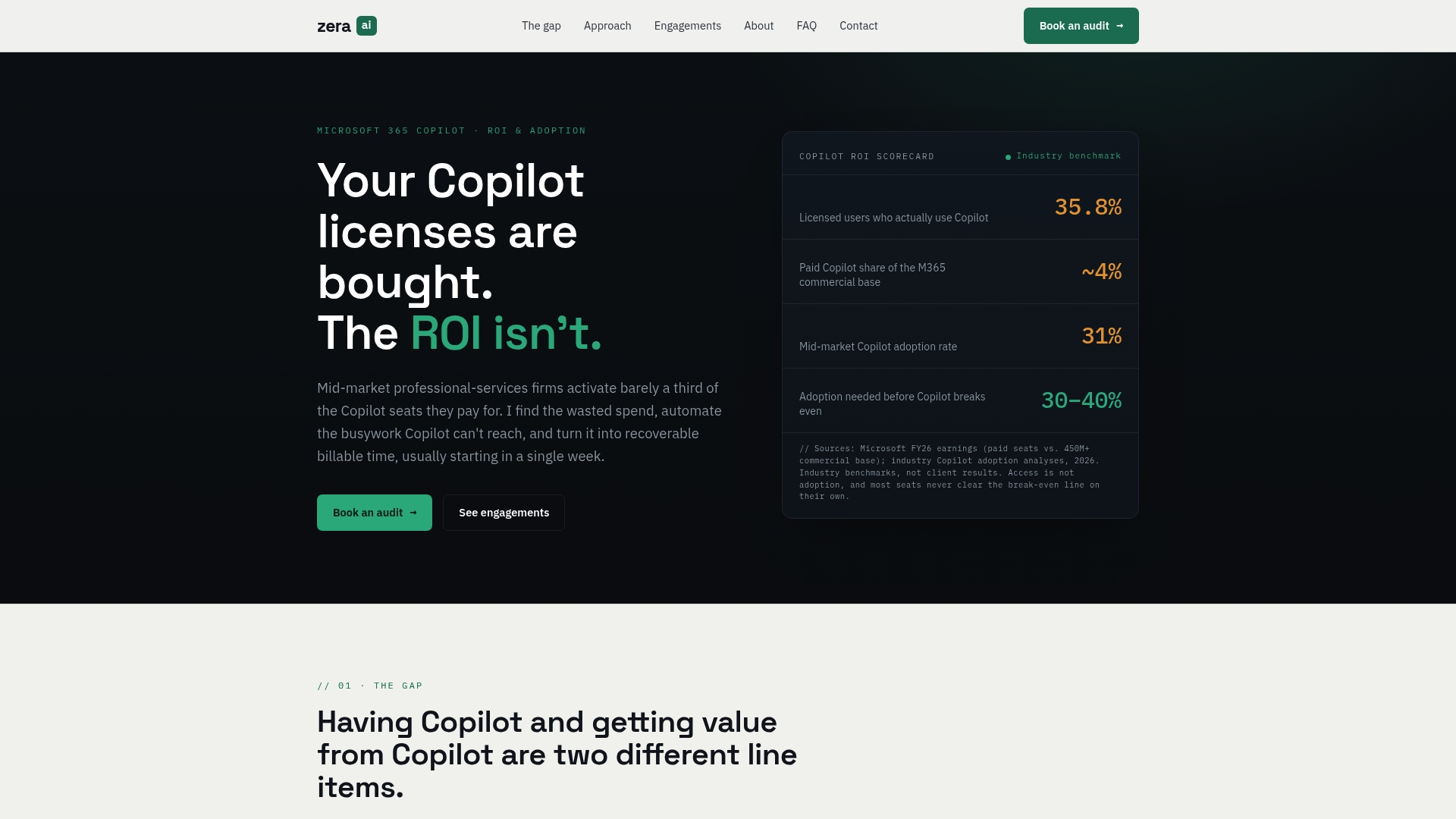
Most mid-market firms already own the Copilot licenses. The gap is between owning them and actually recovering billable time from them. Gozera closes that gap with a telemetry-first approach: we audit which licenses are active, identify the workflow bottlenecks where Copilot should be embedded, and rebuild those workflows inside Word, SharePoint, and Teams so the tool does real work on real contracts.
Engagements are fixed-price and structured around outcomes: recoverable billable hours, active license utilization rates, and rewrite-cycle reduction. We use Python and n8n to automate the gaps Copilot cannot fill natively, and every pilot produces a documented ROI report you can put in front of a managing partner. No lengthy change management programs. No vague productivity promises. If you want to see what a Copilot adoption audit looks like for a legal team your size, reach out for a scoping call.
Sources
The following resources cover implementation detail, security configuration, and specialist legal-AI context that complement the guidance above.
- Legal scenario: Quicker contract review (Microsoft 365 Copilot) (Copilot Scenario Library) – Microsoft Adoption
- Automated Contract Analysis: Unlock Faster, Smarter Reviews | Icertis
- eBrevia Contract Analyzer | AI-Powered Contract Review
- Microsoft