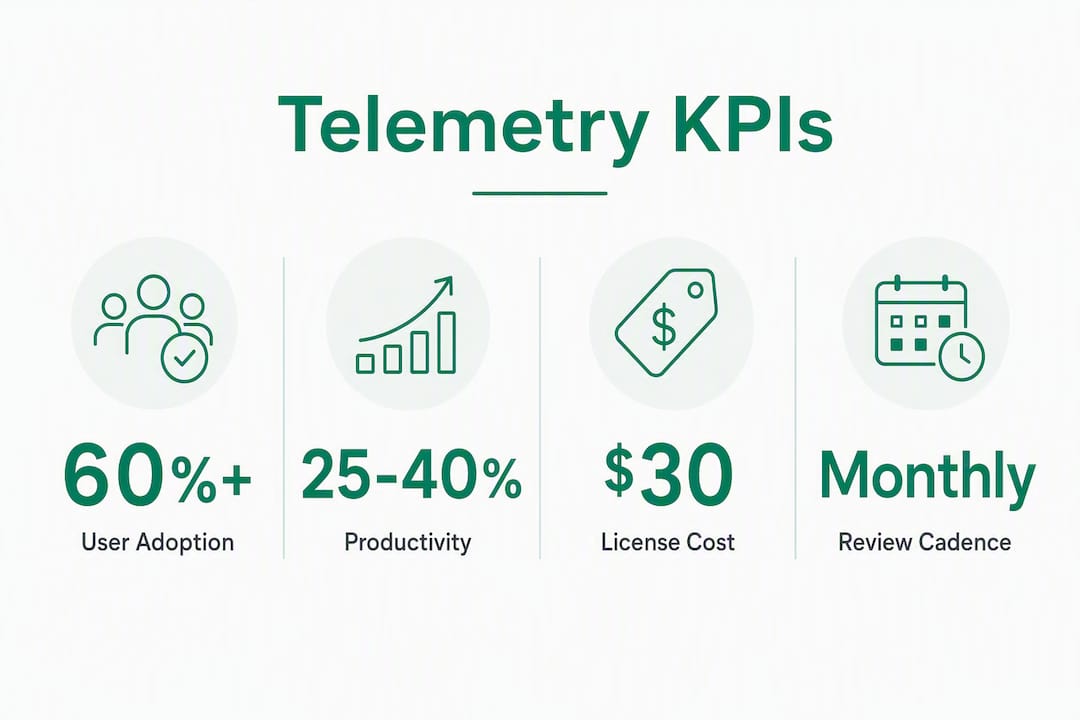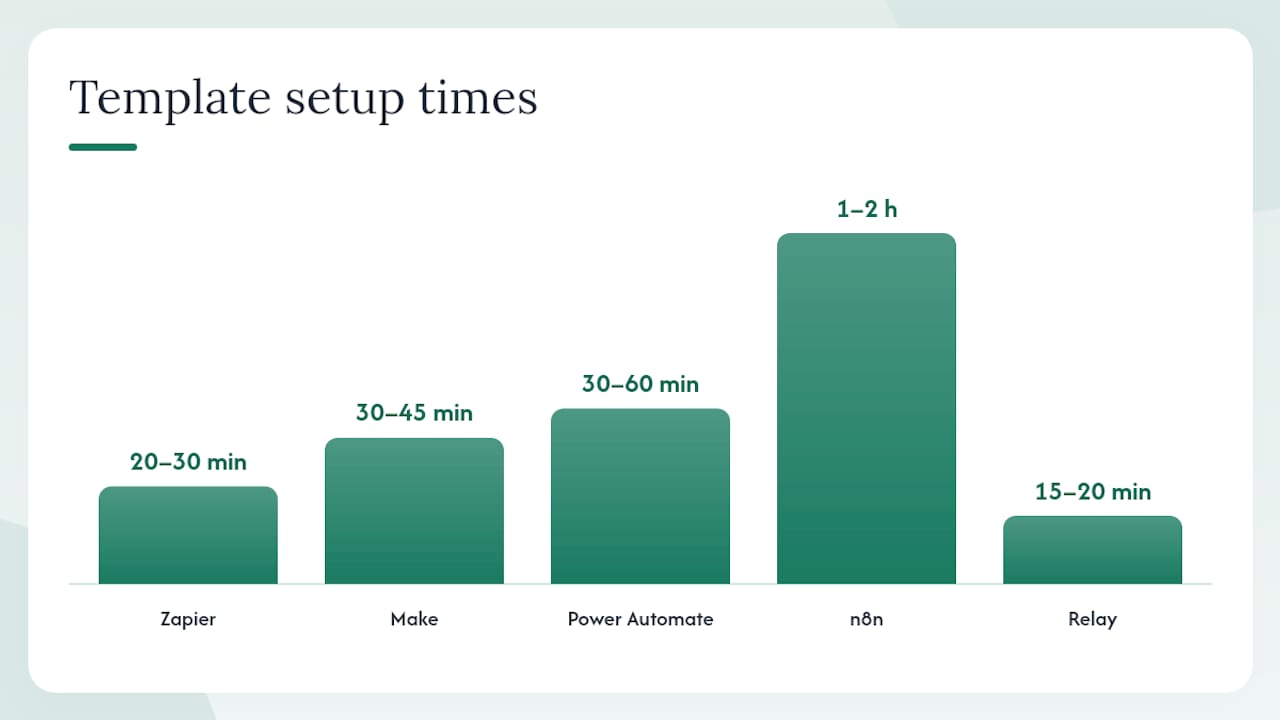
Author: zeraconsulting

  • Copilot with iManage: Pilot & ROI Guide for Law Firms

    Copilot with iManage: Pilot & ROI Guide for Law Firms

    Microsoft 365 Copilot with iManage connects your firm’s governed document repository directly to Copilot’s generative AI, so every answer Copilot produces is grounded in your actual matters, contracts, and emails rather than generic training data. The integration respects iManage’s existing permission model, meaning Copilot only surfaces content the signed-in user is already authorized to view.

    Your first move: confirm that your iManage instance has the MCP server enabled and that your Microsoft 365 tenant supports Copilot Studio or Power Platform connectors. Then designate a service account with the narrowest folder and matter permissions your pilot scope requires.

    • The iManage Work MCP connector is available in the Microsoft connector store and as a custom connector in Copilot Studio, and it defaults to read-only access.
    • Documents stay inside iManage. No bulk export, no replication to an external index.
    • Supported operations include search, fetch, get_document_profile, download_document, and get_document_versions.
    • Regional exclusions apply: US Government GCC, GCC High, DoD, and China Cloud tenants are not supported.

    Pro Tip: Before your first test query, verify your iManage subdomain URL. The generic cloudimanage.com endpoint will fail for custom tenant instances. You need the exact format: https://[yoursubdomain].cloudimanage.com/mcp/work.


    Table of Contents

    What does the iManage–Copilot integration actually do?

    The integration grounds Copilot responses in content stored inside iManage Work, covering documents, emails, and matter workspaces. When a user asks Copilot a question, the MCP connector queries iManage in real time, retrieves relevant content the user is permitted to see, and passes it to Copilot as context. The answer reflects your firm’s actual work product, not a generic language model response.

    Woman typing Copilot queries in office

    Architecturally, you have three paths:

    Deployment Path How It Works Best For
    Connector store (prebuilt) Add iManage Work MCP directly from Microsoft’s connector gallery Fastest setup; standard subdomain tenants
    Custom MCP connector in Copilot Studio Configure a custom MCP server URL with your exact subdomain Custom subdomains, bespoke auth flows
    Federated vs. indexed MCP uses federated real-time access; no data sync required Governance-sensitive environments

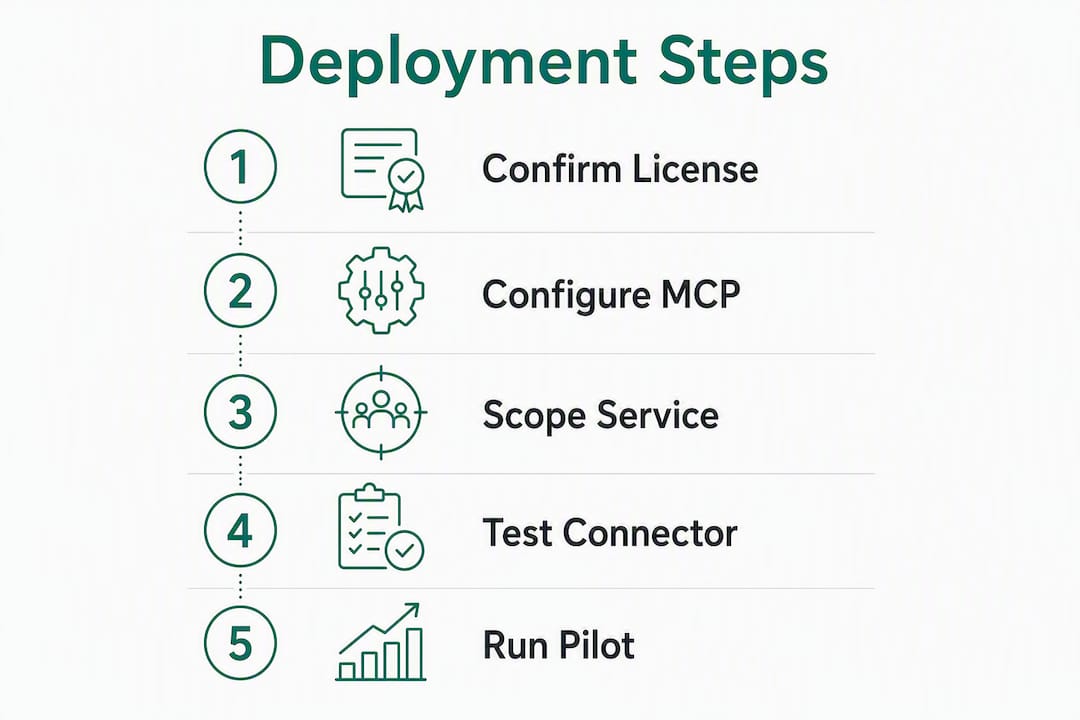
    Infographic outlining deployment steps for Copilot with iManage

    The Microsoft Connectors gallery lists both Microsoft-built and partner-built connectors, including the iManage Work connector, and distinguishes between federated real-time access (what MCP provides) and synced/indexed models that copy data out of iManage.

    Practical use cases that legal and professional-services teams are already running:

    • Matter research: Ask Copilot to surface relevant precedents or prior work product from a specific matter workspace.
    • Document summarization: Get a plain-language summary of a lengthy contract or due diligence report without leaving Teams or Outlook.
    • Clause extraction: Query for specific clause types (indemnification, limitation of liability) across a set of agreements.
    • Drafting assistance: Reference governed templates and prior drafts stored in iManage while generating a new document.
    • Version history review: Retrieve document version history to understand how a contract evolved before a negotiation.

    The read-only default is not a limitation for these use cases. It is a deliberate governance choice: Copilot reasons over your content without modifying it.


    What licenses and prerequisites do you need before deploying?

    Missing a license or a misconfigured service account is the most common reason deployments stall. Confirm every item below before your first configuration session.

    Microsoft-side requirements:

    Requirement Details
    Microsoft 365 Copilot license Required for each user who will query iManage content through Copilot
    Copilot Studio or Power Platform Premium Required if deploying via custom MCP connector; check tenant entitlements
    Tenant admin access Needed to add connectors and authorize OAuth2 flows
    Supported cloud region US Gov GCC, GCC High, DoD, and China Cloud are excluded

    iManage-side requirements:

    Requirement Details
    iManage Work subscription Active cloud subscription required; on-premises configurations vary
    MCP server enabled Must be activated in your iManage environment by your iManage admin
    Exact environment subdomain You need the precise subdomain, not the generic cloudimanage.com URL
    Service account Least-privilege account scoped to the matters and folders in your pilot

    The four roles that must be in the room before you start:

    • Tenant admin: Adds the connector and manages OAuth2 authorization.
    • iManage admin: Enables MCP, confirms the subdomain, and creates the service account.
    • Security/compliance lead: Reviews permission scoping and audit requirements.
    • Practice lead: Defines pilot scope, selects the matters, and owns success metrics.

    Pro Tip: Check your iManage subscription tier before scheduling the configuration session. Not all iManage plans include MCP server access by default. Confirming this with your iManage account rep takes one email and saves a week of delay.


    How do you deploy the connector, step by step?

    Connector store path (faster, simpler)

    Use this when your iManage instance runs on a standard subdomain and you want the fastest path to a working test query.

    1. Sign in to the Microsoft connector store or the Copilot Studio agent builder.
    2. Search for “iManage Work MCP” and select the prebuilt connector.
    3. Enter your exact iManage environment URL (e.g., https://yourfirm.cloudimanage.com/mcp/work).
    4. Authorize the OAuth2 connection using the service account credentials.
    5. Add the iManage tool to your Copilot agent.
    6. Run a test search query against a known matter to confirm the connection.

    Custom MCP connector path (Copilot Studio)

    Use this when you have a custom subdomain, need bespoke authentication flows, or are building a more advanced agent scenario.

    1. In Copilot Studio, navigate to Settings > AI capabilities > Model Context Protocol.
    2. Select Add MCP server and enter your precise subdomain URL: https://[yoursubdomain].cloudimanage.com/mcp/work.
    3. Configure OAuth2 with the service account. Do not use a personal user account here.
    4. Add the connector as a tool in your agent definition.
    5. Save and publish the agent to a test environment.
    6. Run the testing checklist below before promoting to production.

    Testing checklist before go-live:

    • Verify that search results respect permission scoping (a user should not see matters they are not assigned to).
    • Run fetch and get_document_profile operations on at least three document types (Word, PDF, email).
    • Test get_document_versions to confirm version history retrieval works.
    • Test download_document and verify file integrity.
    • Check connector invocation logs in Copilot Studio for errors or latency spikes.
    • Confirm that the service account cannot write, delete, or modify any iManage content.

    The connector store path is faster and requires less configuration. The custom MCP path gives you control over the exact URL, auth parameters, and agent behavior, which matters for firms with non-standard iManage environments or complex matter structures.


    How does the integration preserve iManage security and governance?

    The short answer: Copilot only returns what the signed-in user is already allowed to see. The iManage MCP connector defaults to read-only access, and the service account’s folder and matter permissions define the outer boundary of what Copilot can retrieve. If a user lacks access to a matter in iManage, Copilot will not surface documents from that matter, regardless of how the query is phrased.

    iManage’s cloud-native Azure architecture supports co-authoring, journaling, and auditable workflows alongside Copilot. That means the integration does not create a shadow copy of your data or bypass your existing records management controls.

    Key governance practices to implement before pilot start:

    • Least-privilege service account: Scope the account to only the workspaces and matter types included in your pilot. Expand scope deliberately as the pilot proves out.
    • Enable journaling and audit trails: iManage’s journaling feature logs document access events. Confirm it is active before Copilot queries begin so you have a complete audit record.
    • Integrate connector logs with your SIEM: Export Copilot Studio connector invocation logs to your security information and event management platform for ongoing monitoring.
    • No bulk replication: MCP provides federated real-time access, so documents remain inside iManage rather than being copied to an external index. This eliminates a significant class of data-leakage risk that older custom API integrations carried.
    • Map responsibilities before day one: Assign explicit ownership of connector logs (IT), audit trail review (records management), and user access review (security) before the pilot starts.

    Pro Tip: Run a permission-boundary test on day one of the pilot: log in as a user who is explicitly excluded from a specific matter and confirm that Copilot returns no results from that matter. Document the test result. Your compliance team will ask for it.


    What are the known limits and how do you fix common errors?

    Documented limitations

    • Regional exclusions: The connector is not available in US Government GCC, GCC High, DoD, or China Cloud tenants. If your firm operates in one of these environments, the MCP connector is not currently an option.
    • Read-only by default: Copilot cannot create, edit, or delete iManage content through this connector. That is by design, but it means any workflow requiring write-back to iManage needs a separate integration layer.
    • Preview status: The iManage Work MCP connector is currently in preview, which means Microsoft may change supported operations or throttling limits before general availability.

    Throttling and API limits

    The connector documentation publishes throttling limits on API calls per connection. Large queries or bulk summarization tasks can hit these ceilings, especially during a pilot when multiple users run concurrent queries.

    Symptom Likely Cause Recommended Fix
    Queries return partial results Throttling ceiling reached Batch queries; add pagination logic
    Authentication failure at setup Wrong subdomain in MCP URL Use exact subdomain URL format
    Connector returns no results MCP server not enabled in iManage Contact iManage admin to activate MCP
    Service account access too broad Over-permissioned service account Rescope to pilot matters only
    Connector invocation errors Insufficient service account permissions Review and adjust folder-level access

    Diagnostics checklist

    • Check Copilot Studio connector invocation logs first. Most authentication and throttling errors appear here within seconds of a failed query.
    • Cross-reference with iManage MCP server logs to confirm whether the request reached iManage at all.
    • Verify the exact subdomain URL in your connector configuration. A single character error causes a silent authentication failure.
    • Confirm the service account has not been locked or had its permissions changed since initial setup.

    How do you run a pilot that proves ROI?

    Pilot design

    Pick 2–3 teams where document-heavy tasks consume measurable time. Litigation, tax, and advisory practices are strong candidates because their work product lives almost entirely in iManage and their time is directly billable.

    Define the tasks you will test before the pilot starts:

    • Document summarization (e.g., summarize a 40-page deposition transcript in under 60 seconds).
    • Clause extraction (e.g., pull all indemnification clauses from a set of vendor agreements).
    • Matter research (e.g., surface prior work product on a specific legal issue from the last three years).

    Establish baseline metrics for each task: how long does it take today without Copilot? That number is your ROI denominator.

    Suggested 6–8 week timeline

    • Weeks 1–2: Planning and configuration. Validate prerequisites, enable MCP, create service account, configure connector, run internal test queries.
    • Weeks 3–4: Controlled user testing. Onboard 5–10 pilot users per team, run scripted test queries, capture telemetry.
    • Weeks 5–6: Early adoption and feedback. Expand to full pilot group, run weekly feedback sessions, log issues.
    • Weeks 7–8: ROI measurement and reporting. Compare time-on-task metrics against baseline, calculate time-to-first-draft reduction, assess license utilization.

    Metrics that matter

    • Query volume: How many Copilot queries are being run against iManage content per user per week?
    • Time-to-first-draft reduction: Minutes saved per document summarization or drafting task.
    • License utilization: What percentage of licensed users are actively using the iManage connector?
    • User satisfaction score: Simple 1–5 rating collected weekly during the pilot.

    Pro Tip: Ask your iManage account team and Microsoft support contact for their SLA commitments on MCP connector uptime and their roadmap for moving the connector from preview to general availability. Both answers affect how you scope the pilot and what you promise to practice leaders.

    For a broader view of Copilot workflows for professional services, including time-savings benchmarks and workflow rebuild patterns, Gozera’s 2026 guide covers the measurement methodology in detail.

    Two men discussing pilot ROI in meeting room


    Key Takeaways

    Deploying Copilot with iManage delivers permission-aware, auditable generative answers grounded in your firm’s governed content, but only if the MCP server is enabled, the service account is correctly scoped, and the pilot is measured against a documented baseline.

    Point Details
    Validate MCP support first Confirm iManage MCP is enabled and your exact subdomain URL before any connector configuration.
    Least-privilege service account Scope the service account to pilot matters only; over-permissioning exposes content Copilot should not surface.
    Regional exclusions apply US Gov GCC, GCC High, DoD, and China Cloud tenants cannot use this connector currently.
    Measure against a baseline Capture time-on-task before the pilot starts so ROI claims are defensible, not estimated.
    Gozera accelerates deployment Gozera’s pilot sprint covers MCP configuration, service account scoping, telemetry setup, and ROI reporting for mid-market firms.

    What the connector docs won’t tell you about adoption

    The technical documentation for the iManage Work MCP connector is thorough on setup steps and sparse on what actually derails deployments. In practice, the failure mode is almost never the connector itself.

    The most common problem is service account scope. Firms configure the account too broadly during setup because it is faster, then discover during the pilot that Copilot is surfacing content from matters the pilot users should not see. That is not a security breach, but it is a governance failure that stops a pilot cold while the security team investigates. Scope narrowly from day one and expand deliberately.

    The second surprise is matter template mismatches. iManage workspaces are organized by matter templates, and if your pilot queries are written against a template structure that does not match how your firm actually organizes matters, you will get poor results that look like a Copilot failure but are actually a metadata problem. Spend thirty minutes with your iManage admin mapping the matter structure before you write a single test query.

    Cross-team coordination is where most mid-market firms underinvest. IT configures the connector, but records management owns the audit trail, security owns the permission review, and practice leaders own the success criteria. When those conversations happen in sequence rather than in parallel, a six-week pilot becomes a twelve-week one. Pull all four roles into a single kickoff call and assign explicit ownership before anyone touches a configuration screen.

    The firms that get the most out of this integration treat the pilot as a workflow redesign exercise, not a technology test. The question is not “does Copilot work with iManage?” It does. The question is “which tasks, in which practice groups, at what volume, justify the license cost?” That answer requires baseline data, a scoped pilot, and someone accountable for measuring the result.


    How Gozera helps you deploy Copilot with iManage and measure the return

    Most firms that license Microsoft 365 Copilot see adoption plateau within the first 90 days because no one owns the workflow integration work. Gozera’s fixed-price consulting engagements are built specifically for mid-market law, accounting, and consulting firms that need the integration done right the first time, with measurable outcomes attached.

    Gozera

    A Gozera engagement covers the full deployment cycle: MCP configuration and service account scoping, connector testing against your actual matter structure, workflow automation for gaps that Copilot alone does not close (using Python and n8n where needed), license utilization telemetry, and an ROI reporting dashboard that shows recovered billable time in hours, not percentages. The Microsoft 365 Copilot implementation guide on Gozera’s site walks through the governance checklist that underpins every engagement.

    For firms that have already licensed Copilot and are watching those licenses sit idle, the audit engagement identifies dormant seats, maps them to high-value workflows, and produces a prioritized integration roadmap within two weeks. No lengthy change management program, no open-ended retainer to start.

    Book a Copilot adoption audit with Gozera to confirm your iManage MCP readiness and get a scoped pilot plan with defined ROI targets.


    Useful sources for your deployment team

    The documentation below covers the technical setup in detail. Read the MCP connector page first if you are using the connector store path; read the iManage Docs setup guide first if you are configuring a custom MCP server in Copilot Studio.

    For firms also evaluating document management integrations beyond iManage, the Microsoft 365 Copilot alternatives guide on Gozera’s blog covers how comparable integrations, including those built for other DMS platforms, compare on governance and deployment complexity.

  • Copilot Training vs Enablement: What Mid-Market Firms Must Prioritize

    Copilot Training vs Enablement: What Mid-Market Firms Must Prioritize

    Enablement wins. If you’re deciding where to put your budget and attention for a Microsoft 365 Copilot rollout, a sustained enablement program produces measurable behavior change and recoverable ROI. One-off training rarely does. That said, short, role-targeted training still belongs in the mix, specifically during pilot onboarding or when a team needs urgent upskilling on a new workflow. The boundary is simple: training transfers knowledge; enablement converts that knowledge into daily habits that show up in your telemetry.

    Two frameworks anchor this distinction. The Microsoft Adoption Framework treats Copilot rollouts as people-change programs, not software deployments. Activation-led programs built on that framework have increased everyday AI use substantially in pilots, with some programs reporting large sustained increases over control groups, according to practitioner data from Cognician. Training completion rates, by contrast, rarely predict those outcomes.

    • Prioritize enablement when you want sustained daily use and measurable ROI.
    • Use targeted training for pilot onboarding, urgent upskilling, or new-hire ramp.
    • Combine both in a hybrid model for the first 90 days, then shift the budget toward ongoing enablement.

    Table of Contents

    What’s the difference between Copilot training and enablement?

    These two terms get used interchangeably, and that confusion is exactly why so many Copilot rollouts stall after the launch event.

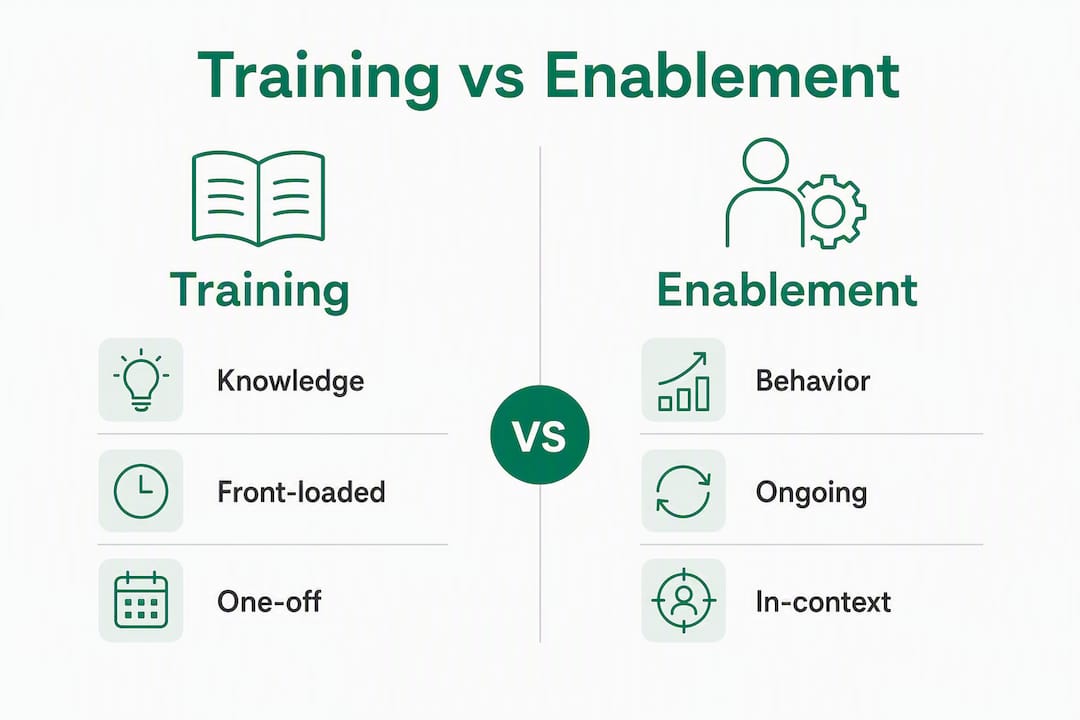
    Training is front-loaded and content-led. Think workshops, LMS modules, one-off certification courses, or a vendor-delivered “Copilot 101” session. The unit of change is knowledge. You measure it by completion rates and quiz scores. Typical deliverables: a recorded webinar, a SharePoint learning path, a certification badge.

    Enablement is ongoing and behavior-led. It embeds Copilot into the way people actually work through nudges, in-app guidance, playbooks, champions, and workflow templates. The unit of change is behavior. You measure it by daily active use, repeat rates on trained workflows, and time saved per task. Typical deliverables: a prompt library, a champions program, monthly office hours, and a telemetry dashboard.

    Dimension Training Enablement
    Unit of change Knowledge Behavior
    Timing Front-loaded, event-based Continuous, in-context
    Measurement focus Completion rate, quiz score DAU/WAU, workflow repeat rate
    Typical deliverables Workshops, LMS modules, certs Playbooks, champions, nudges, templates
    ROI signal Attendance Active weekly use, billable time recovered

    Infographic comparing Copilot training and enablement

    When to choose training only: your pilot group is technically confident, the use case is narrow and well-defined, and you need fast ramp in under two weeks.

    When to invest in full enablement: you’re rolling out to 50+ users across multiple roles, licenses are already deployed but underused, or you need to demonstrate ROI to partners or a CFO within 90 days.

    Hybrid approach: run a short role-based training sprint in weeks 1–2, then shift immediately to an enablement cadence (champions, nudges, office hours, measurement) for the remainder of the quarter.


    Why one-off training often fails to move the needle

    The most common Copilot failure pattern isn’t a bad tool. It’s a good tool deployed like a software update.

    Licenses go live. An IT team sends a “Copilot is now available” email. A vendor runs a 90-minute workshop. Completion rates hit 80%. Then nothing changes. Six weeks later, fewer than 20% of users have opened Copilot in the past week. That gap between training completion and sustained use is the core problem, and it’s structural, not motivational.

    Practitioner data from Cognician shows that activation-led programs produce measurable behavior change in 2–4 weeks in targeted pilots, while traditional LMS-based training metrics rarely reflect real workflow value at all. The mechanism is straightforward: training gives people knowledge they can’t immediately apply because there’s no in-work reinforcement, no manager accountability, and no role-specific context telling them which Copilot feature to use on which task today.

    Stat to watch: Everyday AI use rose from 54% to 76% in activation pilots, with some programs reporting sustained increases exceeding 200% over control groups. Training-only cohorts in the same studies showed minimal sustained gains.

    Four failure patterns show up repeatedly in mid-market rollouts:

    • No role mapping. Licenses deployed to everyone with the same generic training, regardless of whether a partner, associate, or analyst has different high-value use cases.
    • Training as a single event. One workshop, no follow-up, no reinforcement loop.
    • No in-work support. Users finish training and return to their desks with no prompt library, no template, and no one to ask.
    • Missing workflow-level measurement. The only metric tracked is license count or training completion, not whether anyone is actually using Copilot to draft proposals or summarize client calls.

    Signals that training has already failed in your firm:

    • Weekly active Copilot use is below 40% of licensed seats.
    • Champions are fielding all the questions because managers aren’t engaged.
    • Users report they “tried it once” but don’t know what to use it for.
    • No one can name a specific workflow where Copilot saved measurable time.

    What does an effective Copilot enablement program actually include?

    A program that moves the needle has six components. Budget and staff for all of them, or expect partial results.

    Hands writing Copilot enablement plan notes

    Role mapping and use-case prioritization. Start by identifying who benefits most from Copilot and on which tasks. In a law firm, that’s associates drafting matter summaries and partners reviewing contracts. In an accounting practice, it’s staff preparing client reports and managers reviewing workpapers. Microsoft’s enablement framework structures this across four phases: Get Ready, Launch, Onboard, and Optimize. Role mapping happens in Get Ready and drives everything downstream.

    In-app and in-context support. Embedded prompts, guided quests, and workflow templates placed inside the tools people already use. The goal is zero friction between “I need to do X” and “here’s how Copilot helps me do X right now.” This is where professional-services workflow templates for proposal drafting, client summaries, and matter intake pay off immediately.

    Playbooks and templates. Role-specific playbooks that show, step by step, how to use Copilot for the three or four tasks that matter most to each job function. Generic “here’s what Copilot can do” documentation doesn’t drive adoption. A one-page prompt card for a paralegal doing matter intake does.

    Champions and manager accountability. Champions are peer advocates who model Copilot use, share wins, and field questions. They work best when managers reinforce the behavior by asking about Copilot use in team meetings and tracking it in their own KPIs. Without manager accountability, champions burn out.

    Ongoing channels. Monthly office hours, a community of practice channel in Teams, a curated prompt library updated with real examples from your own workflows. These keep the program alive past week four.

    Activation mechanics. Small, guided daily challenges (5–10 minutes) beat long workshops for habit formation. A “use Copilot to summarize today’s longest email” challenge repeated for five days builds a habit that a two-hour workshop never will.

    Pro Tip: Design your first activation challenge around a task every participant does every single day. The lower the friction, the higher the completion, and the faster the habit forms.


    How do you design a Copilot enablement program from pilot to scale?

    The 90-day window is the right planning unit. Here’s how to structure it.

    Readiness assessment (pre-pilot, weeks -2 to 0). Audit your Microsoft 365 tenant for data governance gaps, sensitivity labels, and SharePoint permissions before Copilot touches live documents. Identify your pilot cohort: 15–30 users across two or three roles with high-value use cases and managers willing to participate. Pull baseline telemetry now so you have a before-state to compare against. The Microsoft 365 Copilot implementation guide covers the governance checklist in detail.

    Pilot design (weeks 1–4). Run role-based scenarios using real documents and real workflows, not demo data. Assign a short activation challenge each week. Measure daily active use and workflow repeat rates, not just satisfaction scores. Hold a weekly 30-minute debrief with champions to surface friction points fast.

    Rollout (weeks 5–8). Expand to the full user group with role-specific playbooks already refined from the pilot. Launch the champions program formally. Begin manager reporting: each manager receives a weekly one-page summary of their team’s Copilot use by workflow.

    Scale and sustain (weeks 9–12). Run a governance checkpoint: which licenses are dormant, which workflows are producing the most time savings, and where do you need to build small automations to close gaps Copilot can’t cover natively? Reallocate dormant licenses. Start the optimization retainer cadence.

    Phase Weeks Owner Key Output Leading KPI
    Readiness -2 to 0 IT + Operations Baseline telemetry report, governance checklist Data readiness score
    Pilot 1–4 L&D + Champions Role playbooks, activation challenges Weekly active use %
    Rollout 5–8 Line managers + L&D Manager dashboards, expanded playbooks Workflow repeat rate
    Scale 9–12 IT + Consulting partner License optimization, automation gaps closed Recoverable billable hours

    How do you measure Copilot adoption and ROI in a mid-market firm?

    Measure at four layers, in order of increasing business impact.

    Professional reviewing Copilot adoption metrics

    Usage: daily and weekly active users (DAU/WAU) as a share of licensed seats. This is your leading indicator. Below 40% WAU at week eight means the enablement program needs adjustment, not more training.

    Adoption of trained use cases: what percentage of users are using Copilot for the specific workflows you targeted? A firm that trained on proposal drafting should be able to show that Copilot is being used in Word for that task at a measurable rate.

    Productivity: time saved per task, measured by comparing before-and-after task completion times for specific workflows. A partner who spent 45 minutes drafting a client summary now spends 12 minutes reviewing and editing a Copilot draft. That’s 33 minutes recovered per instance.

    Business outcomes: recoverable billable hours and revenue impact. This is the number that gets a CFO’s attention.

    A simple model for a 100-person professional-services firm: if 60 users save an average of 30 minutes per day on Copilot-assisted tasks, that’s 30 hours per day across the firm. At a blended billable rate of $200/hour and a 50% recoverability assumption (not every saved minute becomes a billed minute), that’s $3,000 per day in recoverable billable time, or roughly $750,000 annually. Training vendors have cited substantial three-year ROI ranges in client marketing materials, though those figures depend heavily on assumptions and firm-specific recoverability rates. Build your own model using your actual billing rates and realistic recoverability percentages.

    Pro Tip: Track recoverable billable time at the workflow level, not the license level. A CFO who sees “60 licenses active” is unimpressed. A CFO who sees “33 minutes recovered per client summary, across 40 matters per week” starts asking how to expand the program.

    Measure business value at the workflow level, not just license counts or prompt volumes, to make the ROI case to partners and CFOs.


    Weeks 0–12 checklist: quick wins and red flags

    Week 0: readiness

    1. Pull baseline telemetry from Microsoft 365 admin center (active users, app usage, SharePoint permissions).
    2. Complete data governance and sensitivity-label audit.
    3. Select pilot cohort (15–30 users, 2–3 roles, engaged managers).
    4. Define three target workflows per role with measurable before-states.

    Weeks 1–4: pilot and activation

    1. Deliver role-based training sprint (max 90 minutes, real documents only).
    2. Launch week-one activation challenge (one specific daily task, 5–10 minutes).
    3. Stand up champions channel in Teams.
    4. Run weekly pilot debrief; log friction points and prompt failures.

    Weeks 5–8: role-based enablement

    1. Distribute refined role playbooks to full user group.
    2. Launch manager reporting cadence (weekly one-pager per team).
    3. Open monthly office hours (30 minutes, open Q&A format).
    4. Publish prompt library with real examples from pilot workflows.

    Weeks 9–12: measure and scale

    1. Pull telemetry comparison: baseline vs. current WAU and workflow repeat rates.
    2. Identify dormant licenses and reallocate or remediate.
    3. Close automation gaps with lightweight tools where Copilot alone isn’t enough.
    4. Present ROI report to leadership: time saved, billable hours recovered, next-quarter plan.

    Quick wins to capture early:

    • Prompt libraries for the three most common document types (proposals, summaries, intake forms).
    • A manager-led live demo in a team meeting, using a real current project.
    • License reallocation: move seats from non-users to high-value roles immediately.
    • A “Copilot win of the week” post in the champions channel to build social proof.

    Red flags that signal course correction:

    • WAU below 40% at week six despite training completion above 70%.
    • Champions fielding more than 80% of user questions (managers aren’t engaged).
    • No manager has referenced Copilot use in a team meeting by week four.
    • Prompt library hasn’t been updated since launch (no one owns it).
    • Users are using Copilot for low-value tasks (formatting, spell-check) but not for the target workflows.

    How Gozera turns Copilot licenses into measurable ROI

    Gozera’s methodology for mid-market professional-services firms follows a structured sequence that produces results before the 90-day mark.

    The engagement model:

    • Baseline telemetry audit: — pull actual usage data from the Microsoft 365 tenant to identify dormant licenses, underused features, and the workflows where Copilot is already being used (often without formal enablement).
    • Targeted enablement sprints: — role-specific playbooks, activation challenges, and champions setup, built around real client documents and workflows.
    • Automation gap-fill: where Copilot alone doesn’t cover a workflow, Gozera builds lightweight automations using Python or n8n to close the gap and capture the full time saving.

    Sample outcomes for a 75-person consulting firm:

    Metric Before engagement After 90-day sprint
    Target workflows with repeat use 0 tracked 4 workflows tracked and measured
    Estimated recoverable billable hours/week Not measured
    Dormant licenses reallocated Unknown 12 licenses moved to high-value roles

    Gozera engages in three stages: a fixed-price Copilot adoption audit, an integration sprint, and an optional ongoing optimization retainer. The audit alone typically surfaces enough dormant license and workflow data to justify the engagement cost within the first 30 days.


    Key Takeaways

    Enablement, not one-off training, is what converts Microsoft 365 Copilot licenses into measurable daily use and recoverable billable time for mid-market professional-services firms.

    Point Details
    Enablement beats training Sustained behavior change requires ongoing, in-context support, not a single workshop or LMS module.
    Measure at the workflow level Track DAU/WAU, workflow repeat rates, and recoverable billable hours, not just license counts or completion rates.
    90-day structure works A readiness audit, 4-week pilot, rollout, and scale phase fits the mid-market budget and timeline.
    Manager accountability is the multiplier Champions programs fail without manager reinforcement; make Copilot use a team-meeting topic from week one.
    Gozera accelerates the process Gozera’s telemetry audit, enablement sprints, and automation gap-fill deliver measurable ROI within 90 days for mid-market firms.

    What actually moves the needle in a Copilot rollout

    Most Copilot rollouts don’t fail because the tool is bad or the training was poorly designed. They fail because the program stops at knowledge transfer and never reaches behavior change. The firms that see real ROI share three things: they measure actual usage from day one (not just license counts), they make managers accountable for their team’s Copilot adoption, and they use small daily activation mechanics instead of relying on a single launch event to carry the program.

    Telemetry is the honest signal. It tells you whether the workshop changed anything, whether the champions are reaching the right people, and whether the workflows you targeted are actually being used. Without it, you’re managing a training program by attendance sheets. With it, you’re managing a productivity program by outcomes.

    The firms that skip the measurement infrastructure in week zero almost always end up repeating the enablement work six months later. The ones that build it first spend less time course-correcting and more time scaling what works.


    Gozera’s Copilot adoption consulting for mid-market firms

    Most mid-market firms have already paid for Copilot licenses. The problem isn’t access. It’s that those licenses are sitting idle while the firm absorbs the cost without the productivity gain.

    Gozera

    Gozera delivers a fixed-price Copilot adoption audit that surfaces exactly which licenses are dormant, which workflows are ready for Copilot integration, and where lightweight automation can close the gaps the tool can’t cover alone. A typical engagement produces a baseline telemetry report, a prioritized workflow map, quick-win automations, and a 90-day activation plan, all before a retainer conversation begins. For a 75-person consulting or law firm, that audit typically pays for itself in recovered billable time within the first month of the sprint.

    If your Copilot licenses have been live for more than 60 days and you can’t point to a specific workflow where the tool is saving measurable time, that’s the signal to act. Book a discovery call with Gozera at gozera.ai to scope your adoption audit.


    Useful sources and further reading

  • n8n vs Make in 2026: Which Platform Fits Your Firm?

    n8n vs Make in 2026: Which Platform Fits Your Firm?

    If your team writes code and cares about data residency, pick n8n. If your team is business-led and needs automations running in days, not weeks, Make.com is the faster path. The decisive factors are billing model and hosting: n8n charges per workflow execution and can run on your own infrastructure, while Make bills per operation (now called credits), which means every step inside a loop counts separately.

    Pick n8n when your firm self-hosts for compliance, runs high-volume or loop-heavy workflows, needs full JavaScript or Python nodes, or is building AI agents that require state and tool-calling. The per-execution billing model keeps costs flat as workflow complexity grows.

    Pick Make when your operations team needs to ship automations without developer support, your workflow volumes are modest and predictable, and you want 2,000+ prebuilt connectors without writing a single HTTP request.

    For mid-market professional-services firms, the ROI math often tips toward n8n once monthly workflow executions exceed a few thousand, especially when those workflows process rows of data in loops. Make’s per-operation credit model can multiply costs quickly in exactly those scenarios.


    Table of Contents

    How do n8n and Make compare across the dimensions that matter?

    Dimension n8n Make.com
    Best for / ideal user Developer-led teams, regulated firms, AI agent builders Citizen developers, ops teams, fast prototypers
    Hosting Self-host (Docker/Kubernetes) or cloud Cloud only
    Pricing model Per execution (cloud) or flat server cost (self-host) Per operation / credits; loops multiply cost
    Custom code support Full JavaScript and Python code nodes Limited inline JS functions
    Connector breadth ~400–500 native nodes + HTTP/GraphQL for any API 2,000+ prebuilt connectors
    Error handling Per-node retries, dedicated error workflows Per-module handlers, rollback options
    AI / agent capabilities Native AI Agent node, LangChain, MCP support AI connectors, Maia assistant, limited autonomous loops
    Ease of use Steeper ramp; developer-friendly canvas Polished visual canvas; low barrier to entry
    Enterprise / security Git export, self-host data control, SSO Cloud-managed team features, enterprise tier available

    Pro Tip: For mid-market professional-services firms, the single biggest cost lever is whether you self-host n8n. Moving from Make’s credit model to a self-hosted n8n instance can convert a variable monthly bill into a predictable server cost, which makes Copilot license ROI calculations far easier to defend to a managing partner.


    What are n8n and Make.com, and why does the difference matter?

    n8n is a fair-code workflow automation platform. You can run it on your own servers (Docker, Kubernetes, or a cloud VM) or use n8n Cloud. On the cloud tier, you pay per workflow execution regardless of how many nodes that workflow contains. Self-hosted, your cost is the server. That architecture matters for law and accounting firms because it means your client data, document content, and Copilot telemetry never leave infrastructure you control.

    Make.com (formerly Integromat, which is why you’ll still see “n8n vs Integromat” in older comparisons) is cloud-only. Its visual canvas is genuinely polished, and its library of 2,000+ prebuilt connectors covers nearly every SaaS tool a professional-services firm uses. The tradeoff is that every step in every scenario consumes credits, and that billing model behaves very differently from n8n’s once your workflows start processing batches of records.

    For context on where these two sit in the broader market: Zapier remains the dominant no-code option for simple point-to-point integrations, and Activepieces is an open-source alternative gaining traction for teams that want self-hosting without n8n’s learning curve. Neither replaces n8n or Make for complex, multi-step professional-services workflows, but they’re worth knowing as you evaluate the full field of n8n alternatives.

    The Copilot connection is direct: if you’re using Microsoft 365 Copilot and want to measure adoption via telemetry, route that telemetry through automation pipelines, or enrich Copilot outputs with external data, your automation platform becomes part of your compliance perimeter. Self-hosting n8n keeps that perimeter tight.


    What are the real feature differences between n8n and Make?

    Hosting and data residency

    n8n’s self-hosting option is its most consequential differentiator for regulated industries. A law firm or accounting practice running n8n on Azure or AWS in a specific region controls exactly where data lands. Make’s cloud infrastructure is managed by Make, and while enterprise tiers offer region selection, you’re still operating within their SaaS boundary. For Copilot adoption telemetry, that distinction affects what you can log, retain, and audit.

    Code and transformation flexibility

    n8n ships full JavaScript and Python code nodes, which means you can write arbitrary transformation logic, call external libraries, and build complex data-shaping steps inline. Make offers custom JavaScript function steps, but the scope is narrower: you can’t install npm packages or run multi-file Python logic. For workflows that ingest documents, normalize time entries, or feed a retrieval-augmented generation (RAG) pipeline, that gap is significant. n8n’s code nodes handle it natively; Make requires workarounds or external services.

    Logic, branching, and agent orchestration

    Both platforms support conditional routing and loops. The difference shows up at the edges. Make’s visual canvas makes simple branching intuitive, but deeply nested conditional logic or dynamic agent loops become brittle as scenario complexity grows. n8n’s node graph handles the same complexity more cleanly because developers can drop into code when the visual approach stops scaling. For AI agent workflows that require tool-calling, memory, or multi-step reasoning, n8n’s architecture is the better fit.

    Error handling and observability

    n8n gives you per-node retry configuration and dedicated error workflows: a separate workflow that triggers when the main one fails, with full access to the error context. That pattern maps well to production operations where you need alerts, logging, and automated recovery. Make’s per-module error handlers and rollback options cover most cases, but the observability story is thinner for teams that want to pipe errors into a monitoring stack like Datadog or PagerDuty.

    Operational maintainability

    Git export and developer-pattern support in n8n means workflows can live in version control alongside application code. CI/CD pipelines can deploy workflow changes the same way they deploy software. Make has no equivalent Git-first workflow. For a consulting firm that treats its automation library as a business-critical asset, that difference compounds over time.

    Pro Tip: Before you commit to either platform, export three of your most complex current automations and map every transformation step. That exercise will tell you whether you need code nodes or whether Make’s visual functions are sufficient. Most firms discover at least one workflow that requires real code.


    How does pricing actually work, and what will it cost your firm?

    Billing mechanics

    n8n Cloud charges per workflow execution. One execution = one run of a workflow, regardless of how many nodes it contains or how many records it processes. Self-hosted n8n has no per-run metering at all; your cost is the server.

    Make bills per operation, now called credits. Every module (step) in a scenario consumes one credit per execution. Loops multiply that: processing 500 invoice records through a 5-step scenario consumes 2,500 credits in a single run. That’s the hidden cost differential that catches teams off guard.

    Worked examples

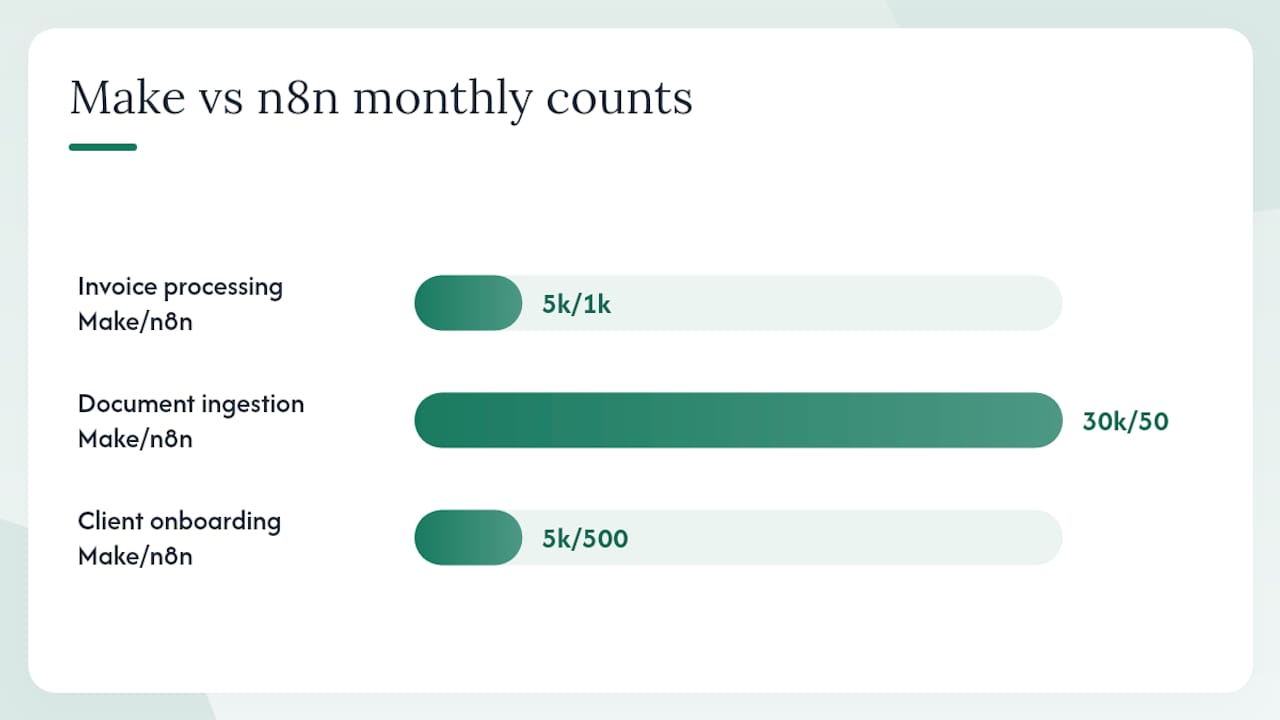
    Scenario A: Invoice processing automation
    A 5-step workflow that pulls invoices from a billing system, normalizes line items, pushes to a document store, updates a CRM record, and sends a Slack notification. Runs 1,000 times per month.

    Scenario B: Document ingestion with loop
    A workflow that ingests a batch of 200 contracts per run, extracts metadata from each (3 steps per record), and writes to a database. Runs 50 times per month.

    Scenario C: Client onboarding sequence
    A 10-step workflow that runs 500 times per month with no loops.

    Cost comparison summary

    Scenario Monthly volume Make operations n8n executions Primary cost driver
    Invoice processing (5 steps) 1,000 runs 5,000 ops 1,000 executions Step count (Make)
    Document ingestion (loop, 200 records, 3 steps) 50 runs 30,000 ops 50 executions Loop depth (Make)
    Client onboarding (10 steps, no loop) 500 runs 5,000 ops 500 executions Step count (Make)

    Cost comparison chart for n8n and Make

    The loop scenario is where Make’s credit model diverges sharply from n8n’s execution model. At scale, that divergence is the single largest unexpected line item for firms that started on Make and grew their automation library.

    Pro Tip: Run a 30-day credit audit on your Make account before any platform decision. Export your scenario history, identify the top five credit consumers, and calculate what those same workflows would cost on n8n Cloud or self-hosted. That single exercise often produces the business case for migration.


    What can each platform do with AI agents in 2026?

    n8n’s AI story in 2026 is meaningfully ahead of Make’s for teams building autonomous or semi-autonomous workflows. n8n ships a native AI Agent node with LangChain-style orchestration, MCP server/client support, and vector store integrations. You can build a looped agent that calls tools, checks memory, and routes based on model output, all within a single workflow. That architecture maps directly to Copilot-adjacent use cases: document Q&A pipelines, contract review assistants, and time-entry classification agents.

    Make has AI connectors and the Maia assistant, which handles agent-like behavior for simpler tasks. The gap is in autonomous loops: Make’s architecture doesn’t support the kind of iterative tool-calling that production AI agents require. Each AI module call also consumes credits, so a multi-turn agent conversation can burn through a credit allocation quickly.

    For Copilot workflows specifically, the practical consequences are:

    • Data control: — Self-hosted n8n keeps model inputs and outputs on your infrastructure, which matters when those inputs include privileged client documents.

    Pro Tip: If you’re building a RAG pipeline to enrich Copilot outputs with firm-specific knowledge, start with n8n’s vector store nodes and a self-hosted embedding model. You get full control over what gets indexed, and you avoid sending client documents to a third-party API as part of the ingestion process.

    For a broader look at AI automation tools for consultants, the agent architecture question is increasingly the deciding factor.


    Which platform should your team actually choose?

    Choose n8n when:

    • Your firm self-hosts for data residency, client confidentiality, or audit requirements
    • Workflows process large batches of records in loops (the billing math strongly favors n8n)
    • Your team includes developers comfortable with JavaScript or Python
    • You’re building AI agents, RAG pipelines, or Copilot-augmented workflows that need tool-calling
    • You need Git-based version control and CI/CD deployment for your automation library
    • You’re a law firm, accounting practice, or consulting firm with strict data handling obligations

    Choose Make when:

    • Your operations team needs to ship automations without developer involvement
    • Workflow volumes are low to moderate and loops are shallow or absent
    • You need broad connector coverage fast and don’t want to write HTTP requests
    • You’re prototyping Copilot-adjacent workflows before committing to a production architecture
    • Your firm is under 100 people and automation is not yet a core operational dependency

    Real mid-market examples where the choice is clear: a 150-person accounting firm running nightly batch reconciliations across 3,000 client records should be on n8n. A 60-person consulting firm that needs to automate proposal generation and CRM updates with no developer on staff should start with Make.

    For workflow automation examples specific to professional services, the pattern holds: complexity and volume tip toward n8n, simplicity and speed tip toward Make.


    What does migration or deployment actually look like?

    Migration mechanics

    Moving from Make to n8n is non-trivial but manageable because both platforms use node-graph mental models. The main refactor work is in transformations: Make’s inline functions and proprietary formatting need to be rewritten as JavaScript or Python code nodes in n8n. Treat each transformation rule as a discrete task, test it with representative data, and don’t try to migrate everything at once.

    Implementation checklist

    • Map scenarios to workflows: — Document every Make scenario, its trigger, step count, and monthly operation volume before touching n8n.
    • Establish CI/CD: — Export workflows to Git, set up a deployment pipeline, and define a promotion process from dev to production.

    Realistic timeline: A firm migrating 20–30 workflows with moderate complexity should budget 6–10 weeks with a platform engineer and an automation owner. Simpler libraries (under 10 workflows, no loops) can move in 2–3 weeks.

    Required roles: Platform engineer or DevOps (self-hosting setup), automation engineer (JS/Python refactoring), and an automation product owner who tracks Copilot adoption metrics through the transition.

    Pro Tip: Run a three-workflow pilot before committing to full migration. Pick one simple workflow, one loop-heavy workflow, and one AI-enabled workflow. Measure execution cost, error rate, and developer time on each. Those three data points will either confirm the migration case or reveal a gap you hadn’t anticipated.


    How do the two platforms handle security and compliance?

    For U.S. professional-services firms, the compliance question usually comes down to one thing: where does client data go, and who controls it?

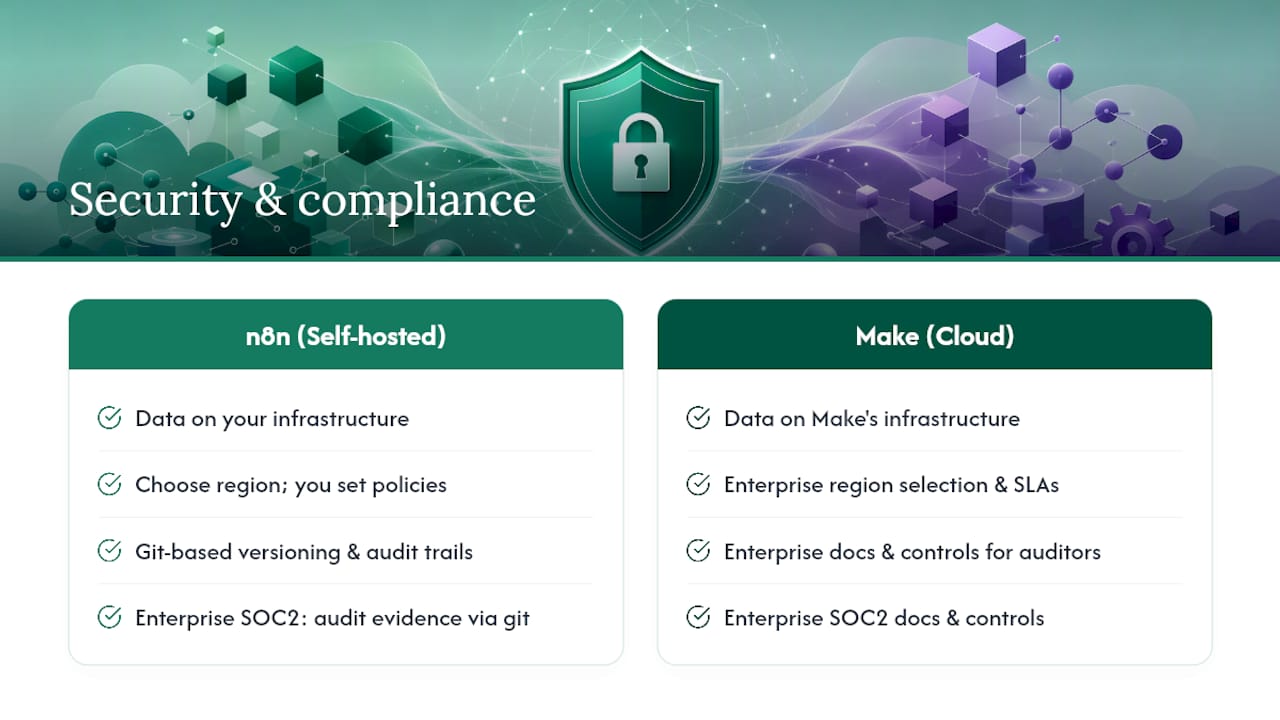
    Self-hosting n8n answers that question cleanly. Your data stays on infrastructure you own, in the region you choose, under the logging and retention policies you set. That matters for law firms under attorney-client privilege obligations, accounting firms handling tax data, and any firm subject to state-level data privacy laws. Git-based versioning and developer audit patterns also make it easier to demonstrate to auditors exactly what a workflow does and when it changed.

    Make’s cloud model is not inherently insecure, but it shifts control to Make’s infrastructure team. Enterprise tiers offer region selection and enhanced SLAs. For SOC 2 alignment, Make’s enterprise tier provides the documentation and controls most firms need. SSO is available on both platforms at enterprise pricing.

    On HIPAA and regulated workflows: Neither platform is a HIPAA Business Associate by default. If your workflows touch protected health information, you need a signed Business Associate Agreement with your platform vendor and must verify that the vendor’s infrastructure meets the technical safeguard requirements. Self-hosted n8n on your own HIPAA-compliant infrastructure sidesteps the vendor BAA question entirely, but introduces your own infrastructure compliance obligations. Consult qualified legal counsel before routing regulated data through any automation platform.

    For Copilot telemetry specifically, self-hosting n8n means your adoption metrics, usage logs, and workflow outputs never leave your environment. That’s a meaningful advantage when you’re trying to build a defensible ROI case for Copilot licenses without exposing firm data to a third-party SaaS platform.

    For regulated-industry context, workflow automation guidance for law firms covers the compliance framing in more detail.

    This section provides general information, not legal or compliance advice. Confirm current requirements with a qualified attorney or compliance professional.


    How do the two platforms handle security and compliance? — overview diagram

    How do connectors and extensibility compare?

    Make’s connector library is its strongest card: roughly 2,000+ native integrations covering the full range of SaaS tools a professional-services firm uses, from billing platforms to document management systems to CRM. For most common integrations, you click, authenticate, and you’re done.

    n8n’s native node set is smaller, around 400–500 nodes, but the HTTP Request node covers the gap for any REST API, and the GraphQL node handles structured query APIs. In practice, most professional-services integrations that aren’t in n8n’s native library are reachable via HTTP with a few lines of configuration.

    For Microsoft 365 specifically, both platforms connect to the Graph API, SharePoint, Teams, and Exchange. n8n’s approach requires more manual configuration; Make has polished Microsoft 365 modules that non-developers can configure without reading API documentation. If Copilot-adjacent workflows need to read from SharePoint or write to Teams channels, Make’s modules get you there faster. n8n gets you there with more control over exactly what the request looks like.

    Extension paths differ significantly:

    • n8n: — Build custom nodes as npm packages, publish them to the community node registry, and install them on your self-hosted instance. Long-term maintenance is your responsibility, but you own the code.
    • Make: — Use the Make Developer Hub to build custom apps. The process is more structured and less code-heavy, but you’re building within Make’s ecosystem and subject to their platform changes.

    For teams evaluating Microsoft 365 workflow tools, the connector question is often secondary to the billing model and hosting question. Don’t let a large connector count drive the decision if the billing model will hurt you at scale.


    What skills and team structure does each platform require?

    Make’s polished visual canvas genuinely reduces the ramp time for citizen developers. An operations analyst with no coding background can build a functional Make scenario in a day. That speed is real and valuable for firms that need to automate quickly without hiring a developer.

    n8n requires more. A developer comfortable with JavaScript or Python will be productive within a week. A non-developer will struggle with code nodes, credential configuration, and self-hosting setup. The learning curve is steeper, and the payoff is proportional.

    Recommended team composition by platform:

    For Make:

    • Automation owner (operations background, no coding required)
    • Optional: IT administrator for credential management and enterprise tier configuration

    For n8n:

    • Platform engineer or DevOps (self-hosting, monitoring, patching)
    • Automation engineer (JavaScript or Python, API experience)
    • Automation product owner (tracks Copilot adoption metrics, owns the ROI reporting)

    The product owner role is often overlooked. Someone needs to translate workflow performance into Copilot license utilization data and present that to managing partners. Without that role, automation investment stays invisible to firm leadership.

    Onboarding cadence: Start with a two-day internal workshop to map the firm’s top 10 automation candidates. Assign ownership to each. Run the first three workflows in parallel with manual processes for two weeks before going live. That approach limits disruption to billable work while building team confidence.


    What does the cost and ROI look like for a real mid-market firm?

    Assumptions: A 120-person accounting firm with 80 Copilot licenses. Monthly automation volume: 3,000 workflow executions, including 200 batch document-processing runs that loop through 150 records each with 4 steps per record.

    Monthly operation count under Make:

    • Standard workflows: 2,800 runs × average 6 steps = 16,800 operations
    • Batch loops: 200 runs × 150 records × 4 steps = 120,000 operations
    • Total: approximately 136,800 operations/month

    Monthly cost under n8n Cloud:

    • 3,000 executions/month (loop depth irrelevant to billing)

    Self-hosted n8n:

    • Server cost (a mid-range cloud VM): approximately $80–$150/month depending on provider and configuration, with no per-execution charge
    Model Monthly volume Estimated monthly cost Primary cost driver
    Make (credit model) ~136,800 ops Varies by plan tier; loop-heavy volume pushes into higher tiers Loop depth × step count
    n8n Cloud 3,000 executions Scales with execution count, not step count Execution volume
    n8n self-hosted Flat server cost ~$80–$150/month infrastructure Server + ops labor

    For Copilot ROI, the firm recovers billable time through automation of document ingestion, time-entry normalization, and client onboarding tasks. If automation frees two hours per week per attorney across 40 attorneys at a $300 blended rate, that’s $24,000 in recoverable billable time per month. The workflow automation ROI case for professional services follows that same structure.

    Implementation timeline for this firm: 8 weeks. Weeks 1–2: environment setup and credential migration. Weeks 3–5: workflow refactoring and parallel testing. Weeks 6–7: Copilot pipeline validation. Week 8: cutover and monitoring.

    Pro Tip: Build the business case around recoverable billable hours, not platform cost savings. A managing partner responds to “$24,000 in recovered time per month” far more readily than “we saved $800 on software credits.” Telemetry from n8n’s execution logs gives you the data to make that calculation credible.


    Key Takeaways

    For mid-market professional-services firms, n8n’s execution-based billing and self-hosting option make it the stronger long-term choice when workflow volume is high, loops are common, or data residency is a compliance requirement.

    Point Details
    Billing model is the decisive factor Make’s per-operation credits multiply fast in loop-heavy workflows; n8n’s per-execution model stays flat.
    Self-hosting controls both cost and compliance Self-hosted n8n converts variable credit bills into a predictable server cost and keeps client data on your infrastructure.
    Code flexibility determines AI agent viability Full JavaScript and Python nodes in n8n support RAG pipelines and agent loops that Make’s inline functions cannot replicate.
    Team skill set drives platform fit Make suits citizen developers shipping fast; n8n suits developer-led teams building for scale and auditability.
    Gozera accelerates the ROI case Gozera’s telemetry-driven audit identifies which workflows to migrate first and translates automation savings into a Copilot license ROI report partners can act on.

    What practitioners learn after the first migration

    The conventional wisdom on automation platform selection focuses on connector count and UI polish. Both matter less than you’d expect once you’re six months into production.

    What actually determines whether a platform choice succeeds at a mid-market firm is whether the billing model stays predictable as the automation library grows. Teams that start on Make for its ease of use consistently hit a moment, usually around month four or five, where a new batch-processing workflow causes the monthly credit bill to spike in a way nobody anticipated. That’s not a Make failure; it’s a mismatch between the billing model and the workflow pattern.

    The other thing practitioners consistently underestimate is the ops burden of self-hosting. “Free” self-hosted n8n is not free: it requires patching, monitoring, backup management, and someone who knows what to do when the container crashes at 2 AM during a client deadline. Budget that labor explicitly, or the TCO calculation will look better on paper than it does in practice.

    The firms that get the most from their automation investment are the ones that treat it as a product, not a project. They assign an automation product owner, track execution metrics, and review the library quarterly. That discipline is what turns Copilot license spend from a sunk cost into a measurable productivity asset.


    Gozera turns your automation platform decision into a Copilot ROI result

    Most firms spend weeks comparing platforms and months second-guessing the choice. Gozera skips that cycle. The firm’s managed audit identifies your highest-value automation candidates, measures current Copilot license utilization via telemetry, and delivers a prioritized workflow build plan in weeks, not quarters.

    Gozera

    The engagement runs as a fixed-price sprint: baseline measurement first, then workflow builds using n8n and Python to close the gaps Copilot alone doesn’t cover, then a monthly optimization retainer that tracks recoverable billable hours and keeps license utilization visible to firm leadership. No open-ended change management. No guessing at ROI.

    If you’re evaluating n8n vs Make and want the decision grounded in your firm’s actual workflow volumes and Copilot adoption data, book a Copilot ROI audit with Gozera and get a clear answer in days.


    Useful sources and further reading

  • Graph Connectors for Copilot: IT Leader’s Practical Guide

    Graph Connectors for Copilot: IT Leader’s Practical Guide

    Microsoft 365 Copilot connectors let you bring external line-of-business data into Copilot either by indexing it (synced model) or by fetching it live at query time (federated model). For most mid-market professional-services firms, the right starting point is a focused synced connector proof-of-concept targeting one high-value knowledge repository, such as matter files, client engagement docs, or a billing knowledge base. Reserve the federated model for regulated or live data that legally or operationally cannot leave its source system.

    TL;DR:

    • Synced connectors index external content into Microsoft Graph for semantic search and Copilot reasoning. Best for knowledge repositories, matter files, and searchable documentation.
    • Federated connectors fetch live data at query time via Model Context Protocol (MCP). Best for regulated, real-time, or source-locked data.
    • Start narrow: pick one high-frequency data object type, run a 4–8 week PoC, and measure time-to-answer improvement and recoverable billable hours.
    • Next step: map your top three staff queries that Copilot fails today, then select the connector model and data source that closes that gap.

    Table of Contents

    What connector model should you use for Copilot?

    Microsoft 365 Copilot supports two primary connector models: synced connectors, which ingest and index external content into Microsoft Graph for semantic search and Copilot reasoning, and federated connectors, which perform query-time fetches without indexing. Choosing the wrong model does not just affect performance — it can either expose sensitive data you never intended to index or leave critical information effectively invisible to Copilot.

    Synced vs. federated: what actually differs

    Capability Synced connector Federated connector
    Data movement Ingested into Microsoft Graph index Stays at source; fetched at query time
    Semantic indexing Yes (content, title fields) No
    Copilot grounding quality High (ranked, contextual results) Moderate (real-time, citation-based)
    Authentication model App-level, admin-consented OAuth 2.0, user-level or app-level
    Latency Low (pre-indexed) Higher (live fetch per query)
    Best for Knowledge repos, matter docs, policies Live financial data, regulated records
    Data residency control Data copied to Microsoft Graph Data never leaves source

    The practical decision path is straightforward. Choose synced when your team needs Copilot to discover content across a corpus, when semantic search quality matters, and when the data can be copied to Microsoft Graph under your data governance policy. Choose federated when the data must remain at source for regulatory reasons, when it changes too frequently to index usefully, or when user-level authorization at query time is a hard requirement.

    For a law firm, this often means synced connectors for precedent libraries and standard operating procedures, and federated connectors for live matter billing records in a practice management system. An accounting firm might index client engagement templates via synced while keeping live general ledger data federated.

    Pro Tip: Before committing to a model, run a quick data classification exercise. If any field in the target dataset is subject to attorney-client privilege, HIPAA, or SOC 2 scope, involve your compliance officer before scoping the connector. Federated connectors eliminate the indexing risk entirely for those datasets.


    How do Copilot connectors actually work?

    The architecture flows in one direction: data source to connector to Microsoft Graph to Copilot surface. Understanding each stage tells you where to invest implementation effort and where failures hide.

    Team reviewing connector architecture diagrams

    For synced connectors, the pipeline starts with an externalConnection, which is the logical container registered in Microsoft Graph that holds your schema and ingested items. Inside that connection, you define an externalItem schema — the field definitions, property types, and semantic labels that tell the indexer what each piece of content means. Items are ingested as externalItem objects with a content property (the full text Copilot reasons over), a properties bag (structured metadata), and an ACL (the permission list that controls who can see each item).

    Semantic indexing improves retrieval quality by enabling approximate and contextual matches and understanding relationships between data points. The content and title fields are the primary indexed fields. Semantic labels — like title, url, createdBy, and lastModifiedDateTime — help Copilot interpret metadata correctly, though they affect filtering and display rather than the semantic index itself.

    Copilot connectors act as essential knowledge sources and must be added at the agent level or via generative answers nodes to ground Copilot and custom agents in line-of-business data. Without a connector, Copilot reasons only over standard Microsoft 365 content — emails, Teams messages, SharePoint files the user already has access to. Connectors extend that corpus to proprietary databases, external SaaS tools, and on-premises repositories.

    The urlToItemResolver is a component many teams skip and later regret. Adding a urlToItemResolver allows Copilot to detect shared URLs and user activity data helps improve item ranking in search and Copilot answers. Without it, items may be indexed but rank poorly in Copilot responses.

    For on-premises sources, the Microsoft Graph connector agent sits between your internal network and the Microsoft Graph ingest endpoint. It handles crawl scheduling, delete/difference detection, and identity mapping for ACL stamping. For cloud-to-cloud connectors, no agent is required — the connector calls the Graph API directly.

    Sysadmin typing in server room setup

    Copilot Studio and the Microsoft 365 Agents Toolkit integrate connectors as knowledge sources at the agent level. When a user asks a question, Copilot retrieves semantically relevant items from the index, applies security trimming (ACL check), and surfaces citations inline in its response.


    How to build a custom synced Copilot connector

    This is the implementation path most IT teams at professional-services firms will follow for their first connector PoC. The steps below assume a cloud-hosted data source; on-premises variations are noted where they diverge.

    1. Register an Azure AD application. Create an app registration in Entra ID, grant the ExternalConnection.ReadWrite.OwnedBy and ExternalItem.ReadWrite.OwnedBy Microsoft Graph application permissions, and obtain admin consent. This is the identity your connector uses to write to Microsoft Graph.

    2. Create the externalConnection. POST to /external/connections with a unique id, a display name, and a description. The connection ID cannot be changed after creation, so name it deliberately (e.g., matterfiles-prod).

    3. Define the schema. POST to /external/connections/{id}/schema. Map your source fields to typed properties (String, DateTime, Boolean, Int64). Apply semantic labels where they fit: title, url, createdBy, lastModifiedDateTime, fileName. Mark high-value text fields as isSearchable: true and isContent: true. The content property is what Copilot reads when generating answers — populate it with the richest, most relevant text from each item.

    4. Implement ingestion. PUT each item to /external/connections/{id}/items/{itemId}. Include the content object (type text or html), the properties bag, and the acl array. Batch ingestion in parallel where your source API allows; the Graph API supports concurrent item writes.

    5. Stamp ACLs correctly. Each acl entry specifies a principal (user, group, or everyone), an access type (grant or deny), and an identity source (azureActiveDirectory or onPremisesActiveDirectory). Mirror your source system’s permissions exactly. A mismatch here means users either cannot see content they should or — worse — can see content they should not.

    6. Add urlToItemResolver. Update the connection to include a urlToItemResolver that maps source URLs back to item IDs. This is required for Copilot to surface items when users share links and for improving ranking signals.

    7. Deploy the connector agent (on-premises only). Download the agent from the Microsoft 365 admin center or the SDK docs. Install it on a Windows Server with outbound HTTPS access to Microsoft Graph. Configure it with your app registration credentials — use a certificate, not a client secret, in production.

    8. Enable inline results. In the Microsoft 365 admin center, navigate to Search & Intelligence, find your connection, and enable it for inline results in Copilot. Without this step, indexed content will not surface in Copilot responses even if it appears in Microsoft Search.

    9. Validate and monitor. Run test queries in Copilot and Microsoft Search. Confirm items appear, citations are correct, and ACLs are trimming as expected.

    Pro Tip: The most common reason ingested content stays invisible in Copilot is a missing or misconfigured urlToItemResolver, combined with no user activity signals. Add both before your first validation query. Also, schema changes after initial ingestion require a full re-crawl — plan your schema carefully before the first ingest run, because retrofitting it costs time.

    For SDK and code samples, the Copilot connectors SDK overview covers the agent download, TypeScript and .NET sample repos, and the ingestion SDK. The GitHub samples under microsoft-graph/msgraph-connectors-samples are the fastest starting point for a PoC.


    How do federated connectors handle live data?

    Federated connectors use the Model Context Protocol (MCP) to fetch data at query time. When a user asks Copilot a question, Copilot calls the federated connector’s MCP server, which queries the source system in real time and returns a structured response. That response is included in Copilot’s context window alongside any indexed content, and Copilot cites the MCP server response inline.

    Authentication patterns

    Federated connectors support two auth patterns. Delegated (user-level) auth uses OAuth 2.0 with the signed-in user’s identity, meaning the connector queries the source system as that user and inherits their permissions. This is the right choice when source-system row-level security must be preserved at query time. Application-level auth uses a service principal, which is simpler to implement but requires careful scoping to avoid over-permissioning.

    For most professional-services scenarios involving regulated data, delegated auth is the safer default. It ensures that a partner who queries a federated connector for client billing records sees only the records their source-system role permits.

    Performance and latency

    Because federated connectors fetch live, every Copilot query that triggers the connector adds a round-trip to your source system. For APIs with sub-200ms response times, this is negligible. For slower systems, consider response caching at the MCP server layer with a short TTL (30–60 seconds for near-real-time data). Avoid federated connectors for sources with response times above 2–3 seconds — users will notice the delay in Copilot’s answer latency.

    One limitation worth stating plainly: federated connectors do not benefit from semantic indexing. Copilot cannot perform approximate or contextual matches across a federated corpus the way it can with indexed content. The connector must return well-structured, relevant responses to each query, because Copilot cannot compensate for a poorly scoped MCP response the way the semantic index can compensate for imperfect queries against indexed content.


    Which prebuilt connectors cover common enterprise sources?

    Microsoft and its partners provide more than 100 prebuilt connectors covering file stores, enterprise SaaS apps, and developer platforms. Before scoping a custom connector build, check the connector gallery — a prebuilt connector cuts PoC time from weeks to days.

    Common prebuilt connectors relevant to professional-services firms, mapped to their primary use cases:

    • SharePoint — intranet knowledge bases, policy libraries, engagement templates, and standard operating procedures. Often the first connector to enable because the content is already in Microsoft 365.
    • ServiceNow — IT incident tracking, change management records, and internal service catalog. Useful for IT-heavy consulting and engineering firms.
    • Salesforce — client relationship data, opportunity history, and account notes. Valuable for business development and client-facing teams at consulting firms.
    • Jira — project and issue tracking, sprint history, and engineering backlogs. Relevant for technology consulting and software engineering practices.
    • Azure DevOps — code repositories, work items, pipeline history, and release notes. Primarily useful for internal IT teams and software-focused practices.
    • Google Drive / Box — external file stores for firms that maintain hybrid cloud document environments alongside Microsoft 365.
    • Network file shares and SQL databases — on-premises repositories requiring the connector agent; common in accounting and legal firms with legacy document management systems.

    For HR and payroll systems, prebuilt connectors are less common. Most firms in this category build a custom synced connector against their HRIS API, indexing only non-sensitive fields (role, department, skills) and excluding compensation data entirely.

    The Copilot connectors gallery is the canonical starting point. Filter by category and check whether a Microsoft-built or partner-built connector exists before writing a single line of custom code. For law firms specifically, the intersection of compliance requirements and data sensitivity means it is worth reviewing why specialized data governance matters for legal practices before selecting which sources to index.


    How do you secure connector data and stay compliant?

    Security in Copilot connectors is not a post-deployment concern. It is a design constraint that shapes every schema and ingestion decision.

    ACL stamping is the foundation. Every externalItem must carry an ACL that mirrors the source system’s permissions. Microsoft Graph applies security trimming at query time — users only see indexed items their ACL grants them access to. If you ingest an item with an overly permissive ACL (or no ACL), that item becomes visible to everyone with access to Copilot. For a law firm, that could mean a paralegal seeing a partner’s privileged communication. Map source permissions to Graph ACLs before the first ingest run, not after.

    For cloud connectors, the same principle applies to your app registration: rotate secrets on a schedule if you must use them, but prefer certificate-based auth from day one. Client secrets that live in config files or environment variables are a breach waiting to happen in a professional-services environment where staff turnover is real.

    PII handling requires deliberate scoping. Minimize what you index in the content field. If a source document contains client PII alongside the substantive content Copilot needs, pre-process the content before ingestion to strip or anonymize the PII. Apply Microsoft Purview sensitivity labels to the externalConnection where your data classification policy requires it. Purview integrates with connector workflows to enforce retention and labeling policies on indexed content.

    Data residency is a concern for firms with international clients or cross-border data obligations. Synced connectors copy data into Microsoft Graph, which stores it in the tenant’s data residency region. Confirm your Microsoft 365 tenant’s data residency configuration before indexing content subject to GDPR, state privacy laws, or client contractual restrictions. When data residency is a hard constraint, federated connectors are the correct architectural choice — the data never leaves its source.

    For a governance review checklist before ingestion: confirm data classification, verify ACL mapping, obtain legal sign-off on what can be indexed, document the data flow for your compliance register, and set a retention policy for the externalConnection.


    How do you validate, monitor, and maintain connectors in production?

    A connector that passes initial testing can still degrade quietly. Sync failures, ACL drift, and schema mismatches accumulate over time if you are not watching the right signals.

    Validation checklist for PoC

    Run these checks before declaring a PoC complete:

    • Query Copilot with five representative questions your staff actually ask. Confirm indexed items appear as citations.
    • Verify urlToItemResolver by sharing a source URL in a Teams chat and confirming Copilot recognizes and surfaces the corresponding indexed item.
    • Test ACL trimming: log in as a user who should NOT have access to a specific item and confirm it does not appear in their Copilot results.
    • Check ingestion error logs in the Microsoft 365 admin center under Search & Intelligence. Any items with ingestion errors are invisible to Copilot.

    Telemetry and monitoring

    For Copilot telemetry, track index health (item count vs. expected count), sync latency (time from source update to index update), ingestion error rate, and — for federated connectors — query latency per request. In Copilot itself, track citation frequency: how often does Copilot cite your connector’s content in responses? A low citation rate despite a healthy index usually points to a schema or urlToItemResolver problem.

    Set alerts on ingestion error rate thresholds and on sync jobs that have not completed within their expected window. The connector agent logs are the first place to look for on-premises sync failures; check them before escalating to Microsoft support.

    Schema updates and versioning

    Schema changes in production require care. Adding a new property to an existing schema is generally safe and triggers an incremental re-index. Changing a property type or removing a property requires deleting and recreating the externalConnection, which means a full re-ingest. Plan schema changes during low-usage windows and maintain a staging externalConnection for testing schema updates before applying them to production.

    For version control, treat your connector code and schema definition as you would any production application: source control in Git, change review process, and a documented rollback procedure.


    Gozera’s implementation checklist for your first connector PoC

    This is the rollout template Gozera uses with mid-market professional-services clients. It is scoped for a 4–8 week PoC that produces a measurable result, not a proof of technology.

    1. Week 1: Source selection and data classification. Identify the top three questions staff ask that Copilot currently cannot answer. Map each to a data source. Run data classification on each source to determine connector model (synced vs. federated) and governance requirements.

    2. Week 2: Schema design and app registration. Define the externalItem schema for your chosen source. Map source fields to Graph properties, apply semantic labels, and plan the ACL mapping. Register the Azure AD app and obtain admin consent.

    3. Week 3: Ingestion pipeline build. Implement the ingestion code using the Copilot connectors SDK. Run a small-batch test ingest (100–500 items). Validate schema, ACLs, and urlToItemResolver in a non-production connection.

    4. Week 4: Full ingest and validation. Run the full ingest. Execute the validation checklist above. Fix any schema or ACL issues before user testing.

    5. Weeks 5–6: User testing and telemetry baseline. Enable the connector for a pilot group (10–20 users). Collect baseline telemetry: time-to-answer for target queries, citation frequency, and user-reported confidence in Copilot responses. For Copilot workflow integration, map connector outputs to specific billable tasks.

    6. Weeks 7–8: ROI measurement and production decision. Measure time-to-answer improvement against baseline. Estimate recoverable billable hours based on time saved per query type and query frequency. Calculate license utilization uplift. Present findings to stakeholders and make the go/no-go decision for production deployment.

    ROI metrics to track during PoC:

    • Time-to-answer improvement for target query types (before vs. after connector)
    • Citation-driven task completion rate (did Copilot’s answer include a connector citation that led to task completion?)
    • Recoverable billable hours per week (time saved × billing rate × query frequency)
    • Copilot license utilization rate (active users / licensed users, measured via telemetry)

    Pro Tip: Pick your first connector target based on query frequency and billable impact, not data volume. A connector that answers 50 high-value queries per day for a team of 10 attorneys delivers more measurable ROI than one that indexes 500,000 documents nobody searches for. Start small, measure fast, and expand.

    For production deployment, the checklist adds: governance sign-off documentation, agent hardening (certificate auth, network firewall rules), SLA definition for sync frequency, telemetry baseline established, and runbooks written for the operations team. Schedule month-1 and month-3 ROI check-ins against the PoC baseline. The Microsoft 365 Copilot implementation guide covers the broader governance and deployment framework if you need it alongside the connector-specific steps.


    Key Takeaways

    Graph connectors for Copilot deliver measurable ROI only when the connector model matches the data’s governance requirements, the schema is designed for semantic retrieval, and ACLs mirror source permissions exactly.

    Point Details
    Choose the right model first Use synced connectors for searchable knowledge repos; use federated for regulated or live data that cannot be indexed.
    Schema and ACLs are non-negotiable Missing urlToItemResolver and misconfigured ACLs are the two most common reasons indexed content stays invisible or leaks to wrong users.
    Start narrow in your PoC Target one high-frequency data object type; measure time-to-answer and recoverable billable hours before expanding scope.
    Prebuilt connectors save weeks Check the connector gallery first — SharePoint, ServiceNow, Salesforce, Jira, and Azure DevOps are available prebuilt and cut PoC time significantly.
    Gozera accelerates PoC delivery Gozera’s fixed-price PoC sprints include schema design, connector build, agent installation, telemetry setup, and ROI measurement for mid-market professional-services firms.

    The part most teams get wrong about connector projects

    The technical implementation of a Copilot connector is genuinely not that hard. Microsoft’s SDK is well-documented, the Graph API is consistent, and the prebuilt connector gallery covers most common enterprise sources. What trips teams is everything that happens before and after the code.

    Schema decisions made in week two become expensive constraints in week eight. I have seen firms ingest 200,000 documents with a schema that omitted semantic labels on the title field, then wonder why Copilot was not citing their content. The fix required a full re-ingest. That is a week of work that a 30-minute schema review would have prevented.

    The governance gap is just as common. A team gets excited about indexing client matter files, builds the connector, and then discovers in week six that legal has concerns about what is being indexed and who can see it. The PoC stalls for a compliance review that should have happened in week one. Bring legal and compliance into the scoping conversation before writing any code.

    The organizational challenge underneath all of this is that connector projects require cross-functional sponsorship. IT builds the connector. Legal approves what gets indexed. Operations defines the target queries. The managing partner signs off on the ROI case. When any one of those stakeholders is not engaged from the start, the project either stalls or delivers a technically correct connector that nobody uses.

    The firms that get this right treat the connector project as a workflow reengineering initiative with a technical component, not a technical project with a workflow component. That framing changes who is in the room, what gets prioritized, and how success is measured. Telemetry-driven KPIs — citation frequency, time-to-answer, recoverable billable hours — keep the conversation grounded in outcomes rather than features.


    Gozera’s Copilot connector services: PoC to production

    Mid-market professional-services firms that have tried to run connector projects internally often hit the same wall: the technical work is manageable, but the combination of schema design, governance review, agent configuration, and ROI measurement is more than an already-stretched IT team can absorb alongside their day job.

    Gozera

    Gozera runs fixed-price connector PoC sprints that cover the full stack: source selection and data classification, schema and semantic label design, connector build using the Microsoft Graph SDK, agent installation for on-premises sources, ACL mapping and governance review, telemetry setup, and a documented ROI measurement report at the end of the engagement. The typical engagement runs 6–8 weeks and delivers a production-ready connector with a measurable baseline for time-to-answer improvement and license utilization uplift. There are no open-ended retainers required to start — the PoC is a fixed scope with a defined output.

    If your Copilot licenses are sitting idle because the out-of-the-box experience does not reach your firm’s actual knowledge, a connector PoC is the fastest path to changing that. Request a Copilot connector assessment and Gozera will scope a PoC against your highest-value data source within one week.


    The resources below are the canonical references for planning and executing a Copilot connector implementation:

    Save these links to your implementation ticket before your first sprint planning session. The SDK samples and the connector agent docs are the two you will return to most often during build.

  • NetDocuments vs iManage: Which DMS Fits Your Firm?

    NetDocuments vs iManage: Which DMS Fits Your Firm?

    NetDocuments is the faster, lower-overhead choice for cloud-first mid-market law firms. iManage is the deeper, more configurable platform for large firms with dedicated IT and complex governance requirements. The deciding factor is rarely features — it’s your deployment model, IT capacity, and how tightly you need Microsoft 365 and Copilot woven into daily workflows.

    • Cloud-first, mid-market firms: NetDocuments deploys faster, demands less IT overhead, and its browser-first architecture reduces the friction that kills Copilot adoption.
    • Large firm or enterprise legal (300+ seats, complex governance): iManage Work gives you granular ethical walls, advanced records management, and private-cloud or on-prem control that NetDocuments cannot match.
    • Microsoft 365 / Copilot priority: Both platforms integrate with Outlook and Office, but the quality of that integration in real daily workflows — not in a vendor demo — determines whether your Copilot licenses pay for themselves or sit idle.

    One TCO caveat worth stating upfront: implementation, reseller fees, and ongoing admin routinely dwarf the per-user license cost for both platforms. Budget accordingly before you compare sticker prices.


    Table of Contents

    How do NetDocuments and iManage compare on the dimensions that matter?

    The table below maps the core decision dimensions IT buyers actually use. Read it alongside your firm’s must-have list, not as a scorecard.

    Dimension iManage / iManage Work NetDocuments
    Deployment model On-prem, private cloud, or iManage Cloud Cloud-native SaaS only
    Best for Large firms, enterprise legal, AmLaw 200 Mid-to-large cloud-first firms, professional services
    Admin complexity High — dedicated IT or reseller typically required Moderate — lighter admin, more self-service
    Migration difficulty High — folder structure, security policies, metadata mapping Moderate — re-architecture still needed; faster cutover
    Pricing & TCO shape Higher implementation and consultant costs; modular add-ons Lower infrastructure cost; add-ins and storage can add up
    Microsoft 365 / Outlook integration Deep via iManage Work add-ins; desktop-first Strong via ndOffice/ndMail; Windows-first desktop add-ins
    AI / automation RAVN engine: document classification, search, analytics Built-in AI search; lighter automation compared to RAVN
    Security & certifications SOC 2, ISO 27001; granular ethical walls SOC 2; cloud-native encryption; SaaS resilience
    Customization & integrations Extensive — APIs, third-party connectors, configurable governance Good — growing connector ecosystem; less deep customization
    User experience / adoption Steeper learning curve; mandatory profiling affects save times Faster adoption; browser-first UX reduces onboarding friction
    Search & document retrieval Powerful full-text search with RAVN-enhanced classification Strong cloud search; workspace model aids retrieval
    Email management Robust Outlook integration; drag-and-drop filing ndMail handles email filing; Windows-first limitation applies

    The most consequential difference: iManage’s desktop-first architecture means per-machine installs and configuration at every workstation. NetDocuments’ browser-first model sidesteps that overhead — which matters enormously when you’re trying to get Copilot prompts surfacing in the same window where lawyers actually work.

    Pro Tip: Before committing to either platform, instrument a sample workflow — search, open, edit, save, email — and count the clicks and app switches required. That “toggle tax” translates directly into lost billable minutes per attorney per day. Run the math on your seat count before you sign anything.


    Legal team discussing DMS features in meeting

    What makes iManage the right call — and when it isn’t

    Infographic comparing NetDocuments and iManage features

    iManage, and specifically iManage Work, is built for firms that treat document governance as a compliance function, not just a filing convenience. Ethical walls, matter-level security, and granular access controls are native to the platform — not bolted-on modules. For AmLaw 200 firms, financial services legal teams, or any organization subject to strict information barrier requirements, that depth is genuinely hard to replicate elsewhere.

    Where iManage leads:

    • Granular governance and ethical walls configurable at the matter, workspace, and document level
    • Private-cloud and on-prem deployment for firms that cannot or will not move everything to a shared SaaS environment
    • RAVN AI engine for document classification, predictive search, and knowledge automation at scale
    • Advanced records management with retention schedules and disposition workflows
    • Broad third-party ecosystem — practice management, billing, and e-discovery integrations

    Where it costs you:

    • Implementation timelines run long. A full enterprise rollout can span several months, often requiring a certified reseller or implementation partner.
    • Mandatory document profiling (matter, client, document type fields on every save) is a governance win but a UX friction point. Attorneys who skip or misfile create downstream search problems.
    • Some desktop add-ins require per-machine installation, which hits Mac users harder and adds IT overhead at every refresh cycle.
    • Administrative overhead is real. Without a dedicated DMS admin or a managed-service arrangement, configuration drift accumulates.

    Migration into iManage: Plan for folder-structure mapping, metadata schema design, and security policy rewrite — not just a file copy. Firms migrating from a legacy system or from SharePoint should budget 3–6 months minimum for a phased rollout, with a pilot cohort of 20–50 users before full cutover. Reseller involvement is almost always necessary, and that cost belongs in your TCO model from day one.

    On the Copilot side, iManage’s desktop add-in architecture creates the toggle tax problem directly. Attorneys switching between the iManage Work pane, Outlook, and a Copilot prompt lose context with every switch. Mitigating that requires deliberate workflow design — not just installing the add-in and hoping for adoption.

    Hands typing migration plans in co-working space


    What makes NetDocuments the right call — and where it falls short

    NetDocuments is the platform that actually gets used. Its browser-first, cloud-native architecture means attorneys can access documents from any device without IT touching a workstation, and the workspace model groups matters, documents, and emails in a way that maps naturally to how legal work is organized. For mid-market firms that want fast time-to-value and don’t have a full-time DMS administrator, that matters more than a feature checklist.

    Where NetDocuments leads:

    • Faster deployment — cloud-native SaaS removes server procurement and on-prem configuration from the critical path
    • Browser-first UX that reduces onboarding friction and accelerates adoption across the firm
    • Workspace model that organizes matters intuitively, reducing misfiled documents
    • Lower infrastructure overhead, which directly reduces IT burden for firms without dedicated DMS staff
    • Strong Microsoft 365 integration via ndOffice and ndMail, with a growing connector ecosystem

    Where it costs you:

    • Cloud-only. If your firm has regulatory, client, or jurisdictional requirements that mandate on-prem data residency, NetDocuments is off the table.
    • ndOffice and ndMail are Windows-first. Mac users get a less complete desktop experience, which matters if your attorneys or staff are on Apple hardware.
    • Governance depth is lighter than iManage. Ethical walls and matter-level security exist, but firms with complex information barrier requirements may find the controls less granular.
    • Migration still requires folder-structure re-architecture and security policy rewriting — the cloud-native destination doesn’t eliminate that planning work.

    Migration into NetDocuments: Cloud-to-cloud migrations run faster than on-prem-to-cloud, but don’t underestimate the re-architecture work. Folder structures that made sense in a legacy system often need to be rebuilt around the workspace model. OCR processing and version history can inflate storage costs during migration. Budget 6–12 weeks for a phased pilot-to-full-rollout cycle for a firm under 200 seats, longer for larger or more complex environments.

    The Copilot integration story is genuinely better here. Because NetDocuments runs in the browser, it’s easier to surface document context alongside Copilot prompts without forcing attorneys to toggle between applications. That said, out-of-the-box M365 add-ins still need fine-tuning in real workflows — validate the actual UX with pilot users in their daily work, not in a training demo.


    How do you choose between iManage and NetDocuments?

    Start with the three questions that eliminate one platform immediately for most firms, then work through the detail.

    The three eliminating questions

    1. Do you require on-prem or private-cloud deployment? If yes, NetDocuments is out. Full stop.
    2. Do you have a dedicated DMS administrator or a managed-service partner? If no, iManage’s administrative overhead will create problems within 12 months.
    3. Are more than 30% of your attorneys on Mac? If yes, both platforms have desktop add-in limitations, but iManage’s are more acute — factor that into your pilot design.

    Decision checklist

    Priority Requirement iManage NetDocuments
    Must-have On-prem or private cloud
    Must-have Granular ethical walls ✓ (native) Partial
    Must-have Cloud-native SaaS Partial
    Must-have Fast deployment Difficult Achievable
    Nice-to-have Advanced AI/RAVN classification Lighter
    Nice-to-have Mac desktop parity Partial Partial
    Nice-to-have Lower IT overhead
    Deal-breaker No dedicated DMS admin Risk Manageable
    Deal-breaker Strict data residency requirements Manageable Risk

    Questions to ask vendors and resellers

    • What does your standard implementation methodology look like, step by step? Who owns each phase?
    • What is the reseller’s role post-go-live, and what does ongoing support cost?
    • Can you provide a documented migration methodology and a reference client who migrated from a similar environment?
    • What are your pilot success criteria, and how do you measure them?
    • How does your platform integrate with Microsoft 365 Copilot today — specifically, which APIs or connectors expose document context to Copilot prompts?
    • What are your SLAs for uptime, support response, and data recovery?
    • Can you provide your current SOC 2 Type II report and ISO 27001 certificate?

    Pricing and TCO: what to actually budget

    Per-user license fees are the visible number. The real cost is everything else. Implementation, reseller fees, add-on modules, and ongoing admin consistently dominate total cost of ownership for both platforms. Build your model around these line items:

    • Implementation and data migration (consultant hours, reseller fees)
    • Desktop add-in deployment and ongoing workstation management
    • Storage overages (especially during migration with OCR and versioning)
    • User training and change management
    • Ongoing DMS administration (internal FTE or managed service)
    • Annual license escalation clauses

    Neither vendor publishes standard list pricing publicly. Require itemized quotes that separate license, implementation, and support costs. Any vendor or reseller who bundles these into a single number is making comparison difficult by design.

    Timeline estimates

    Phase Scope Realistic timeline
    Pilot Small user group, a few practice groups Several weeks
    Phased rollout Mid-sized user group, full matter migration Several months
    Full cutover Large user base, all data, all integrations Several months up to a year

    Pro Tip: Build your Copilot integration test into the pilot phase, not after go-live. Instrument three high-value workflows — matter search, document drafting, and email filing — and measure clicks, app switches, and time-to-complete before and after. That data is your Copilot ROI baseline, and it’s the number that justifies the platform investment to partners.

    Red flags to watch for

    • Reseller quotes that bundle license and implementation without line-item separation
    • Vendor unable to produce a current SOC 2 Type II report on request
    • No documented pilot program or pilot success criteria
    • M365/Copilot integration described only in marketing terms, with no API or connector documentation
    • Migration methodology described as “we’ll handle it” with no written plan

    A unified search layer that surfaces results from the DMS, SharePoint, and email simultaneously often delivers more measurable productivity lift than the platform choice alone. Ask both vendors how their platform participates in a unified search architecture.


    Key Takeaways

    NetDocuments wins on deployment speed and Copilot integration simplicity for mid-market firms; iManage wins on governance depth and deployment flexibility for large or enterprise legal teams.

    Point Details
    Deployment model is the first filter If you need on-prem or private cloud, iManage is the only option; NetDocuments is cloud-only.
    TCO goes beyond license fees Implementation, reseller costs, and ongoing admin routinely exceed per-user license costs for both platforms.
    Toggle tax kills Copilot ROI Measure app-switching friction in a pilot before full rollout; browser-first NetDocuments typically reduces this friction.
    Governance depth favors iManage Ethical walls and granular records management are native to iManage Work; NetDocuments is lighter on this axis.
    Gozera validates Copilot ROI Gozera’s telemetry-based audits measure actual Copilot usage and DMS integration friction, giving mid-market firms a data-backed go/no-go before full platform commitment.

    Why the DMS decision is really a Copilot ROI decision

    Most firms treat the DMS selection as a document management problem. It isn’t. It’s a productivity infrastructure decision, and the variable that determines whether your Copilot licenses generate recoverable billable time or sit idle is how cleanly the DMS integrates into the workflows where attorneys actually spend their day.

    The toggle tax concept is not abstract. Every unnecessary application switch between a DMS, Outlook, and a Copilot prompt costs seconds. Multiply that by the number of document interactions per attorney per day, across a 100-seat firm, and you’re looking at a material number of billable hours lost annually. The platform that minimizes that switching cost for your specific device mix and workflow patterns is the right platform — regardless of which vendor has the longer feature list.

    For mid-market firms in the 50–300 seat range, the evidence points toward NetDocuments as the faster path to measurable Copilot ROI, primarily because the browser-first architecture reduces the integration surface area that needs to be configured and maintained. For larger firms with complex governance requirements, iManage Work’s depth justifies the overhead — but only if the implementation is resourced properly from day one.

    The one action worth taking this quarter: design a 6–8 week pilot that tests your chosen platform against three specific high-value workflows, with Copilot integration active from week one. Measure toggle tax, time-to-complete, and user-reported friction. That pilot data is more valuable than any vendor comparison document, including this one.


    Gozera helps you measure Copilot ROI before you commit

    Choosing between iManage and NetDocuments is the visible decision. The less visible one — whether your Copilot licenses will actually generate measurable productivity gains after go-live — is where most mid-market firms lose money.

    Gozera

    Gozera’s Copilot adoption consulting gives IT leaders and managing partners a telemetry-based baseline before full platform commitment. The engagement covers actual usage measurement across your Microsoft 365 environment, identification of dormant licenses, workflow rebuilds that embed Copilot into your highest-value legal processes, and a clear ROI report that partners can read in five minutes. Automation gaps get closed with Python and n8n integrations, not workarounds. A typical engagement runs 6–8 weeks and delivers a documented ROI baseline tied to recoverable billable time — the number that makes the platform investment defensible.

    If you’re in the evaluation phase and want to validate whether your DMS shortlist will actually support Copilot-driven workflows at your firm’s scale, book a Copilot adoption audit with Gozera and get the data before you sign a multi-year contract.


    Useful sources for vendor evaluation and RFP planning

    Use these resources to validate vendor claims, build your RFP, and pressure-test migration methodology before you commit.

    Third-party reviews and comparisons:

    • NetDocuments vs. iManage Work — G2: Side-by-side user reviews across enterprise content management; useful for sentiment patterns and feature-level feedback from practitioners.
    • iManage vs. NetDocuments — Capterra: Aggregated ratings with filter by firm size and use case.
    • iManage vs. NetDocuments — BigMode Consulting: Practitioner-level comparison with deployment and adoption notes.
    • iManage vs. NetDocuments — LexWorkplace: Strong on TCO and migration planning considerations.
    • Toggle Tax and unified search — Powell Software: Useful framing for measuring productivity friction between DMS and M365.

    Vendor documentation:

    What to request in vendor RFP responses:

    • Current SOC 2 Type II report and ISO 27001 certificate (not a marketing summary — the actual report)
    • Documented migration methodology with a reference client from a comparable environment
    • Itemized pricing that separates license, implementation, storage, and support costs
    • API and connector documentation for Microsoft 365 Copilot integration
    • Pilot program structure, success criteria, and go/no-go decision framework
    • SLA documentation covering uptime, support response tiers, and data recovery objectives
  • Governance and AI: A Copilot Playbook for Mid-Market Firms

    Governance and AI: A Copilot Playbook for Mid-Market Firms

    Start here: assign a named Copilot governance owner, enable Microsoft 365 telemetry, and run a 90-day GOVERN → MAP → MEASURE sprint. That sequence, drawn from the NIST AI Risk Management Framework, is the fastest path from idle licenses to provable billable-time recovery. Without it, most firms end up with Copilot seats that nobody uses and no data to explain why.

    First-day actions:

    • Assign one accountable owner (Head of IT or designated AI governance lead) with authority to set policy and pull telemetry reports.
    • Enable Microsoft 365 admin center usage reports and confirm Graph API access for license utilization data.
    • Pick one or two high-value workflows — partner intake drafting, contract review summaries — as your pilot scope.

    Pro Tip: Don’t start with a governance committee. Start with a single owner and a telemetry baseline. Committees without data produce policy theater, not results.


    Table of Contents

    What does governance actually mean for Copilot in your firm?

    Governance, in operational terms, means accountability, policy, telemetry, and lifecycle management applied to every AI decision-making process your firm runs through Copilot. It is not a compliance checkbox. It covers who can use Copilot, what data it can touch, how prompts are logged, and what happens when something goes wrong.

    For Microsoft 365 Copilot specifically, governance maps to four concrete concerns: data access controls at the tenant level, prompt leakage risk (Copilot can surface files users technically have access to but shouldn’t see in context), content retention settings, and license utilization. A firm that ignores tenant-level sensitivity labels, for example, risks Copilot surfacing confidential client files in a general document draft.

    Governance is not a constraint on AI adoption — it is the prerequisite for it. Partnership on AI frames governance as the mechanism that builds the trust required for teams to actually use AI tools at scale. Firms with clear governance reduce stalled pilots and recover wasted license spend faster than those without it.

    Governance outcomes that matter to IT and operations leaders:

    • Reduced license waste: telemetry identifies dormant seats within days, not quarters.
    • Provable billable-time recovery: baseline metrics let you show partners exactly how many hours Copilot saved per matter or engagement.
    • Audit readiness: documented policies and telemetry logs satisfy both internal audit and client data-handling requirements.

    Pro Tip: Map your Copilot governance scope to your existing data classification tiers. If your firm already labels documents as Confidential or Restricted, those labels should drive Copilot’s data access rules in the Microsoft Purview Compliance Portal — no new taxonomy needed.


    Infographic comparing NIST AI RMF and ISO/IEC 42001 governance frameworks

    Which standards should you base Copilot governance on?

    Two frameworks do the heavy lifting: the NIST AI RMF and ISO/IEC 42001.

    The NIST AI RMF, released January 26, 2023, organizes AI risk management into four functions: GOVERN, MAP, MEASURE, and MANAGE. GOVERN is cross-cutting — it sets the policies, accountability structures, and risk-tolerance thresholds that the other three functions operate within. NIST also published a Generative AI Profile (NIST-AI-600-1) that translates those functions into actions specific to tools like Copilot.

    ISO/IEC 42001 is the first international AI Management System (AIMS) standard. It uses a Plan-Do-Check-Act (PDCA) cycle to govern AI at the organizational level, not just the application level. For mid-market firms, formal certification is rarely necessary in year one. What matters is adopting the PDCA structure: plan your governance controls, deploy them, check telemetry to see whether they work, and adjust.

    Standard Core element Practical Copilot control
    NIST AI RMF — GOVERN Policy and accountability Tenant settings, sensitivity labels, named owner
    NIST AI RMF — MAP Workflow and data inventory Copilot use-case scoping, data flow documentation
    NIST AI RMF — MEASURE Metrics and telemetry License utilization, prompt counts, billable-time delta
    NIST AI RMF — MANAGE Operational controls Incident response runbook, remediation workflows
    ISO/IEC 42001 — PDCA Continuous improvement Quarterly governance review cycle

    Both frameworks map cleanly onto existing enterprise risk management (ERM) controls. Your current audit cycle, risk register, and vendor review process are the right hooks. Add Copilot as a named AI system in your risk register and assign it to an existing ERM owner.

    Pro Tip: Use these standards to define outcomes, not infinite checklists. Ask: “What evidence would prove this control is working?” If you can’t answer that in one sentence, the control is too vague to implement.


    How to apply the four NIST AI RMF functions to Microsoft 365 Copilot

    GOVERN: set policy and assign ownership

    1. Name one accountable owner with authority over Copilot policy.
    2. Document legal and regulatory requirements (HIPAA, CCPA, client NDAs) that constrain Copilot data use.
    3. Set risk-tolerance thresholds: which data classifications may Copilot access? Which are off-limits?
    4. Publish a one-page Copilot Acceptable Use Policy and distribute it before any pilot launch.

    MAP: inventory workflows and data flows

    1. List every workflow where Copilot will be used (document drafting, meeting summaries, client intake).
    2. For each workflow, identify what data Copilot will access and whether that data carries sensitivity labels.
    3. Document the data flow: user prompt → Copilot → Microsoft 365 tenant → output. Note where data leaves the tenant boundary.
    4. Flag high-risk workflows (anything touching client PII or privileged matter files) for additional controls.

    MEASURE: define telemetry and success metrics

    1. Enable Microsoft 365 admin center reports for Copilot activity.
    2. Pull license utilization via Graph API; export to a Python or n8n pipeline for weekly reporting.
    3. Define your baseline: average time per document review, billable hours per user per week, Copilot prompt counts.
    4. Set a measurement cadence — weekly during the pilot, monthly after scale-up.

    MANAGE: operate controls and respond to incidents

    1. Configure admin alerts for anomalous Copilot activity (unusual prompt volumes, access to restricted SharePoint sites).
    2. Write a one-page incident response runbook: who gets notified, what gets logged, how access gets revoked.
    3. Schedule a quarterly review of telemetry data against your governance policy.
    4. For workflow automation gaps Copilot doesn’t cover natively, use Python or n8n to automate telemetry exports and alert routing.

    Pro Tip: Prioritize governing high-value billable workflows first — document drafting and client intake templates — before tackling lower-stakes internal tasks. Governance effort should follow revenue risk.


    Who should own AI governance for Copilot, and what does the RACI look like?

    Assign a single named owner: your Head of IT or a designated AI governance lead. That person holds accountability. Responsibility distributes across legal, compliance, and practice leads, but accountability must not.

    Two professionals discussing AI governance RACI matrix

    Task Accountable Responsible Consulted Informed
    Governance policy Head of IT IT + Legal Practice leads All staff
    Telemetry reporting Head of IT IT analyst Compliance Managing partner
    User training Head of IT HR + IT Practice leads All staff
    Incident response Head of IT IT + Legal External counsel Managing partner
    Vendor/supplier audits Head of IT Procurement Legal Compliance

    For law firm IT environments and similar regulated professional services settings, governance authority works best when it sits with IT but has a direct reporting line to the managing partner or COO. A matrix structure where governance is “everyone’s job” reliably produces the gaps the Ohio State Program on Data and Governance identified: no measurement, no vendor audits, and no employee adherence checks.

    Vendor dos and don’ts:

    • Do require Microsoft to provide tenant-level data residency confirmation in writing.
    • Do review Microsoft’s Copilot data processing addendum annually.
    • Don’t assume a vendor’s SOC 2 report covers your Copilot-specific data flows.

    Pro Tip: Name a backup owner before you launch the pilot. Governance programs that depend on one person with no designated backup stall the moment that person changes roles.


    How do you measure Microsoft 365 Copilot impact and prove ROI?

    Measure before you optimize. Baseline what billable workflows look like today, instrument telemetry, then run a controlled pilot. The OECD finds that AI initiatives stall in pilot phase precisely because organizations lack impact measurement frameworks — and professional services firms are no exception.

    Metric Baseline source Measurement tool
    Billable hours per user per week Time-tracking system Manual export or API
    Avg. time per document review Matter management system Stopwatch audit or system log
    License utilization rate Microsoft 365 admin center Graph API
    Copilot prompt counts M365 admin reports Admin center + Python export
    Dormant license count Graph API query n8n pipeline

    Sample ROI calculation: A 10-attorney firm pays for 10 Copilot licenses. Telemetry shows 4 are dormant. Recovering those 4 seats saves the license cost immediately. For the 6 active users, if Copilot saves 30 minutes per day on document drafting at a $300/hour billing rate, that’s $150 per attorney per day. Over 20 working days, that’s $3,000 per attorney per month in recoverable billable time. See Gozera’s Copilot ROI analysis for a fuller worked model.

    1. Run a two-week baseline before any Copilot use in the pilot cohort.
    2. Run the pilot for six weeks minimum with at least 8–10 users to get statistically meaningful data.
    3. Control for confounders: avoid running the pilot during a firm-wide system migration or a seasonal billing spike.

    Pro Tip: Export your Graph API telemetry to a simple Python script that writes to a shared Excel or Power BI dashboard. Partners understand dashboards. Raw admin-center screenshots do not close budget conversations.


    What does a 90-day governance and ROI roadmap look like?

    Sprint 1 — Discover (weeks 1–2):

    1. Assign governance owner and publish Acceptable Use Policy.
    2. Enable telemetry; run license utilization query; identify dormant seats.
    3. Select pilot cohort (8–12 users in one practice group).
    4. Document baseline metrics for chosen workflows.

    Sprint 2 — Pilot (weeks 3–8):

    1. Deploy Copilot to pilot cohort with configured sensitivity labels and tenant controls.
    2. Run weekly telemetry reviews; log incidents in the runbook.
    3. Deliver mid-pilot check-in memo to managing partner with early utilization data.

    Sprint 3 — Scale and govern (weeks 9–12):

    1. Publish pilot ROI memo with before/after metrics.
    2. Expand to additional practice groups based on pilot results.
    3. Conduct first vendor audit and update the risk register.
    4. Schedule quarterly governance review.

    Key deliverables: RACI matrix, telemetry dashboard, pilot ROI memo, updated Acceptable Use Policy, incident response runbook.

    Resource notes: expect 20–40 internal IT hours across the 90 days, plus a consulting engagement for telemetry setup and workflow automation if internal capacity is limited. For mid-market firms, fixed-price audit and sprint engagements typically cost less than one month of dormant license spend recovered.


    What governance gaps do most mid-market firms miss?

    Measurement, accountability, and vendor audits are the three most commonly missing items. The Ohio State RAIM report found that while most firms implement risk assessments and set up management structures, they rarely measure whether those programs change outcomes or audit their AI suppliers.

    Common gaps and fixes:

    • No telemetry baseline: In one week, enable Microsoft 365 admin reports and run a Graph API license query. Within 30 days, build a weekly export pipeline. By 90 days, you have a trend line.
    • No named accountable owner: This week, assign the role. Within 30 days, document it in the RACI and communicate it firm-wide.
    • No vendor audits: Within 30 days, request Microsoft’s data processing addendum. Within 90 days, add an annual Copilot vendor review to your audit calendar.
    • Weak employee adherence: Within one week, schedule a 30-minute Copilot policy briefing for all users. Within 30 days, run a spot audit of prompt logs for policy violations.
    • Untested incident response: Within 30 days, run a tabletop exercise using a simulated prompt-leakage scenario.
    1. Prioritize telemetry first — you cannot fix what you cannot see.
    2. Prioritize the named owner second — governance without accountability is a document, not a program.
    3. Address vendor audits third — they surface risks that internal controls miss entirely.

    Governance checklist: what IT leaders can do this month

    The three highest-impact actions for the next 30 days: assign your governance owner, enable telemetry, and select your pilot cohort.

    • Assign a named Copilot governance owner with documented authority.
    • Enable Microsoft 365 admin center usage reports and confirm Graph API access.
    • Run a license utilization query; flag dormant seats for recovery or reallocation.
    • Select a pilot cohort of 8–12 users in one practice group.
    • Draft a one-page Copilot Acceptable Use Policy covering data classification and prohibited use cases.
    • Configure sensitivity labels in Microsoft Purview to restrict Copilot access to confidential matter files.
    • Schedule a 30-minute policy briefing for all Copilot users.
    • Define three baseline metrics (billable hours, document review time, license utilization) and record current values.
    • Set up admin alerts for anomalous Copilot activity.
    • Book a 90-day governance review date on the managing partner’s calendar now.

    Pro Tip: Run the license utilization query before you do anything else. Firms routinely find a significant portion of Copilot seats unused. That number, shown to a managing partner in the first week, funds the entire governance program.


    Key Takeaways

    Effective governance of AI for Microsoft 365 Copilot requires a named owner, baseline telemetry, and a 90-day GOVERN-MAP-MEASURE sprint before scaling adoption firm-wide.

    Point Details
    Assign one owner first A named accountable owner with documented authority is the single most important governance action.
    Baseline before you optimize Measure billable hours, license utilization, and document review time before the pilot starts.
    Frameworks anchor decisions NIST AI RMF and ISO/IEC 42001 PDCA provide the structure; map them to your existing ERM controls.
    Measurement gaps stall pilots The Ohio State RAIM report found measuring performance and auditing suppliers are the least common governance activities.
    Gozera accelerates the sprint Gozera’s fixed-price audit and workflow automation engagements deliver telemetry baselines and pilot ROI memos within 90 days.

    The real reason governance programs fail

    Most firms treat governance as a policy exercise and skip the measurement. They write an Acceptable Use Policy, form a committee, and call it done. Six months later, Copilot adoption is flat, licenses are still dormant, and no one can explain why.

    The Ohio State RAIM findings make this concrete: risk assessments and management structures are common; measuring whether those structures actually change behavior is rare. That gap is where ROI disappears. A governance program that never checks its own telemetry is indistinguishable from one that doesn’t exist.

    The contrarian view worth holding: governance done right is not a cost center. It is the mechanism that converts a software license into a measurable productivity asset. Firms that instrument telemetry in week one, assign a real owner, and run a structured pilot consistently recover dormant license costs and surface billable-time gains that justify the entire investment. The firms that skip governance to “move faster” are the ones still running the same stalled pilot a year later.


    Gozera’s Copilot governance consulting gets you to ROI in 90 days

    Most mid-market firms have the licenses. What they lack is the telemetry, the governance structure, and the workflow automation to turn those licenses into measurable output. Gozera closes that gap with fixed-price engagements: a telemetry audit that identifies dormant seats and baseline metrics in week one, a governed pilot sprint with workflow automation using Python and n8n, and a pilot ROI memo your managing partner can act on. No open-ended retainers, no months of change management before you see a number.

    Gozera

    If your firm has Copilot licenses and no clear picture of what they’re producing, that’s the starting point. Book a Copilot ROI assessment with Gozera and get a baseline telemetry report and governance gap analysis within the first engagement week.


    Authoritative sources and further reading

    • NIST AI Risk Management Framework — The four functions (GOVERN, MAP, MEASURE, MANAGE) and the Generative AI Profile; the primary reference for operationalizing Copilot governance controls.
    • NIST AI RMF 1.0 (PDF) — Full framework text including GOVERN subcategories on policy, roles, and risk-tolerance thresholds.
    • ISO/IEC 42001: AI Management Systems — The PDCA-based AIMS standard; use it to structure your quarterly governance review cycle.
    • Responsible AI Management — Ohio State Program on Data and Governance — Survey findings on which RAIM activities firms implement and which they skip; essential reading for gap analysis.
    • Governing with Artificial Intelligence — OECD — Analysis of why AI pilots stall without measurement frameworks; directly applicable to Copilot ROI justification.
    • Decoding AI Governance — Partnership on AI — Explains how governance enables trust and accelerates adoption rather than constraining it.
    • Copilot ROI for Mid-Market Firms — Gozera — Worked ROI models and telemetry approaches specific to professional services Copilot deployments.
    • IT Compliance Standards for Financial Services — 247Techify — Practical compliance controls for financial services IT; useful for mapping Copilot governance to industry-specific regulatory requirements.
  • RPA vs Workflow Automation: A Copilot Adoption Guide

    RPA vs Workflow Automation: A Copilot Adoption Guide

    Workflow automation should be your default orchestration layer for Microsoft 365 Copilot adoption. Use RPA only to bridge legacy systems that lack APIs. That single rule will save your firm from the most expensive automation mistakes IT teams make during Copilot rollouts.

    The verdict for Copilot pilots: Start with workflow automation as your orchestration backbone. Add RPA only where a system genuinely has no API. Track billable-time recovery and Copilot active-user rate as your primary ROI signals from week one.

    • Primary recommendation: Build Copilot integrations on API-based workflow automation using tools like Microsoft Power Automate or n8n.
    • When RPA is acceptable: A legacy desktop application or on-premise ERP with no API endpoint forces your hand. Use RPA there, and only there.
    • Immediate next step: Run a telemetry audit of your Copilot license usage before writing a single automation. Automate what people actually use, not what you assume they need.

    Table of Contents

    What is the difference between RPA and workflow automation?

    Both technologies reduce manual work, but they operate at different layers of your technology stack, and confusing them is where most mid-market firms waste their automation budget.

    Robotic Process Automation (RPA) mimics a human user at the screen level. A bot opens an application, reads fields, types data, and clicks buttons, exactly as a person would. Tools like UiPath and Automation Anywhere are built on this model. RPA operates at the UI level, which makes it useful for legacy desktop applications that expose no API. A practical example: a bot that logs into an aging time-billing system, reads entries, and copies them into your ERP.

    Workflow automation connects applications through APIs and orchestrates multi-step processes end-to-end. It handles triggers, conditions, approvals, and data routing without touching a screen. Microsoft Power Automate, n8n, and Python-scripted pipelines all work this way. A practical example: a client onboarding flow that fires when a contract is signed in DocuSign, creates a matter in your practice management system, provisions a SharePoint folder, and notifies the responsible partner, all without human intervention.

    • RPA: task-level, UI-dependent, best for isolated repetitive actions in legacy systems
    • Workflow automation: process-level, API-driven, best for cross-system orchestration and approvals
    • Both sit within the broader category of business process automation but solve different problems

    How do they differ technically?

    The table below maps the key technical dimensions IT teams need to evaluate before choosing an approach for a Copilot integration.

    Hands pointing at RPA and workflow automation comparison table

    Dimension RPA Workflow Automation
    Integration method UI emulation (screen scraping, mouse/keyboard) API calls, webhooks, connectors
    Stability Fragile: UI changes break bots and require developer fixes Stable: API contracts change infrequently and with notice
    Maintenance burden High: frequent fixes after application updates Low: logic lives in version-controlled workflows
    Visibility and auditability Limited: execution logs are bot-level, not process-level Strong: centralized logs, dashboards, and audit trails
    Scalability Task-by-task; scaling requires more bot licenses Scales across departments with the same workflow definition
    Copilot integration fit Indirect: RPA can feed data to Copilot but cannot natively trigger Copilot actions Direct: Power Automate and n8n connect to Copilot APIs and Microsoft Graph endpoints

    Infographic comparing RPA and workflow automation features

    For Copilot adoption specifically, the visibility gap matters most. Workflow automation gives you centralized tracking and analytics that let you prove billable-time recovery to partners. RPA logs tell you a bot ran. They rarely tell you whether the outcome moved a business metric.


    When should you use workflow automation vs. RPA?

    Work through this checklist for each process you are considering automating during your Copilot pilot.

    1. Does the target system have a documented API or connector? If yes, use workflow automation. Stop here.
    2. Does the process cross more than one department or require human approvals? If yes, workflow automation is mandatory. RPA cannot manage hand-offs or conditional routing reliably.
    3. Is the process subject to audit, compliance, or partner reporting? Workflow automation provides the audit trail. RPA does not.
    4. Is the system a legacy desktop application or on-premise tool with no API? This is the one scenario where RPA earns its place. Use it as a discrete adapter, not the orchestration layer.
    5. Is this a quick proof-of-concept for a single repetitive task? RPA can deliver a fast win, but plan to replace it with an API-based workflow before you scale.

    Representative scenarios:

    • Employee onboarding: Spans HR, IT, and finance with approvals at each stage. Workflow automation with Power Automate or n8n. Copilot can draft the welcome pack and provision access automatically.
    • Time-entry reconciliation: If your time-billing system has an API, use workflow automation. If it is a legacy desktop tool, an RPA bot extracts the data and hands it to a workflow for processing and reporting.
    • Legacy ERP invoice posting: Classic RPA use case. The bot posts the invoice; a workflow automation layer handles the approval chain, notification, and audit log.
    • Hybrid pattern: Use RPA to extract data from legacy systems and pass it to workflow automation for cloud-based processing. This is the architecture most mid-market firms land on after their first honest audit.

    For accounting teams, the month-end close workflow is a good test case: most of the orchestration belongs in workflow automation, with RPA reserved only for any legacy general-ledger system that has no modern connector.


    What pitfalls should you avoid when automating?

    The single most expensive mistake is automating a broken process. Automation experts consistently flag this: if your invoice approval process has three redundant steps and unclear ownership, automating it multiplies the problem at machine speed. Workflow automation forces you to define the business logic explicitly before you build, which is a feature, not a burden. RPA skips that discipline and bots inherit the dysfunction.

    Common pitfalls and governance controls:

    • UI fragility: Application layout changes break RPA bots immediately. Budget for ongoing developer maintenance or the bot becomes shelfware.
    • Technical debt accumulation: Over-reliance on RPA creates a growing portfolio of brittle bots that no one wants to touch. Set a policy: RPA is approved only when no API exists and the process is stable.
    • No change-control process: Any application update that touches a bot’s UI must trigger a bot-review ticket. Without this, bots fail silently.
    • Missing SLA for bot upkeep: Define who owns each bot, what the acceptable downtime is, and who gets paged when it breaks.
    • No telemetry on workflow outcomes: Execution logs are not enough. Track whether the workflow produced the intended business result.

    Pro Tip: Before approving any RPA deployment, require the process owner to document the workflow in plain language first. If they cannot describe it clearly, the process is not ready to automate.


    How do you implement automation for a Copilot pilot?

    Start with measurement. Every other step depends on knowing what is actually happening in your environment today.

    1. Audit Copilot license utilization via telemetry. Pull usage data from the Microsoft 365 admin center. Identify which licenses are active, which are dormant, and which users are running Copilot prompts that touch automatable processes. Gozera’s Copilot workflow guide covers the telemetry setup in detail.
    2. Map the highest-value processes. Focus on processes where time saved translates directly to billable hours recovered. Client intake, matter setup, document review routing, and time-entry reconciliation are the usual leaders in professional-services firms.
    3. Define the process logic before touching a tool. Write out every step, decision point, and exception. This is where broken processes surface.
    4. Choose orchestration-first tooling. Microsoft Power Automate for anything inside the Microsoft 365 ecosystem. n8n or Python for custom integrations or processes that span non-Microsoft systems. Reserve UiPath or Automation Anywhere for the specific legacy endpoints that have no API.
    5. Pilot on one process, one team. Measure cycle time and error rate before and after. Collect Copilot usage logs and workflow execution logs side by side.
    6. Validate ROI with finance before scaling. Show the billable-time calculation to a partner or CFO. If the number holds, scale to the next process.

    Workflow automation examples from professional-services deployments show that client onboarding and document routing consistently deliver the fastest measurable returns.

    Pro Tip: Non-technical staff can build and maintain workflow automations in Power Automate without IT involvement. Business-user ownership of workflows reduces your IT backlog and speeds adoption.


    How do you measure ROI for Copilot automation?

    Tie every automation to a metric finance can validate. Vague productivity claims do not survive partner reviews.

    Metric Definition Data source
    Billable time recovered (hrs/month) Hours previously spent on manual tasks now handled by automation Time-entry system, workflow execution logs
    Copilot active-user rate Percentage of licensed users running at least one Copilot prompt per week Microsoft 365 admin center telemetry
    License utilization rate Active licenses ÷ total purchased licenses Microsoft 365 admin center
    Task cycle time Average time from process trigger to completion, before and after automation Workflow execution logs
    Error rate reduction Manual errors before and after automation Process audit logs, rework tickets

    Example calculation: A small firm recovers significant hours per attorney weekly through automated matter setup and document routing, translating to substantial recoverable billable time against a workflow automation and Copilot integration cost that is a fraction of that figure. Track this in your billable hour recovery reporting from month one.


    The pattern that works for most mid-market professional-services firms is orchestration-first with RPA as a last-resort adapter.

    • Layer 1: Copilot prompts and actions. Users interact with Microsoft 365 Copilot. Copilot triggers actions via Graph API connectors.
    • Layer 2: Workflow orchestrator. Power Automate or n8n receives the trigger, applies business logic, routes approvals, and calls downstream systems via API.
    • Layer 3: RPA adapters. Where a legacy system has no API, an RPA bot handles that discrete interaction and returns the result to the workflow orchestrator. The bot is a component, not the architecture.

    Operational responsibilities:

    • Workflow automation is owned by the business process owner, with IT governance oversight.
    • RPA bots are owned by IT or a designated automation CoE, with documented change-control and SLA.
    • Both layers feed a shared telemetry dashboard so you can report Copilot ROI in one view.

    This architecture keeps visibility centralized, limits RPA’s blast radius, and gives you a clean upgrade path when a legacy system eventually gets an API.


    Key Takeaways

    Workflow automation is the right default for Copilot adoption; RPA earns its place only at legacy system boundaries where no API exists.

    Point Details
    Orchestration-first approach Build Copilot integrations on API-based workflow automation; add RPA only for legacy gaps.
    Telemetry before automation Audit Copilot license usage and process bottlenecks before building anything.
    Governance for RPA Require documented change-control, SLA, and bot ownership for every RPA deployment.
    ROI metric to track Measure billable time recovered monthly and tie it to a dollar figure finance can validate.
    Gozera’s role Gozera audits Copilot telemetry, rebuilds high-value workflows, and bridges legacy gaps with Python and n8n to deliver measurable billable-time recovery.

    How Gozera approaches RPA vs. workflow automation for Copilot pilots

    The firms that get the most from Copilot are not the ones that deployed the most bots. They are the ones that measured first, automated the right processes, and built workflows their teams actually use. That is the pattern Gozera follows: telemetry audit before any build, orchestration-first architecture using Python and n8n, and RPA reserved for the specific legacy endpoints where there is genuinely no alternative. The billable-time recovery calculation is not a slide-deck estimate. It comes from workflow execution logs and time-entry data, the kind of number a managing partner can take to a partner meeting. Copilot pilots that skip the measurement step tend to stall at the proof-of-concept stage because no one can prove the value. The ones that start with telemetry scale.


    Gozera’s Copilot ROI consulting can recover billable time fast

    Most mid-market firms are sitting on underused Copilot licenses and manual processes that are costing them billable hours every week. Gozera’s fixed-price consulting engagements start with a telemetry audit that shows exactly which licenses are active, which workflows are bottlenecks, and where automation will recover the most time. From there, Gozera’s team rebuilds the highest-value workflows using Power Automate, n8n, and Python, bridging any legacy gaps without building a fragile bot portfolio.

    Gozera

    No lengthy change management. No open-ended retainer before you see results. The audit delivers a prioritized ROI roadmap in weeks, not months. Request a Copilot ROI audit and find out exactly how much billable time your firm is leaving on the table.


    Useful sources and further reading

    • RPA vs Workflow Automation | Automation Atlas: Detailed comparison of UI vs API integration, cost bands, and deployment trade-offs. Good reference for cost modeling.
    • Workflow vs. RPA | Kissflow: Practical breakdown of when each approach fits, with scenario examples useful for decision checklists.
    • RPA vs. Workflow Automation | Coursera: Accessible overview of how RPA and workflow automation relate within business process automation.
    • Workflow Automation vs. RPA | Zoho Creator: Covers scalability, visibility, and hybrid strategy with clear definitions.
    • What Is Workflow Automation? | IBM: IBM’s technical framing of workflow types and the role of RPA within broader automation programs.
    • Workflow Automation vs. RPA | Techelix: Focused on maintenance risks and UI fragility; useful for governance planning.
    • RPA vs Workflow Automation | Turbotic: Covers technical debt risks from over-reliance on RPA and when to plan a migration to API-based workflows.
    • RPA vs. Workflow Automation | Workato: Strong on business-user ownership and the case for low-code workflow tools in mid-market firms.
    • Workflow Automation Examples for Professional Services | Gozera: Practical Copilot workflow playbooks and Python/n8n examples from professional-services deployments.
    • Copilot Workflows for Professional Services | Gozera: Telemetry setup and Copilot integration guidance for law, accounting, and consulting firms.
    • Workflow Automation for Law Firms | Gozera: Sector-specific ROI measurement and billable-time recovery examples for legal practices.
  • How to Measure Microsoft 365 Adoption: A Practical Guide

    How to Measure Microsoft 365 Adoption: A Practical Guide

    To measure Microsoft 365 adoption, enable the Adoption Score People experiences, export 30-day Admin center usage reports, and install the Copilot Power BI template — then track these six signals weekly: active users (windowed), DAU/MAU ratio, feature session counts per workload, Copilot prompt and session volume, enablement-event lift, and license utilization rate.

    That one-sentence setup gives you a repeatable baseline. Here is what to track from day one:

    • Active users (windowed): unique users performing intentional actions within a selected time window (7, 30, 90, or 180 days)
    • DAU/MAU ratio: daily active users divided by monthly active users — a proxy for habit formation, not just access
    • Feature sessions per workload: Teams meetings joined, SharePoint files edited, Copilot prompts submitted — workload-specific signals that show depth of use
    • Copilot prompts and sessions: total prompts submitted and sessions completed per licensed user per week
    • Enablement-event lift: the measurable change in DAU or feature sessions correlated with a training event or communication campaign
    • License utilization rate: active users divided by assigned licenses — the fastest way to find idle spend

    Your first action this week: enable Adoption Score People experiences in the Microsoft 365 admin center, export a 30-day CSV from the activity reports, and connect the M365UsageAnalytics Power BI template to your tenant.


    Table of Contents

    How to measure Microsoft 365 adoption: where the data lives

    Microsoft gives you five native telemetry sources. Each covers a different slice of the picture, and knowing which one to reach for first saves hours of setup.

    Microsoft Adoption Score

    The Adoption Score aggregates People experiences across six categories: communication, meetings, content collaboration, teamwork, mobility, and onboarding. As of January 22, 2026, Microsoft retired the Technology experiences categories, so the maximum possible score dropped from 900 to 600. The overall score updates daily based on the last 28 days of activity. Sub-scores use both 28-day and 180-day views depending on the category.

    Two men analyzing Microsoft Adoption Score report

    Group Level Aggregates extend the score further. A Global Administrator can enable segmentation by Entra ID attributes — department, region, job function — so you can see which practice groups at your firm are lagging and target enablement precisely.

    Microsoft 365 admin center usage reports

    The admin center activity reports cover 7, 30, 90, and 180-day windows. Data typically lands within 24–72 hours of the activity occurring. By default, user-level details are hidden to comply with privacy controls, but administrators can export CSV or Excel files for offline analysis or pipe the data through the Microsoft Graph reports API for programmatic access.

    Microsoft 365 Copilot adoption Power BI template

    The M365UsageAnalytics template on GitHub includes dedicated pages for M365 App Usage, Usage Trends, Copilot License Recommendations, and a Copilot Enablement quadrant. When Purview audit logs are enabled, the template surfaces per-user prompt and session counts. Prerequisites: a Copilot license assigned to the reporting account, Global Admin or Reports Reader role, and Purview audit logging turned on.

    Microsoft Graph reports API

    The Graph reports API lets you pull structured telemetry into any data model — Power BI, a Python pipeline, or a custom dashboard. It is the right path when you need cross-workload joins, historical retention beyond the admin center’s 180-day cap, or automated scheduled exports.

    Experience insights dashboard

    Hands typing at laptop with notes and mug

    The Experience insights dashboard, accessible from the admin center, lets you log enablement events (training sessions, communications, champion campaigns) and overlay them against usage trends. Microsoft’s own internal teams used it to correlate a single event with a 33,000-user increase in Viva Engage activity — a concrete example of why logging your enablement actions matters.

    Pro Tip: Start with the admin center reports and Adoption Score before touching the Graph API. The native reports answer 80% of adoption questions with zero engineering work. Reach for the API only when you need custom segmentation or cross-workload joins the admin center cannot produce.


    What KPIs actually tell you about adoption

    Tracking the right metrics is less obvious than it sounds. Most teams default to active-user counts and stop there. That misses the behavioral depth that separates real adoption from license compliance.

    The canonical KPI set

    Metric Purpose Typical calculation Reporting window Business outcome
    Active users (windowed) Breadth of use Unique users with intentional activity ÷ total licensed users 30 days License ROI baseline
    DAU/MAU ratio Habit formation Daily active users ÷ monthly active users 28 days Productivity depth
    Activation rate Onboarding health Users who completed first intentional action ÷ total assigned licenses 7 days post-assign Onboarding efficiency
    Feature sessions per workload Depth of use Sessions in Teams, SharePoint, Copilot, etc. per active user 30 days Workflow integration
    Copilot prompts and sessions AI value signal Total prompts submitted; sessions completed per licensed user Weekly Billable time recovered
    Enablement-event lift Training ROI DAU delta in 14 days post-event vs. 14-day pre-event baseline Per event Enablement effectiveness
    License utilization rate Cost control Active users ÷ assigned licenses 30 days License cost savings
    Retention of active users Stickiness Users active in month N who were also active in month N-1 Monthly Long-term adoption health

    Infographic showing Microsoft 365 adoption KPIs

    Metric types fall into three categories. Activation metrics (activation rate, first-use date) tell you whether users got started. Active-use metrics (DAU/MAU, feature sessions, Copilot prompts) tell you whether they are building habits. Retention and outcome metrics (month-over-month retention, billable time recovered, license utilization) tell you whether the investment is paying off.

    For mid-market professional-services firms, a healthy DAU/MAU ratio for a core workload like Teams is considered to indicate that users are actively engaged on a substantial portion of days in a month. A low Copilot license utilization rate signals that licenses may be idle and could require reclamation or targeted enablement.

    The Adoption Score’s peer benchmark feature lets you compare your organization’s People experiences scores against those of similar-sized tenants. Use that benchmark to set realistic targets rather than chasing an arbitrary internal goal.

    Pro Tip: Classify users into five tiers — Daily, Frequent, Moderate, Light, and Inactive — based on their activity counts. This segmentation makes license reclamation decisions defensible and gives your enablement team a prioritized list of who to reach next.


    How to set up repeatable adoption reporting

    Getting from zero to a working dashboard takes about a week if you follow these steps in order.

    1. Enable Adoption Score People experiences in the Microsoft 365 admin center under Reports > Adoption Score. Confirm your role is Global Admin, Reports Reader, or Usage Summary Reports Reader.
    2. Enable Group Level Aggregates so Adoption Score filters by Entra ID attributes. A Global Administrator must turn this on under Adoption Score settings.
    3. Configure Purview unified audit logging if it is not already active. This is a prerequisite for per-user Copilot telemetry in the Power BI template.
    4. Export a 30-day Admin center CSV from Reports > Usage > Microsoft 365 Apps active users. This becomes your baseline file.
    5. Install the M365UsageAnalytics Power BI template from GitHub. Connect it to your tenant using the Graph reports API connector, then publish to a Power BI workspace with scheduled refresh.
    6. Set up the Copilot adoption report within the template. Verify that Copilot license data and Purview logs are flowing before interpreting prompt counts.
    7. Schedule automated exports via the Graph reports API for any metric the admin center does not retain beyond 180 days. A lightweight Python or Power Automate flow works well here.

    Choosing the right time window

    Window Best for Latency
    7 days Activation rate, onboarding checks 24–72 hours
    30 days Active users, DAU/MAU, Copilot sessions 24–72 hours
    90 days Feature adoption trends, enablement lift 24–72 hours
    180 days Retention, churn of active users 24–72 hours
    12 months Long-term trend analysis, license planning Full calendar month lag

    The 12-month Power BI dashboard is the right tool for annual license reviews and board-level reporting. For weekly operational checks, the 30-day admin center report is faster and sufficient.

    Pro Tip: Normalize every export by user ID before joining workloads. Mismatched UPNs between Entra ID and the activity reports are the single most common reason adoption dashboards show inflated inactive-user counts. Map Entra AD attributes at the ETL stage, not after the fact.

    For technical guidance on mapping Purview audit logs to user engagement signals, Gozera’s telemetry guide covers the exact field mappings and ETL patterns.


    How to read the numbers and act on them

    A metric without a mapped action is just a number. Here is how specific signal patterns should drive specific decisions.

    • Rising activation, low 30-day retention: Users started but did not build habits. Run a targeted advanced-use training session for that cohort within 14 days of activation. Overlay the event in Experience insights and measure the DAU delta over the following two weeks.
    • High Copilot prompt volume, low session completion: Something is creating friction — a policy block, a UI gap, or prompts that are not producing useful outputs. Audit the Copilot usage logs for error rates and check whether sensitivity labels are blocking responses.
    • License utilization below 50%: Segment by department using Entra ID attributes. Identify which groups have the lowest utilization and either reclaim those licenses or assign a champion and a 30-day enablement sprint before deciding. Gozera’s guide on reducing idle licenses walks through the reclamation math in detail.
    • Flat DAU/MAU despite high activation: The product is being opened but not used meaningfully. This usually means the workflow integration is missing — users have Copilot but no embedded use case in their daily work.

    Before and after: what measurable outcomes look like

    Scenario Baseline After intervention Intervention
    DAU lift after targeted training DAU/MAU: — DAU/MAU: — 2-hour advanced Teams training for one practice group
    License utilization improvement License utilization improved noticeably among reclaimed and reallocated licenses. License reclamation + reallocation to high-use roles
    Copilot session completion Prompt library deployed; policy friction removed

    The Experience insights Actions tab is where you log each enablement event and then watch the correlated usage change. Microsoft’s internal teams use exactly this approach to measure enablement effectiveness — logging every training, communication, and champion activity, then identifying which types reliably move DAU.

    For executive reporting, the CFO wants two numbers: license cost per active user and estimated billable time recovered. Practice leaders want behavioral signals: which teams are using Copilot in client-facing workflows and which are not. Build two separate report pages in Power BI — one for each audience. For a deeper look at translating behavioral uplift into billable-time ROI, Gozera’s ROI framework covers the full calculation.

    Pro Tip: Run pilots with a modestly sized cohort over a typical period and a control group that receives no enablement. The contrast between cohorts is what makes the ROI case credible to a CFO — not the absolute numbers alone.


    Gozera’s measurement and improvement workflow

    Gozera runs a structured 6–8 week engagement that takes a firm from zero telemetry to a working adoption dashboard and a prioritized action plan. Here is the methodology in outline form:

    • Week 1–2: Baseline telemetry collection. Export 30-day and 90-day admin center reports, enable Adoption Score Group Level Aggregates, and install the M365UsageAnalytics Power BI template. Map Entra ID attributes to the user activity data.
    • Week 2–3: Segmentation and tier classification. Classify every licensed user into an activity tier (Daily, Frequent, Moderate, Light, Inactive) by workload. Identify the highest-value cohort for the first enablement sprint.
    • Week 3–5: Enablement and experimentation sprint. Run a targeted training or workflow-integration session for the pilot cohort. Log the event in Experience insights. Track DAU and feature session lift daily.
    • Week 5–6: License optimization. Use the Copilot License Recommendations page in the Power BI template to identify candidates for reclamation or reallocation. Build the license cost savings model.
    • Week 6–8: Automation and workflow integration. Identify the two or three Copilot use cases with the highest session completion rates and embed them into the firm’s existing workflows using Copilot workflow patterns for professional services.
    • Ongoing: ROI validation and optimization. Deliver a monthly dashboard update, a license-reclamation plan, and an ROI model that ties behavioral uplift to billable time recovered and license cost savings.

    Clients receive a Power BI dashboard, a prioritized enablement list ranked by expected lift, a license-reclamation plan with cost savings estimate, and an ROI model they can present to leadership. The minimum data prerequisites for a pilot are: 30 days of admin center activity data, Entra ID group attributes mapped, and Purview audit logging enabled.

    Pro Tip: The ROI model inputs you need to collect before the pilot ends: average billable rate per role, estimated minutes saved per Copilot session by task type, number of sessions per user per week, and current license cost per user. With those four inputs, the ROI calculation is straightforward.


    Common pitfalls and privacy considerations

    Even well-intentioned measurement programs run into the same traps. Here is what to watch for.

    • Over-relying on activation as a success metric. A user who opened Teams once in 30 days counts as “active” in some reports. Activation is a starting point, not evidence of value. Always pair it with a depth metric like DAU/MAU or feature sessions.
    • Ignoring cross-workload signals. Surface-level activity counts do not reveal cross-workload collaboration density or feature-velocity metrics needed for ROI analysis. A user active in Teams but never using Copilot in Word or Outlook is a partial adopter, not a full one.
    • Stale data windows. Using a 7-day window to evaluate a training campaign that ran three weeks ago produces misleading results. Match the reporting window to the intervention timeline.
    • Poor Entra ID mapping. If your Entra ID group attributes are incomplete or inconsistent, group-level aggregates will be unreliable. Audit your directory data before enabling segmentation.
    • Using individual-level telemetry for performance management. This is both a privacy risk and a trust risk. Microsoft’s admin center hides user-level details by default for exactly this reason. Use group-level aggregates for enablement decisions and keep individual data in role-scoped reports accessible only to IT administrators.

    US organizations should align their reporting practices with internal privacy policies and any applicable state-level data protection requirements. The admin center’s default privacy settings (user details hidden) are a reasonable starting point. If your firm needs per-user data for license reclamation, scope that access to a Reports Reader role and document the business justification.

    Pro Tip: Annotate every data gap directly in your Power BI report. If Purview logging was not enabled for the first two weeks of a pilot, note it on the dashboard. Unexplained gaps in a report undermine executive confidence more than the gap itself does.


    Key Takeaways

    Measuring Microsoft 365 and Copilot adoption requires six behavioral signals, three Microsoft telemetry sources, and a repeatable Power BI pipeline tied to business outcomes — not a single activation count.

    Point Details
    Start with three native sources Enable Adoption Score, export 30-day admin center CSV, and install the M365UsageAnalytics Power BI template before anything else.
    Track depth, not just breadth DAU/MAU ratio and feature sessions per workload reveal habit formation; active-user counts alone do not.
    Segment by Entra ID groups Group Level Aggregates let you target enablement at the department or role level, which is faster and more effective than org-wide campaigns.
    Map signals to actions Rising activation with low retention means advanced training; license utilization below 50% means reclamation or reallocation within 30 days.
    Gozera’s 6–8 week pilot Gozera delivers a baseline dashboard, license-reclamation plan, and ROI model within 6–8 weeks for mid-market professional-services firms.

    What the adoption score misses

    The Adoption Score is a useful compass, but it is not a business outcome. A firm can score well on communication and meetings while Copilot licenses sit completely idle — because the score does not weight AI feature usage heavily enough to surface that gap on its own.

    The more useful frame is this: pick two or three workflows where Copilot should be saving time — drafting client memos, summarizing meeting notes, reviewing contracts — and measure the session completion rate and estimated time saved for those specific tasks. That number, multiplied by your average billable rate, is the ROI figure your managing partner actually cares about. The Adoption Score tells you whether people are using Microsoft 365 broadly. It does not tell you whether the investment is paying off.

    Chasing a perfect 600/600 Adoption Score is a distraction. Firms that focus on business-aligned categories — the ones tied to their highest-value workflows — get to a defensible ROI number faster and with less organizational friction. Measurement is also not a one-time exercise. The firms that sustain adoption gains treat the dashboard as a live operational tool, not a project deliverable.


    Gozera turns your adoption data into a clear ROI case

    Most mid-market firms have the telemetry. What they lack is the time and the framework to turn raw Microsoft usage data into a number the CFO will act on. Gozera’s Copilot adoption engagements are fixed-price, scoped to 6–8 weeks, and deliver four concrete outputs: a Power BI adoption dashboard, a prioritized enablement plan, a license-reclamation model with cost savings estimate, and an ROI report tied to billable time recovered.

    Gozera

    The engagement starts with a baseline audit — pulling 30 and 90-day admin center data, mapping Entra ID groups, and classifying every licensed user by activity tier. From there, Gozera runs a targeted enablement sprint for your highest-value cohort, measures the lift, and builds the automation or workflow integrations that make the gains stick. No multi-year change management program. No vague productivity claims.

    If your Copilot licenses are underperforming, the data will show exactly where and why within the first two weeks. Book a scoping call with Gozera to see what your current telemetry already reveals.


    Useful sources

    The following official Microsoft documentation and templates were used to build and validate this guide.

    • Microsoft Adoption Score overview — covers score calculation, People experiences categories, and the January 2026 Technology experiences retirement
    • Activity reports in the Microsoft 365 admin center — time windows, data latency, export options, and privacy defaults
    • Microsoft 365 Apps Active Users report — per-user activity breakdown and license assignment data
    • Microsoft 365 usage analytics overview — Power BI prebuilt dashboard, 12-month trend data, and department-level slicing
    • M365UsageAnalytics Power BI templates (GitHub) — Copilot adoption template, license recommendation pages, and Purview export integration
    • Microsoft Adoption Score (adoption.microsoft.com) — Group Level Aggregates setup and Entra ID segmentation guidance
    • Measuring employee user enablement at Microsoft — Experience insights Actions tab, event-overlay methodology, and the 33,000-user Viva Engage case
    • Microsoft 365 Copilot adoption report — Viva Insights analyst template for Copilot session and prompt analytics
    • Gozera Copilot adoption and ROI consulting — implementation support for the measurement pipeline described in this guide
  • Microsoft 365 Copilot Implementation Guide for IT Leaders

    Microsoft 365 Copilot Implementation Guide for IT Leaders

    Start governance first, pilot second, scale third. That is the verdict for any mid-market professional-services firm deploying Microsoft 365 Copilot in 2026. The single most effective first action is a phased pilot anchored to specific business workflows, not a broad license drop across the organization.

    Your 30/60/90 action plan:

    Days 1–30 (IT + Security lead)

    • Complete tenant readiness: update channels, conditional access, MFA enforcement
    • Run SharePoint/OneDrive permission audit and apply sensitivity labels to top-priority sites
    • Select pilot cohort across a small, focused group of users covering roles with clear workflow problems to solve
    • Assign pilot licenses via security group; enable Copilot Dashboard telemetry

    Days 31–60 (Adoption lead + IT)

    • Launch champion program and role-based training sessions
    • Deploy scenario library for pilot roles (document synthesis, meeting prep, brief generation)
    • Collect baseline metrics: time-per-task, active user rate, sessions per user
    • Hold first AI council review at week 6; gate scale decision on adoption thresholds

    Days 61–90 (All owners: IT, Security, Finance, Adoption)

    • Evaluate pilot KPIs against acceptance criteria; identify dormant licenses
    • Begin phased license expansion to next cohort using security group automation
    • Publish internal ROI report; present telemetry findings to executive sponsor
    • Finalize rollback and incident response procedures before broad rollout

    The four pillars that govern every phase:

    • Technical readiness: tenant settings, licensing, identity, network, and client prerequisites
    • Data governance: sensitivity labeling, DLP, SharePoint permissions, and content indexing
    • User enablement: champions, scenario library, role-based training, and community building
    • Performance management: telemetry, KPIs, dormant license detection, and continuous improvement

    Pro Tip: Before you assign a single Copilot license, pull a SharePoint permission state report. Copilot surfaces content based on existing M365 permissions, so an overshared site becomes an oversharing AI. Fix permissions first, then enable the tool.


    Table of Contents

    What does a solid Microsoft 365 Copilot implementation framework look like?

    A successful Copilot rollout follows four phases: Plan, Implement/Pilot, Adopt, and Manage/Improve. Each phase maps directly to the four pillars above, and each has a defined decision gate before you move forward.

    Two IT professionals discussing Copilot rollout phases

    The four phases and their owners

    Infographic illustrating four Copilot implementation phases

    Plan is where IT and Security establish the governance baseline: tenant configuration, data classification, and pilot cohort design. No licenses go out during this phase.

    Implement/Pilot is where a small, targeted group of users gets hands-on access. The goal is not to prove Copilot works in general. It is to prove it works for your specific workflows, with your data, under your security controls.

    Adopt is the scale phase, triggered only after the pilot meets its KPI thresholds. This is where the champion network, scenario library, and community infrastructure carry the load.

    Manage/Improve is ongoing. Copilot is not a one-time deployment project. Features change, user needs evolve, and the telemetry will surface new opportunities and new risks every quarter.

    Governance bodies and stakeholders

    Forming an AI council before the pilot launches is a leading practice for bridging technical deployment and day-to-day productivity gains. The council should include IT, at least one business unit leader per pilot department, a security representative, and a change management or adoption lead. The executive sponsor sits above the council and owns the “why” narrative for the broader organization.

    Pro Tip: Assign a named adoption lead who is not the IT admin. The IT team owns technical gates; the adoption lead owns behavior change. Conflating those roles is one of the most common reasons pilots stall at 40% active usage.


    Technical prerequisites and the admin checklist you need before go-live

    Readiness activities include test environments, pilot testing, conditional access review, SharePoint Advanced Management reports, and network compliance checks. Run these in order before enabling Copilot for any user group.

    Prioritized admin checklist

    1. Verify Microsoft 365 licensing eligibility. Copilot requires Microsoft 365 E3, E5, Business Standard, or Business Premium as the base license. Confirm every pilot user has a qualifying base license before assigning the Copilot add-on.
    2. Set update channels. Copilot features require Current Channel or Monthly Enterprise Channel for Microsoft 365 Apps. Devices on Semi-Annual Enterprise Channel will not receive all Copilot capabilities.
    3. Configure Entra ID conditional access. Enforce MFA for all Copilot-licensed users. Create a dedicated security group for Copilot pilot users to scope conditional access policies without disrupting the broader tenant.
    4. Run SharePoint Advanced Management reports. Pull the permission state report and the site ownership report. Flag any site with more than 1,000 unique permissions or no active owner.
    5. Enable unified audit logging. This must be on before Copilot goes live. Audit logs capture Copilot interactions and are required for compliance and incident response.
    6. Validate network readiness. Confirm endpoints for Microsoft 365 services are reachable per the Office 365 URL and IP address ranges documentation. Proxy configurations that intercept TLS can break Copilot responses.
    7. Set up a test environment. Use a non-production tenant or a dedicated test security group to validate Copilot behavior against your sensitivity labels and DLP policies before the pilot.
    8. Stage license assignment via security groups. Assign Copilot licenses to the pilot security group, not to individual users manually. Group-based licensing lets you add or remove users cleanly and automate expansion later.

    Roles and responsibilities

    Role Primary responsibilities Decision authority
    IT admin Tenant config, licensing, update channels, network Technical go/no-go
    Security lead Conditional access, DLP, audit logging, incident response Security gate sign-off
    Adoption lead Champion program, training, scenario library Adoption KPI gate
    Executive sponsor Budget, organizational narrative, escalation Scale authorization
    Finance License cost tracking, ROI reporting Budget approval

    Key principle: Copilot inherits every permission the user already has in Microsoft 365. It does not create new access paths. But it does make existing oversharing dramatically more visible and more consequential. A document a user could technically access but would never find manually is now one prompt away.

    Pro Tip: Use the Microsoft 365 admin center’s group-based license assignment to automate pilot expansion. When a user joins the Copilot security group, they get the license automatically. When they leave, it reclaims. No manual ticket queue required.


    How do you prepare your data and content for Copilot?

    Copilot grounds its responses in the content it can reach through Microsoft Search. If that content is poorly labeled, overshared, or stale, the responses will reflect that. Data preparation is not optional; it is what separates a useful Copilot deployment from a liability.

    Content readiness checklist

    • Apply Microsoft Purview sensitivity labels to all SharePoint sites containing confidential, privileged, or client-specific data before enabling Copilot
    • Configure Purview Data Loss Prevention policies to block Copilot from surfacing content labeled as highly confidential in chat or email responses
    • Enable Restricted SharePoint Search if your governance posture is not yet mature enough to label all sites; this limits Copilot to a curated set of approved sites
    • Run a top-site export to identify the 20 highest-traffic SharePoint sites and confirm each has an active owner and a current permission review
    • Audit external sharing settings on OneDrive and SharePoint; disable anonymous link sharing for any site Copilot will index
    • Inventory Microsoft 365 connectors and confirm which external content sources (if any) are enabled for Microsoft Search

    Connector and indexing priorities

    Content source Copilot access method Governance action required
    SharePoint Online Native (Microsoft Search) Permission audit, sensitivity labels
    OneDrive for Business Native (Microsoft Search) External sharing review
    Microsoft Teams channels Native (Microsoft Search) Channel membership review
    Exchange Online Native (Microsoft Search) Mailbox permission review
    External knowledge bases Microsoft Graph connectors Connector scope and auth review
    Third-party document systems Custom connectors or plugins Least-privilege auth, data classification

    Pro Tip: Use sensitivity labeling plus Purview DLP policies to prevent Copilot from surfacing confidential content. Labeling is the single most effective control for safe knowledge extraction, and it pays dividends beyond Copilot for every compliance audit your firm faces.

    For professional-services firms specifically, the highest-risk content categories are client matter files, draft legal documents, financial workpapers, and personnel records. Label those first, in that order.


    What governance, compliance, and security controls does Copilot require?

    Copilot respects existing Microsoft 365 permissions and sensitivity labels. It does not bypass them. But it does amplify the consequences of gaps in your governance posture, which is why security controls need to be in place before the pilot, not after.

    Compliance policy checklist

    1. Enable Microsoft Purview Audit (formerly Advanced Audit) to capture Copilot interaction logs, including prompts and responses, for eDiscovery and compliance review.
    2. Apply Rights Management Service (RMS) encryption to documents labeled as confidential or highly confidential so that Copilot cannot extract and share their content outside approved contexts.
    3. Restrict external sharing at the tenant level for SharePoint and OneDrive; require IT approval for any exception during the pilot period.
    4. Configure DLP policies in Purview to detect and block sensitive data types (SSNs, financial account numbers, attorney-client privilege markers) in Copilot-generated outputs.
    5. Set retention policies for Copilot interaction data in Microsoft Purview to align with your firm’s record retention schedule and any applicable U.S. regulatory requirements.
    6. Review and document agent connector permissions before any Copilot Studio agent goes to production; apply least-privilege principles to every connector.

    On data residency: Microsoft 365 Copilot processes prompts and responses within the Microsoft 365 service boundary for your tenant’s region. For U.S.-based firms, data is processed in U.S. data centers when the tenant is provisioned in the U.S. region. Confirm your tenant’s data residency configuration in the Microsoft 365 admin center before enabling Copilot, particularly if your firm handles data subject to HIPAA, FINRA, or state-level privacy statutes.

    Rollback and incident response

    If Copilot surfaces content it should not, the response sequence is: (1) disable Copilot for the affected user or group immediately via the security group license assignment, (2) pull the Purview audit log for the interaction, (3) assess whether the root cause is a permission gap or a labeling gap, (4) remediate the gap, (5) re-enable after a security lead sign-off. Document every incident in your IT service management system with a root cause and remediation record.

    Pro Tip: Enable Purview Audit before day one of the pilot. Retroactive log capture is not possible. If an incident occurs during the pilot and audit logging was not active, you have no forensic record.


    How should you design your Copilot pilot and stage licenses?

    Microsoft’s internal deployment found that starting with pilot cohorts tied to specific business problems produced better long-term adoption than broad license assignments. That finding should anchor your pilot design.

    Pilot cohort selection template

    A good pilot cohort has three characteristics: a shared workflow problem Copilot can plausibly solve, a manager willing to track outcomes, and users who are not already overwhelmed by a major project deadline. Aim for 15–30 users across 2–3 distinct roles.

    Example cohort for a professional-services firm:

    • 8–10 attorneys or consultants who draft client-facing documents weekly
    • 6–8 accountants or analysts who summarize data and prepare reports
    • 4–6 operations or admin staff who manage meeting coordination and email triage

    Sample 8–12 week pilot timeline

    1. Week 1–2: License assignment, onboarding session, baseline metric capture (time-per-task survey, active user count at day 7)
    2. Week 3–6: Active use period; adoption lead runs weekly 30-minute office hours; champions share prompt examples in the community channel
    3. Week 6: First AI council review; assess active user rate, sessions per user, and qualitative feedback; decide whether to continue, adjust, or pause
    4. Week 7–10: Adjusted use period based on week-6 findings; introduce second scenario set if adoption is healthy
    5. Week 11–12: Final measurement; compile pilot ROI report; present scale recommendation to executive sponsor

    KPIs to track during the pilot

    • Active user rate (target: 70%+ of licensed users active in week 4)
    • Sessions per active user per week (baseline: establish in week 1)
    • Self-reported time savings per task (survey at weeks 2, 6, and 12)
    • High-value workflow automation counts (document drafts, meeting summaries generated)
    • Support ticket volume related to Copilot (indicator of friction)

    Pro Tip: Automate license staging via security groups from day one. When the pilot succeeds and you add cohort two, you add users to the group, not to a manual license queue. It also makes license reclamation clean when a user leaves the pilot.

    Scale decision criteria

    Before expanding beyond the pilot, confirm: active user rate meets or exceeds your target threshold, at least one documented workflow improvement per pilot role, no unresolved security incidents, and the AI council has reviewed and approved the scale plan.


    How do you build a user enablement program that actually drives adoption?

    The primary barrier to Copilot ROI is not technical capability. It is user habits. A champion network and role-based scenarios convert licensing into measurable productivity. Training alone does not.

    Training and enablement checklist

    • Deliver a live 60-minute onboarding session for each pilot cohort on day one of their access period
    • Publish a role-specific prompt library in a shared Teams channel or SharePoint site within the first week
    • Schedule weekly 30-minute “Copilot office hours” for the first six weeks, hosted by the adoption lead or a champion
    • Use Viva Amplify to push targeted communications to pilot users at weeks 1, 3, and 6
    • Record a short (5–7 minute) demo video for each key scenario and post it in the community channel

    Scenario library for professional-services firms

    These are the workflows where Copilot delivers the fastest, most measurable time savings for law, accounting, and consulting teams:

    1. Document synthesis: Summarize a 40-page contract or audit report into a structured executive brief using Copilot in Word
    2. Meeting prep: Generate a pre-meeting briefing from recent emails, documents, and calendar context using Copilot in Teams
    3. Matter or client brief generation: Draft a new client intake summary or matter status update from existing case notes
    4. Billing and time capture support: Use Copilot in Outlook to reconstruct a day’s activity log from email and calendar data for time entry
    5. Research summarization: Compile a literature or precedent summary from a set of uploaded documents using Copilot in Word or Loop

    For a deeper look at Copilot workflows for professional services, the highest-ROI automations tend to cluster around document drafting and meeting intelligence.

    Champion program structure

    • Selection: Identify one champion per department in the pilot cohort; look for users who are already curious about the tool, not just the most senior person
    • Responsibilities: Share weekly prompt tips in the community channel, collect peer feedback, attend monthly AI council reviews
    • Reward mechanics: Recognition in firm communications, early access to new Copilot features, input into the scenario library roadmap
    • Community: Use a dedicated Teams channel or Viva Engage community for champions to share wins, questions, and escalations

    Pro Tip: The Copilot coaching program that works is role-specific, not generic. “Here is how Copilot helps attorneys draft engagement letters” lands differently than “here is what Copilot can do.” Build your training around the five scenarios above, not around feature tours.


    When should you extend Copilot with Copilot Studio agents?

    Out-of-the-box Copilot covers a wide range of general productivity tasks. Custom agents built in Copilot Studio unlock the highest ROI for professional-services firms because they automate role-specific workflows that generic chat cannot handle: drafting briefs from matter data, generating client summaries from CRM records, or pulling billing entries from a time-tracking system.

    When to build a custom agent

    Build a custom agent when: (1) the workflow requires data from a system outside Microsoft 365, (2) the task follows a repeatable structure that can be templated, or (3) the out-of-the-box Copilot response quality is insufficient because the required context is not in M365.

    Use out-of-the-box Copilot when: the task is document-centric, the data is already in SharePoint or Teams, and the user’s prompt is the primary variable.

    Integration examples for professional-services firms

    Integration target Agent use case Connector type
    Document management system (iManage, NetDocuments) Draft matter summaries from document history Custom connector (REST API)
    Practice management / billing (Clio, Aderant) Generate time entry drafts from activity logs Custom connector (REST API)
    CRM (Salesforce, HubSpot) Create client briefings from opportunity records Power Platform connector
    Accounting ERP (Sage, QuickBooks) Summarize client account status for advisory calls Custom connector (REST API)

    Agent testing checklist

    1. Test all conversation flows end-to-end in a non-production environment before any user access
    2. Validate fallback behavior: what does the agent do when it cannot answer? It should hand off gracefully, not fail silently
    3. Confirm connector authentication uses service accounts with least-privilege permissions, not admin credentials
    4. Run user acceptance testing with 3–5 pilot users before production release
    5. Set up monitoring alerts in Copilot Studio analytics for failed sessions and low-confidence responses

    The Copilot Studio implementation guide on GitHub provides reference architectures, testing checklists, and integration patterns that are worth pulling into your internal playbook before you build anything custom.

    Pro Tip: Treat agent environments the same way you treat application environments: dev, test, production, with separate connectors and secrets for each. Sharing a production connector in a dev agent is how credential exposure incidents happen.


    How do you measure Copilot adoption and prove ROI?

    Copilot telemetry and the Copilot Dashboard provide the metrics organizations need to measure value and identify dormant licenses. The dashboard is available in the Microsoft 365 admin center and shows active users, app-by-app usage, and agent invocation counts.

    Telemetry metrics to track

    • Active users: licensed users who triggered at least one Copilot interaction in the reporting period
    • Feature usage by app: breakdown of Copilot usage in Word, Excel, PowerPoint, Outlook, Teams, and Loop
    • Sessions per active user: frequency indicator; low sessions per user signals friction or low awareness
    • Agent invocation counts: how often custom agents are triggered; key for measuring automation ROI
    • Dormant license count: licensed users with zero activity in the past 30 days; these are your reclamation candidates
    • Task time reduction: self-reported or system-measured reduction in time for key workflows (requires baseline)

    ROI calculation framework

    Step What to measure How to measure
    Baseline Time per task before Copilot Week-1 survey or time-tracking system
    Post-pilot Time per task after Copilot Week-12 survey or time-tracking system
    Time savings (Baseline time – Post time) × active users × task frequency Calculated
    License cost Monthly Copilot license cost × licensed users Finance records
    Net ROI (Time savings × hourly billing rate) – License cost Calculated

    For a detailed Copilot ROI framework built for mid-market firms, the key variable is billable rate. A firm billing at $300/hour recovers license costs with fewer saved hours than a firm billing at $100/hour. Build your ROI model around your actual billing rate, not a generic productivity multiplier.

    Pro Tip: Pull Copilot telemetry data weekly during the pilot and monthly after scale. Dormant licenses are expensive. A user who has not touched Copilot in 30 days is a candidate for retraining, reassignment, or license reclamation. The dashboard makes this visible; acting on it is what separates a managed deployment from a sunk cost.

    AI council review cadence

    Hold a monthly AI council review for the first six months post-launch, then quarterly. Each review should cover: active user trends, dormant license actions taken, new scenario requests from users, security incidents (if any), and the next 30-day improvement priority.


    What Microsoft resources and templates should you use?

    Microsoft provides a substantial library of official resources. The ones below are worth pulling into your internal playbook at the phases indicated.

    Phase-by-phase resource index

    Planning phase:

    • Microsoft 365 Copilot setup and license assignment guide on Microsoft Learn: the canonical technical prerequisites reference
    • Microsoft Copilot Success Kit (available via the Microsoft Adoption Hub): contains readiness checklists, adoption playbooks, and scenario libraries organized by role
    • Microsoft Adoption Hub implementation checklist: a downloadable Excel checklist covering executive sponsor identification, team assembly, champion selection, and technical readiness steps

    Pilot and adoption phase:

    • Implement Microsoft 365 Copilot training module on Microsoft Learn: covers prerequisites, SharePoint Advanced Management, data preparation, license assignment, security controls, and agent extension in a structured learning path
    • Microsoft 365 Copilot Adoption Playbook: champion program templates, community setup guidance, and user feedback frameworks
    • Microsoft Inside Track blog: deploying Copilot in five chapters documents Microsoft’s own internal rollout, including pilot cohort design and governance lessons

    Copilot Studio and agent development:

    • Copilot Studio implementation guide on GitHub: reference architectures, integration patterns, and a production-readiness checklist
    • Copilot Studio implementation guidance on Microsoft Learn: lifecycle framing, KPI-driven management, and continuous improvement practices

    Resource comparison by use case

    Resource Best used for Format
    Copilot Success Kit Readiness checklists, adoption playbooks, scenario library Downloadable templates
    Microsoft Learn: Implement module Admin technical training and prerequisites walkthrough Self-paced learning module
    Inside Track deployment blog Real-world deployment lessons and pilot design Blog series
    Copilot Studio GitHub guide Agent architecture, testing checklists, integration patterns GitHub repository
    Microsoft Adoption Hub checklist Planning phase team assembly and launch checklist Excel download

    Copy the Adoption Hub checklist and the Success Kit scenario library into a SharePoint site at the start of your planning phase. Customize them for your firm’s roles and workflows before the pilot launches.


    Your 90-day implementation roadmap with owners and decision gates

    This roadmap operationalizes the BLUF plan with specific owners, acceptance criteria, and cost considerations for each gate.

    Days 1–30: Foundation (IT + Security lead)

    1. Complete tenant readiness checklist (update channels, MFA, conditional access)
    2. Run SharePoint permission audit; flag overshared sites for remediation
    3. Apply sensitivity labels to top-priority content categories
    4. Enable unified audit logging and Purview Audit
    5. Define pilot cohort; create Copilot security group; assign pilot licenses
    6. Set up Copilot Dashboard and baseline telemetry capture
    7. Gate 1 decision: Security lead confirms no critical permission gaps; IT confirms telemetry is active

    Days 31–60: Pilot (Adoption lead + IT)

    1. Launch pilot with onboarding session and scenario library
    2. Stand up champion community channel; publish prompt library
    3. Run weekly office hours for weeks 5–8
    4. Conduct week-6 AI council review; assess active user rate and qualitative feedback
    5. Begin Copilot Studio agent scoping for highest-ROI workflow (if applicable)
    6. Gate 2 decision: Active user rate meets threshold; no unresolved security incidents; adoption lead recommends scale

    Days 61–90: Scale and measure (All owners)

    1. Expand licenses to cohort 2 via security group automation
    2. Publish pilot ROI report to executive sponsor and finance
    3. Identify and act on dormant licenses (retrain, reassign, or reclaim)
    4. Finalize rollback and incident response documentation
    5. Set AI council quarterly review cadence
    6. Gate 3 decision: Finance confirms license cost vs. measured time savings; executive sponsor authorizes full rollout

    Owners and decision gates

    Gate Owner Acceptance criteria
    Gate 1: Technical go-live IT admin + Security lead Permission audit complete, audit logging active, MFA enforced
    Gate 2: Pilot scale Adoption lead + IT admin Active user rate on target, no open security incidents
    Gate 3: Full rollout Executive sponsor + Finance Positive ROI projection, rollback plan documented

    Cost and licensing notes

    Microsoft 365 Copilot is available as an add-on license to qualifying Microsoft 365 base plans. Pricing is not publicly listed as a flat rate for all configurations; confirm current pricing and volume discount eligibility with your Microsoft account team or licensing partner. Budget for the Copilot add-on per licensed user, plus operational costs for the adoption lead’s time, any Copilot Studio development work, and ongoing AI council facilitation.

    Pro Tip: Size your pilot license count conservatively. It is far easier to justify expanding a successful pilot than to justify reclaiming licenses from a failed broad rollout. Start with 20–30 users, prove the model, then scale with data.


    How Gozera approaches Copilot implementation for professional-services firms

    Gozera’s lifecycle approach follows five steps: audit, pilot, automate, measure, and optimize. Each step is time-boxed and outcome-anchored, which means clients see measurable results within 90 days rather than waiting for a multi-year change management program to produce evidence.

    Close-up hands typing near lifecycle implementation cards

    The audit phase uses telemetry to establish a baseline: which licenses are active, which are dormant, which workflows are candidates for automation, and where the permission gaps are. This is not a theoretical assessment. It produces a ranked list of interventions with estimated time savings attached.

    The pilot phase mirrors the framework in this guide, with Gozera providing the scenario library, champion program structure, and telemetry configuration so the client’s IT team does not have to build those from scratch.

    The automate phase is where Gozera’s differentiation shows most clearly. For workflows that Copilot alone cannot handle, Gozera integrates automation using Python and n8n to close the gap, connecting Copilot outputs to downstream systems like billing platforms, document management systems, and CRM tools.

    The measure phase produces an ROI report tied to actual telemetry: time saved per task, license utilization rate, automation event counts, and recoverable billable time. These are not estimates. They come from the Copilot Dashboard and the firm’s own time-tracking data.

    The optimize phase is the ongoing retainer: monthly telemetry reviews, dormant license actions, new scenario development, and AI council facilitation.

    What Gozera measures in every engagement: active user rate by week, sessions per user by role, dormant license count and trend, agent invocation counts for custom workflows, and self-reported time savings validated against billing system data. Every metric is tied to a dollar value the firm can report to its partners or board.

    Pro Tip: The AI automation consulting work that moves the needle fastest is not the Copilot configuration. It is the workflow rebuild that happens around Copilot. The tool is the accelerant; the process redesign is the engine.


    Key Takeaways

    A governance-first, telemetry-driven Microsoft 365 Copilot implementation produces measurable ROI within 90 days when IT, Security, and Adoption leads execute against clear decision gates and pilot cohorts tied to specific business workflows.

    Point Details
    Governance before licenses Run permission audits and apply sensitivity labels before assigning any Copilot licenses to prevent oversharing.
    Pilot cohort design Select a small group of users across a few roles with a shared workflow problem; tie the pilot to specific KPIs, not general curiosity.
    Telemetry from day one Enable the Copilot Dashboard and Purview Audit before the pilot launches; retroactive log capture is not possible.
    Dormant license action Review license utilization monthly; users with zero activity in 30 days are candidates for retraining or reclamation.
    Gozera engagement Gozera audits dormant licenses, rebuilds high-value workflows, and delivers a telemetry-based ROI report within a fixed-price 90-day engagement.

    What most Copilot deployments get wrong

    Most Microsoft 365 Copilot deployments fail at the same point: they treat adoption as a training problem and throw more sessions at it when the real issue is that users do not have a workflow reason to open Copilot every day. A one-hour onboarding and a prompt library are not enough. The tool has to be embedded in a task the user does repeatedly, ideally daily, before it becomes a habit.

    The second failure mode is deploying Copilot before the data governance work is done. Firms that skip the permission audit and sensitivity labeling phase discover the problem the hard way, when Copilot surfaces a confidential document in a context where it should not appear. That incident, even if minor, creates organizational anxiety that is much harder to reverse than it would have been to prevent.

    The third thing most guides understate is the value of the AI council. A monthly review meeting sounds bureaucratic, but it is the mechanism that keeps the deployment from drifting. Without it, dormant licenses accumulate, new feature releases go unnoticed, and the adoption lead loses organizational support because there is no forum to report wins or escalate blockers.

    The practical shortcut that actually works: pick one workflow per role, make Copilot the default tool for that workflow, and measure it obsessively for 90 days. One workflow done well beats ten workflows done poorly. The telemetry will tell you whether it is working, and the champion network will tell you why or why not.


    Gozera’s Copilot ROI consulting gets you to measurable results in 90 days

    Most mid-market professional-services firms are paying for Copilot licenses that a significant portion of their users have never touched. Gozera’s fixed-price consulting engagements are built to fix that, starting with a telemetry audit that shows exactly which licenses are active, which workflows are automatable, and where the fastest ROI is hiding.

    Gozera

    An engagement with Gozera covers the full lifecycle: audit, pilot design, workflow automation (including Python and n8n integrations for gaps Copilot alone cannot close), and a 90-day ROI report tied to your actual billing and time-tracking data. Pricing is fixed per engagement, not hourly, so you know the cost before the work starts.

    Law firms, accounting practices, and consulting firms working with Gozera get a deployment that is governed correctly from day one, a champion program that does not require a full-time change manager, and telemetry that gives partners and managing directors a number they can defend. If your Copilot licenses are sitting idle, book an assessment with Gozera and find out what they should be doing instead.


    Authoritative sources and further reading

    Copilot Studio resources

    • Copilot Studio implementation guidance overview (Microsoft Learn): lifecycle framing, KPI-driven management, and continuous improvement practices for agent projects
    • Copilot Studio implementation guide (GitHub): reference architectures, integration patterns, testing checklists, and a production-readiness review framework; download and adapt for your internal playbook
    • New Microsoft Copilot Studio implementation guide announcement (Microsoft Copilot Blog): background on the Success by Design framework underpinning the guide

    Gozera resources

    • Gozera Copilot ROI and adoption consulting: service landing page for Copilot adoption audits, workflow automation sprints, and optimization retainers
    • Copilot telemetry guide for IT managers: detailed telemetry and dashboard guidance for tracking adoption and identifying dormant licenses
    • ROI of Microsoft Copilot for mid-market firms: ROI calculation frameworks and sample models for professional-services billing structures
  • n8n Automation for Professional Services: Copilot ROI Playbook

    n8n Automation for Professional Services: Copilot ROI Playbook

    Yes — n8n is a practical automation foundation for accelerating Microsoft 365 Copilot adoption and recovering measurable billable time at mid-market professional-services firms. The fastest path to ROI starts with a telemetry audit: pull your Microsoft Graph usage data today to identify which Copilot seats are dormant, then target those gaps with n8n workflows that push Copilot into the daily task flow.

    Gozera’s approach pairs n8n’s self-hosted workflow engine with Microsoft 365 Copilot telemetry to turn idle licenses into recoverable billable time. Two things make this combination work at the mid-market level: n8n’s flat infrastructure cost at scale, and its native API connectors into the CRM, time-tracking, and matter-management systems your staff already use.

    • Run a Microsoft Graph telemetry pull to baseline active Copilot sessions per seat
    • Flag licenses with zero or sub-threshold activity over the past 30 days
    • Map those dormant seats to specific workflow gaps n8n can close
    • Prioritize 2–3 automations that touch the highest-volume daily tasks

    Table of Contents

    Why n8n fits mid-market professional services using Microsoft 365 Copilot

    The cost model alone is worth understanding before anything else. Per-execution pricing on cloud automation platforms erodes margins fast once you’re running 15–25 active client workflows. Self-hosted n8n flips that to flat infrastructure cost, which protects margins as volume grows. For a 100-person consulting firm running billing handoffs, CRM hygiene, and matter updates daily, that difference compounds quickly.

    Beyond cost, n8n’s API-first architecture connects directly to HubSpot, Salesforce, Clio, QuickBooks, Harvest, and Microsoft 365 without middleware layers that break under load. Native API integrations preserve data integrity and give Copilot clean, structured inputs — which is exactly what the model needs to produce useful output rather than hallucinated summaries.

    The Copilot adoption lever here is specific: n8n automates the task preparation that Copilot depends on. When CRM records are stale, meeting notes are unstructured, and time entries are missing, Copilot has nothing useful to work with. Fix the data pipeline, and Copilot adoption follows.

    Pro Tip: Start with 2–3 high-impact automations before pushing firm-wide adoption. A CRM hygiene workflow and a meeting-notes-to-matter-update flow will produce visible ROI within two weeks and build internal credibility for the broader rollout.

    Architecture that works at this scale: a self-hosted n8n instance behind your firewall, secure credential vaulting, direct API connectors to your line-of-business systems, and a telemetry pipeline feeding Microsoft Graph data into your ROI dashboard.

    Infographic outlining n8n automation blueprint steps

    High-impact n8n automations that increase Copilot adoption and recover billable time

    These eight use cases consistently produce the fastest time-to-value for professional-services firms. Each one also improves the data quality Copilot needs to generate useful output.

    1. CRM hygiene automation — n8n polls your CRM nightly, flags stale contacts and missing fields, and queues updates for Copilot-assisted completion. Recovers multiple hours per week per team.
    2. Time-tracking validation — Compares calendar events to time entries, flags gaps, and prompts staff via Teams. Directly recovers unbilled hours that would otherwise disappear.
    3. Matter and client status updates — Pulls activity from email, calendar, and document systems; drafts status notes via Copilot; posts to the matter management system. Eliminates 30–60 minutes of manual writing per matter per week.
    4. Proposal generation — n8n ingests intake data, retrieves comparable past engagements, and triggers a Copilot draft. Proposal turnaround drops from multiple days to within the same day.
    5. Billing handoffs — Approved time entries flow automatically from your PSA to your accounting system, with Copilot summarizing any exceptions. Cuts billing cycle time significantly.
    6. Meeting notes to CRM — Transcripts from Teams meetings route through n8n, Copilot extracts action items and decisions, and the structured output lands in HubSpot or Salesforce automatically.
    7. Executive dashboards — n8n aggregates utilization, billing, and pipeline data on a schedule; Copilot drafts the narrative summary; the report lands in the managing partner’s inbox every Monday.
    8. AR follow-up sequences — Overdue invoices trigger personalized follow-up emails drafted by Copilot and sent via your email system, with escalation logic built into the n8n workflow. Law firms automating billing and AR operations see meaningful reductions in days-sales-outstanding.

    Example flow: CRM hygiene + Copilot enrichment
    Trigger (nightly schedule) → Query CRM for contacts not updated in 30 days → Pull associated email and calendar activity via Microsoft Graph → Send activity summary to Copilot for field suggestions → Write enriched fields back to CRM → Log completion to telemetry dashboard.

    For more workflow automation examples built specifically for professional-services contexts, Gozera’s resource library covers law, accounting, and consulting patterns in detail.

    Hands reviewing workflow documents in meeting room

    A practical blueprint to build and scale n8n automations that drive Copilot ROI

    Phase Duration Key Outputs
    Baseline telemetry Week 1 Microsoft Graph report, dormant seat list, utilization heatmap
    Gap analysis Week 2 Prioritized automation backlog, workflow map
    Build sprint Weeks 3–6 2–3 production n8n workflows, Copilot touchpoints wired
    Test and validate Week 7 Error rate baseline, user acceptance sign-off
    Secure and deploy Week 8 Self-hosted instance live, credential vault, TLS, audit log
    Measure and optimize Weeks 9 and beyond ROI dashboard, monthly optimization cadence

    A staged approach reduces risk: run your proof-of-concept on n8n’s cloud tier, validate the workflow logic and ROI signal, then migrate to self-hosted once patterns are confirmed. This avoids over-investing in infrastructure before you know which automations actually move the needle.

    Success metrics to track from day one:

    • Active Copilot sessions per licensed seat (Microsoft Graph)
    • License utilization rate (active seats / total seats)
    • Recoverable billable hours per workflow per week
    • Mean time-to-complete for target tasks (pre/post)
    • Workflow error and retry rates (n8n execution logs)

    For the 2-week sprint scope: implement CRM hygiene and proposal automation together. Both share the same CRM connector and Microsoft Graph credential, so the second workflow costs a fraction of the first to build. Required skills: one n8n workflow builder, Python for lightweight data transforms, and basic DevOps capacity for the self-hosted deployment.

    How to architect n8n automations for confidential client data

    Self-hosting n8n is the standard choice for law and accounting firms where attorney-client privilege and IRS data confidentiality are non-negotiable. When workflow logic and data processing stay inside your private infrastructure, the compliance review is straightforward.

    Secure deployment checklist:

    • Self-hosted instance on private cloud or on-premises infrastructure
    • Network segmentation isolating n8n from public-facing systems
    • Credential vaulting (HashiCorp Vault or Azure Key Vault) for all API keys
    • TLS on all internal and external connections
    • Automated encrypted backups with tested restore procedures
    • Execution logging with tamper-evident audit trail

    Governance controls matter as much as the infrastructure. Role-based access limits who can view, edit, or deploy workflows. Version control on workflow definitions (Git-backed) gives you rollback capability and a change history that satisfies most audit requirements. For US-based law and accounting firms, data residency and privilege considerations mean client-sensitive workflow data should never transit third-party cloud automation services without explicit legal review.

    Pro Tip: Keep all client-sensitive workflows on your self-hosted n8n instance. Feed only anonymized telemetry (execution counts, timing, error rates) to external analytics clusters. This preserves confidentiality while still giving you the adoption metrics you need.

    How to measure adoption and calculate ROI from n8n-driven Copilot automation

    The core formula is straightforward. Recoverable billable hours × blended hourly rate = recovered revenue. License ROI = (recovered revenue minus project cost) divided by total Copilot license spend.

    Sample calculation for a 100-person consulting firm:

    • 60 Copilot seats at a typical monthly cost
    • Target: recovered hours per active user weekly across active users
    • Blended rate: a representative hourly rate
    • Monthly recovered revenue calculated accordingly
    • Automation project cost estimated as a one-time investment
    • Achieved license ROI multiple demonstrates strong return on investment.
    KPI Source Target
    Active Copilot sessions per seat Microsoft Graph >15 sessions/month
    License utilization rate Microsoft Graph High license utilization rate
    Recoverable billable hours n8n logs + time-tracking 2+ hours/user/week
    Task completion time (pre/post) Time-tracking system Significant reduction
    Workflow error rate n8n execution logs <2% per workflow

    The ROI of Microsoft Copilot depends almost entirely on whether staff actually use it in their daily workflow. n8n automations that push Copilot into the task flow, rather than leaving it as an optional add-on, are what convert license spend into measurable output.

    Should you build n8n and Copilot automations in-house or hire a specialist?

    Hire a specialist when:

    • You have no internal n8n or Python expertise
    • Copilot licenses have been dormant for 60+ days with no clear owner
    • Client data confidentiality requires a defensible self-hosting architecture from day one
    • You need ROI evidence within a quarter, not a year
    • Workflow volume or complexity exceeds what one IT generalist can manage alongside other duties

    Build in-house when:

    • You have a dedicated automation engineer or a DevOps-capable IT team
    • Workflow scope is limited to 3–5 automations with low compliance risk
    • You have 3–6 months of runway before ROI pressure becomes acute
    1. Assess internal capability against the skills checklist: n8n builder, Python, DevOps, Microsoft Graph API familiarity.
    2. Estimate time-to-value for each path. A specialist engagement typically delivers production workflows in 6–8 weeks. An internal build with a learning curve often runs 4–6 months.
    3. Calculate the cost of delay. At $150/hour blended rate, every month of dormant Copilot licenses costs real money.
    4. Scope the engagement model. Fixed-price audit plus sprint, then optional monthly optimization retainer, is the lowest-risk structure for most mid-market firms.

    For context on AI automation consulting engagement models and what to expect from a specialist sprint, Gozera’s consulting guide covers typical timelines and deliverables.

    Key Takeaways

    n8n automation for professional services produces the fastest Copilot ROI when telemetry comes first, self-hosting protects client data, and automations target the 2–3 workflows with the highest daily volume before any firm-wide rollout begins.

    Point Details
    Telemetry before automation Pull Microsoft Graph data first to identify dormant seats and target the right workflow gaps.
    Self-hosting for compliance Law and accounting firms should run n8n on private infrastructure to preserve privilege and data residency.
    Start with 2–3 automations CRM hygiene and proposal generation deliver visible ROI within two weeks and build internal credibility.
    Measure recoverable billable time Track hours recovered per workflow weekly; at a typical $150/hour blended rate, the math justifies the project cost quickly.
    Gozera for fast, measured outcomes Gozera delivers telemetry baseline, n8n workflow builds, and an ROI dashboard in a fixed-price 6–8 week sprint.

    What most firms get wrong about n8n and Copilot adoption

    The firms that struggle with Copilot adoption almost always share one pattern: they bought the licenses, ran a training session, and waited for usage to climb. It doesn’t. Copilot is not a self-adopting tool. It needs clean data inputs, structured task triggers, and a workflow that puts it in front of staff at the moment they need it, not as a tab they have to remember to open.

    The second mistake is treating automation as a point solution rather than an operating system. A single billing handoff workflow is useful. But when CRM hygiene, time-tracking validation, matter updates, and proposal generation all run through the same n8n instance with shared telemetry, you get compounding returns. Each workflow improves the data quality that the next one depends on.

    Governance shortcuts kill adoption faster than anything else. Firms that skip credential vaulting, audit logging, and version control on their workflows end up with fragile automations that break silently and erode staff trust. When a workflow fails and nobody knows, staff revert to manual processes and Copilot goes dormant again. Treat automation as a first-class engineering discipline from week one, and the ROI arrives on schedule.

    Gozera’s Copilot adoption consulting: measured outcomes in weeks, not quarters

    Most firms spending on Copilot licenses are leaving the majority of that investment idle. Gozera’s fixed-price consulting engagements start with a telemetry audit that shows exactly which seats are dormant and why, then move directly into a 6–8 week n8n automation sprint that wires Copilot into your highest-volume daily workflows.

    Gozera

    Deliverables include a Microsoft Graph telemetry report, a prioritized automation backlog, production n8n workflow builds with Python transforms where needed, a secure self-hosted deployment option for firms with strict confidentiality requirements, and an ROI dashboard tracking recoverable billable hours from week one. Cale Werake leads every engagement, combining enterprise governance expertise with hands-on AI development so the architecture holds up under compliance review.

    Engagements are fixed-price with no open-ended retainer required. Monthly optimization support is available after the sprint for firms that want ongoing workflow tuning and adoption reporting. Book a Copilot adoption audit with Gozera to get your telemetry baseline and automation roadmap within two weeks.

    Useful sources and further reading

    • n8n for professional services firms — covers self-hosting architecture, confidentiality controls, and deployment patterns for law and accounting firms.
    • Self-hosted n8n at scale for client workflows — explains the cost model shift from per-execution to flat infrastructure and the staged POC-to-production migration path.
    • Automating consulting business workflows with n8n — step-by-step flows for proposal generation, billing, and project tracking.
    • Professional services automation architecture — native API integration patterns and production-grade monitoring requirements.
    • Gozera: ROI of Microsoft Copilot for mid-market firms — ties Copilot license economics to recoverable billable time with worked examples.
    • Gozera: Copilot workflows for professional services — implementation guidance pairing Copilot with n8n workflow automations.
    • Gozera: workflow automation for law firms — sector-specific compliance and ROI considerations for legal practices.
    • TaxBowl law firm accounting support — partner resource for automating billing and accounting handoffs at law firms.